University AI Policy Discoverability: A Global Webometrics Study
Executive Summary
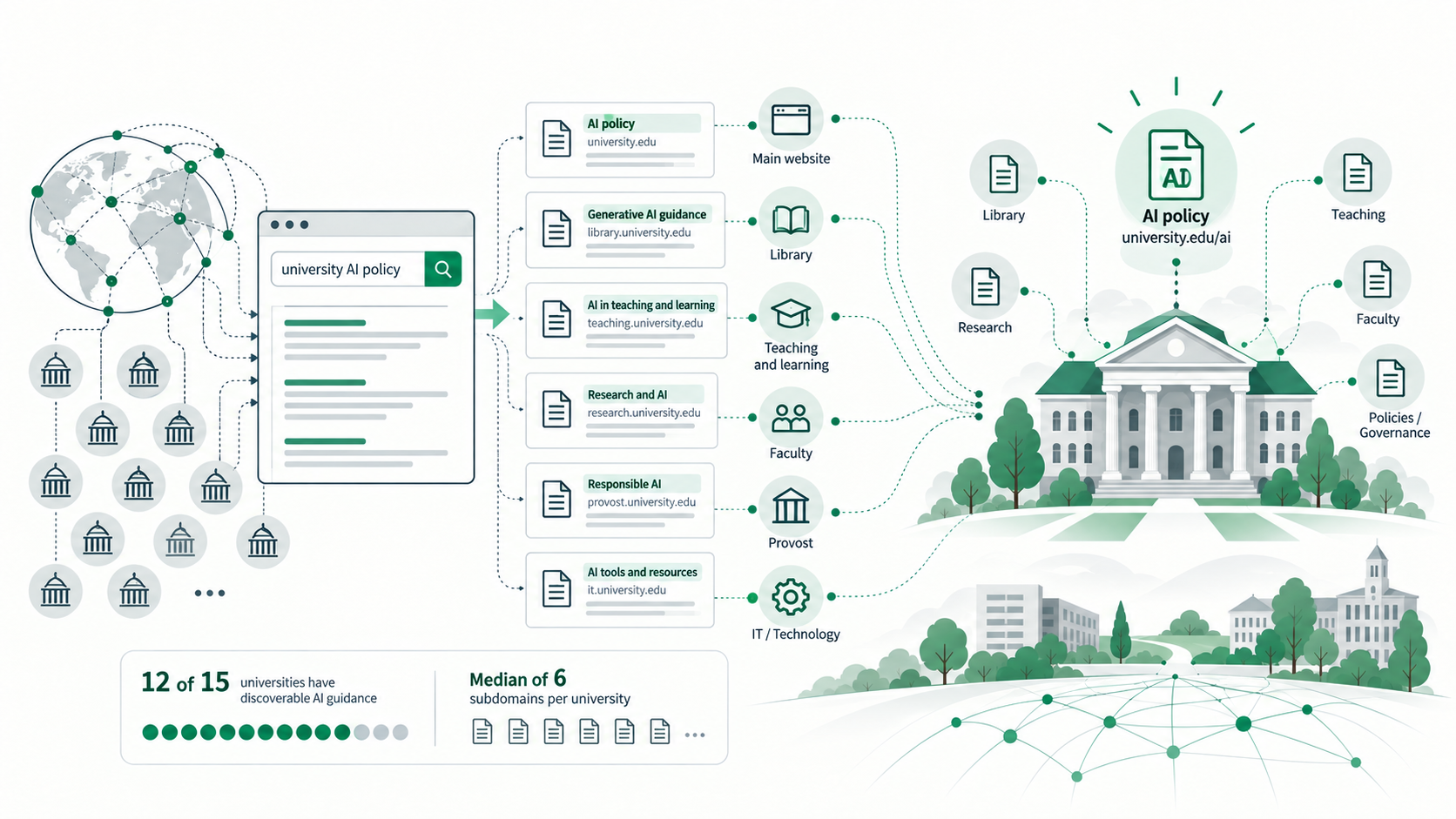
At UNESCO's Digital Learning Week 2026 (8–11 September 2026, Paris), more than 25 education ministers adopted a joint statement on sustaining education as a common good in the age of artificial intelligence, and UNESCO released its second annual survey of UNESCO Chairs on AI in higher education. The survey found that 93% of responding academics believe their students use generative AI for assignments and that 63% perceive declining cognitive capacities among students, alongside a ministerial call to govern educational data as a public interest. Webometrics used this as the starting point for an original question: when a university has adopted a generative-AI use policy, can a member of the public actually find it? On 19 September 2026, Webometrics examined a purposive global sample of 15 universities across nine countries, using targeted public web searches restricted to each institution's own domain. Twelve of the 15 universities (80%) had at least one page or document addressing generative-AI use discoverable this way; three did not. Among the 12, discoverable content was spread across a median of 6 distinct institutional subdomains, and only 5 universities had a dedicated AI-specific subdomain, of which just 2 hosted their most authoritative policy document on that subdomain itself.
Key Findings
- 12 of 15 universities (80%) in the sample had at least one page or document on their own domain(s) that a targeted public web search, conducted 19 September 2026, surfaced as addressing generative-AI use, guidance, or academic-integrity rules for students or staff.
- 3 of 15 universities (20%) — Universidade de São Paulo, King Saud University, and the University of Nairobi — did not have any institutional AI-use guidance page or document surfaced by this study's search method, even though secondary reporting shows AI-policy activity is underway at two of the three (São Paulo's public university system and the wider Sub-Saharan African higher-education sector).
- Among the 12 universities with discoverable content, results were spread across a median of 6 distinct institutional subdomains (range: 2–8) in the search results returned for each institution.
- Only 5 of 15 universities (33.3%) had a dedicated AI-specific subdomain (for example, an "ai." or "ia." prefix) appear in the search results: the University of Toronto, the University of Cape Town, Pontificia Universidad Católica de Chile, Yale University, and ETH Zurich.
- Of those 5, only 2 (University of Toronto and Pontificia Universidad Católica de Chile) hosted their most formally authoritative AI-use document on that dedicated subdomain itself; the other 3 hosted their primary guidance elsewhere (a provost's office, a general institutional domain path, or a teaching-and-learning-centre subdomain).
- Universitas Indonesia was the only institution in the sample with evidence of a numbered, rector-level regulation specifically on generative AI (Peraturan Rektor Nomor 16 Tahun 2026, on generative AI in academic writing) — the highest formal governance instrument observed in the study — yet the only publicly discoverable copy found was hosted on a single faculty subdomain rather than the university's central domain.
- The Indian Institute of Science was the only one of the 12 "found" institutions whose primary AI document was hosted directly on the university's apex domain rather than any subdomain; that document also carried the oldest visible date in the sample (2024).
Why This Matters for Universities
UNESCO's ministerial statement explicitly frames "governing educational data as a public interest" and "building collaborative AI governance capacity" as priority actions for education systems. A university-level AI-use policy that exists but cannot be found by the people it is meant to guide — prospective students, current students, faculty, journalists, or accreditation bodies — only partially fulfils that governance purpose. Discoverability is also a directly measurable dimension of institutional digital presence: it maps onto the Discoverability & Indexability and Institutional Digital Content indicators within the Openness pillar of the Webometrics methodology, which evaluates how effectively an institution makes its knowledge and digital resources publicly available, accessible, and discoverable.
What the Authoritative Source Says
UNESCO reported in September 2025, based on a survey of 400 UNESCO Chairs and UNITWIN Networks across 90 countries (a 38% response rate), that 19% of responding institutions already had a formal AI policy and a further 42% reported that AI guiding frameworks were under development — a combined 61%. Regional variation was substantial: around 70% of institutions in Europe and North America reported having or developing guidance, compared with 45% in Latin America and the Caribbean.
At Digital Learning Week 2026 (8–11 September 2026), UNESCO released its second annual survey of UNESCO Chairs on AI in higher education. That survey found that 93% of responding academics believe their students use generative AI for assignments, that 63% perceive declining cognitive capacities among students, and that two-thirds of respondents found AI guidelines issued by professional societies useful. More than 25 education ministers and designated representatives adopted a joint ministerial statement at the event calling for education to remain "a human right and a common good in the age of artificial intelligence," and setting out eight priority actions, including restoring public-interest conditions for AI systems, governing educational data as a public interest, and building collaborative AI governance capacity. UNESCO's own framing draws a clear line between an institution having AI guidance internally and that guidance functioning as part of a transparent, public-interest governance system — but neither UNESCO survey measured whether the resulting policies are publicly discoverable. That is the gap this study addresses.
Research Question
Among a global sample of universities, is institutional guidance on generative-AI use discoverable through an ordinary public web search restricted to the institution's own domain, and where it exists, is it concentrated on a single canonical page or dispersed across multiple subdomains?
Methodology
Collection date: 19 September 2026, a single point-in-time snapshot.
Population and sample: a purposive global sample of 15 widely recognized universities, selected for spread across world regions and income contexts rather than by Webometrics rank: the University of Cambridge and ETH Zurich (Europe); the University of Toronto and Yale University (North America); the University of Melbourne (Oceania); the National University of Singapore, the University of Tokyo, Universitas Indonesia, and the Indian Institute of Science (Asia); the University of Cape Town, the American University in Cairo, and the University of Nairobi (Africa); the Universidade de São Paulo and Pontificia Universidad Católica de Chile (Latin America); and King Saud University (Middle East). The sample deliberately includes institutions in three of Webometrics' current country-growth-priority markets (Indonesia, India, and Egypt) to test whether the global pattern also held in those markets, without making this a country-specific study.
Selection method: institutions were chosen as prominent, widely known research or teaching universities in their country or region, for regional and linguistic diversity, without regard to any expected result and without using Webometrics ranking data to select institutions.
Variables: (1) whether a targeted, domain-restricted public web search surfaced at least one page or document addressing generative-AI use, guidance, or policy for students, staff, or academic integrity; (2) the number of distinct institutional hostnames (subdomains) appearing among the returned results, as an observable proxy for how dispersed the discoverable content is; (3) whether a dedicated AI-specific subdomain appeared among the results; (4) where a dedicated AI-specific subdomain existed, whether the institution's most formally authoritative document (for example, a rector's regulation, a provost's guidelines, or an official framework) was hosted on that subdomain or elsewhere; and (5) whether a visible date or version marker (in a URL, filename, or title) was present.
Evidence source: targeted public web searches using domain-restriction operators combined with English-language terms (and, for Universitas Indonesia, Portuguese for the Universidade de São Paulo, Spanish for Pontificia Universidad Católica de Chile, and Indonesian-language terms) for "generative AI," "artificial intelligence," "policy," "guidance," and "academic integrity." For the three institutions returning no domain-specific result on the first query, a second, broader query (without a domain restriction, naming the institution) was run to reduce the risk of a false negative before recording an institution as "not found."
Analysis approach: descriptive frequency counts and hostname counts with stated denominators; no statistical inference; no causal interpretation of any observed pattern.
Limitations: disclosed in full below.
Results
| University | Country | AI-use guidance discoverable | Distinct hostnames in results | Dedicated AI-specific subdomain | Most authoritative document found — host |
|---|---|---|---|---|---|
| University of Cambridge | United Kingdom | Yes | 6 | No | Central domain (cam.ac.uk) and a data-protection subdomain, split across sources |
| ETH Zurich | Switzerland | Yes | 2 | Yes (aiethicspolicy.ethz.ch) | Main domain path (ethz.ch), not the dedicated subdomain |
| University of Toronto | Canada | Yes | 7 | Yes (ai.utoronto.ca) | Dedicated subdomain (ai.utoronto.ca/guidelines) |
| Yale University | USA | Yes | 6 | Yes (ai.yale.edu) | Provost's office domain (provost.yale.edu), not the dedicated subdomain |
| University of Melbourne | Australia | Yes | 6 | No | Academic-integrity subdomain (academicintegrity.unimelb.edu.au) |
| National University of Singapore | Singapore | Yes | 6 | No | Teaching-centre subdomain (ctlt.nus.edu.sg) |
| University of Tokyo | Japan | Yes | 5 | No | E-learning support subdomain (utelecon.adm.u-tokyo.ac.jp) |
| Universitas Indonesia | Indonesia | Yes | 8 | No | Faculty subdomain (psikologi.ui.ac.id), hosting a university-wide rector regulation |
| Indian Institute of Science | India | Yes | 4 | No | Apex domain (iisc.ac.in), document dated 2024 |
| University of Cape Town | South Africa | Yes | 4 | Yes (ai.uct.ac.za) | Teaching-centre subdomain (cilt.uct.ac.za), not the dedicated subdomain |
| American University in Cairo | Egypt | Yes | 5 | No | Apex domain (aucegypt.edu) |
| University of Nairobi | Kenya | Not found | — | — | — |
| Universidade de São Paulo | Brazil | Not found | — | — | — |
| Pontificia Universidad Católica de Chile | Chile | Yes | 7 | Yes (ia.uc.cl) | Dedicated subdomain family (docencia.ia.uc.cl) |
| King Saud University | Saudi Arabia | Not found | — | — | — |
Analysis
Discoverability of institutional generative-AI guidance was high in the sample (12 of 15, 80%), consistent with UNESCO's own finding that a large majority of surveyed institutions globally report having adopted or being in the process of developing such guidance. However, discoverability and architectural concentration are different properties, and this study's evidence points to dispersion as the more common pattern: only 4 of the 12 discoverable cases (Indian Institute of Science, University of Cape Town, American University in Cairo, and ETH Zurich, counting its two-hostname result) returned three or fewer distinct hostnames, while 8 of the 12 returned five or more.
A dedicated AI-specific subdomain is not, by itself, evidence of centralization. Of the 5 institutions where such a subdomain appeared in results, 3 (Yale, ETH Zurich, and the University of Cape Town) had their most authoritative document hosted elsewhere. This suggests that a purpose-built AI subdomain, where present, more often functions as one resource among several rather than as the institution's single canonical reference point — a pattern this study can observe but not fully explain from search-result evidence alone.
The Universitas Indonesia observation is a useful illustration of a broader point about institutional web architecture: a formal governance instrument's authority level (a numbered rector regulation is among the highest a university can issue) did not correspond, in this instance, to its position in the university's information architecture (a single faculty subdomain rather than the university's central domain). A plausible explanation is that faculties or departments sometimes republish or archive centrally issued regulations for their own users, and that the faculty copy simply ranked more prominently in this study's search results than any central-domain copy that may also exist; this study's method cannot distinguish that possibility from an architecture in which no central-domain copy is published at all, and it does not attempt to adjudicate between them.
For the three institutions where no institutional AI-use guidance was found, this study's design supports only a narrow conclusion: a targeted public search restricted to that institution's known domain(s), on 19 September 2026, did not surface such content. It does not establish that no policy exists internally, only that it was not discoverable by this method on this date — itself a relevant finding given that discoverability, not internal existence, is what the research question examines.
University Examples
The University of Toronto's ai.utoronto.ca hosts a page titled "Guidelines - Toward an AI-ready University," making it, in this sample, the clearest example of a university housing both a dedicated AI-specific subdomain and its central guidance document on that same subdomain. The same university's search results also returned guidance pages hosted separately by its three constituent campuses (Scarborough, Mississauga, and the St. George graduate studies office) and by its central library and human-resources divisions, illustrating how a federated university structure can produce both a clear central resource and substantial parallel divisional content at the same time.
Universitas Indonesia's Peraturan Rektor Nomor 16 Tahun 2026 tentang Generative AI dalam Penulisan Ilmiah (Rector Regulation Number 16 of 2026 on Generative AI in Scientific Writing) is, by document type, the single most formally authoritative instrument identified anywhere in this study's sample. Its discoverable location, at the time of collection, was a PDF hosted on the domain of the Faculty of Psychology (psikologi.ui.ac.id) rather than the university's central ui.ac.id domain.
Implications for Higher Education
For university leadership, this study's evidence suggests that having adopted AI-use guidance and having that guidance function as a discoverable, public reference point are related but distinct achievements, and that the second does not automatically follow from the first.
For web teams, IT departments, and communications and digital-strategy teams, the specific, measurable pattern in this data is dispersion across subdomains rather than absence of content: most institutions in this sample had produced substantial AI-related material, distributed across teaching centres, libraries, individual schools, and administrative offices, without a single page that a search engine or a first-time visitor would reliably identify as the canonical source.
For research offices and libraries, the Universitas Indonesia example illustrates a specific, checkable question worth asking internally: when a central policy or regulation is issued, is an authoritative copy published and kept current on the institution's central domain, in addition to any departmental republication?
For academics and students, the practical implication of this study's findings is that even where a policy exists, finding "the" institutional answer to a question about generative-AI use may currently require checking several different offices' web pages rather than a single source.
Recommended Actions
- Confirm that an authoritative, currently maintained AI-use policy or guidance page exists on the institution's central domain, not only on a departmental, faculty, or teaching-centre subdomain, and that it is reachable through ordinary site navigation.
- Where a dedicated AI-specific subdomain has already been created, treat it as the canonical home for the institution's most authoritative document, and link out to it from divisional and departmental pages rather than the reverse.
- When a formal governance instrument is issued, such as a rector's regulation or provost's directive, publish or index a copy on the central domain in addition to any departmental archive, and apply a visible last-reviewed or version date to support both readers and search engines.
- Periodically test discoverability using the same method a prospective student, journalist, or accreditation reviewer would use: a plain public web search naming the institution and "AI policy" or "generative AI guidance."
These actions are not presented as a guarantee of improved search ranking, AI-system citation, or Webometrics indicator performance. No source cited in this study makes such a claim, and this study did not test for one.
For Universities
Universities seeking to better understand their Webometrics results, institutional digital visibility, or digital-presence architecture may contact the Webometrics and UNIRANKS Support Team for institutional support and engagement options. Request Institutional Support.
Limitations
This study used a purposive convenience sample of 15 widely recognized universities across nine countries; it is not random or Webometrics-rank-stratified, and its findings should not be generalized to the global university population or to any single country's higher-education sector. Discoverability was assessed through search-engine index behavior at a single point in time (19 September 2026); search results can vary by query phrasing, personalization, and index freshness, and a page absent from this study's results is not necessarily absent from every possible search a user might run. This study counted distinct hostnames appearing in returned search results as a proxy for architectural dispersion; it did not independently crawl each institution's full site architecture, verify internal navigation paths, or confirm that every page identified is currently the institution's most up-to-date guidance. Language coverage was limited to English plus one supplementary local-language query per non-English-primary institution, which may undercount content published only in other local or regional languages. This study did not evaluate the substantive content or quality of any policy found, only its discoverability and architectural location. It also did not verify whether the three "not found" institutions maintain AI-use guidance through channels this method cannot observe, such as internal-only intranets, learning-management systems, or printed handbooks.
Conclusion
Nine days after UNESCO's Digital Learning Week 2026 ministerial statement called for governing educational data as a public interest, this study found that institutional guidance on generative-AI use was discoverable through ordinary public web search for 12 of 15 sampled universities, but that this discoverable content was typically spread across a median of six distinct subdomains rather than concentrated on a single canonical page, and that a dedicated AI-specific subdomain, where one existed, hosted the institution's primary document in only two of five cases. These findings describe a global sample's information architecture on a single date; they do not establish why any individual institution's pattern takes the form it does, and they are not a measure of any institution's underlying AI governance quality.
Sources
- UNESCO, "Education Ministers call for education to remain a common good in the age of AI at UNESCO's Digital Learning Week," 9 September 2026 (updated 10 September 2026) — unesco.org/en/articles/education-ministers-call-education-remain-common-good-age-ai-unescos-digital-learning-week
- UNESCO, "UNESCO survey: Two-thirds of higher education institutions have or are developing guidance on AI use," 2 September 2025 — unesco.org/en/articles/unesco-survey-two-thirds-higher-education-institutions-have-or-are-developing-guidance-ai-use
- UNESCO, "Digital Learning Week, 8 to 11 September 2026" — unesco.org/en/weeks/digital-learning
- Webometrics by UNIRANKS, current methodology — webometrics.org/blog/methodology
- Direct review of publicly available, domain-restricted search results for the 15 sampled university domains, collected 19 September 2026.
Suggested Citation
Webometrics by UNIRANKS (2026). Findable but Fragmented: A Webometrics Study of University Generative-AI Policy Discoverability. Webometrics.org, 19 September 2026.