Multilingual Website Architecture at Algerian Universities: A Webometrics Study
Executive Summary
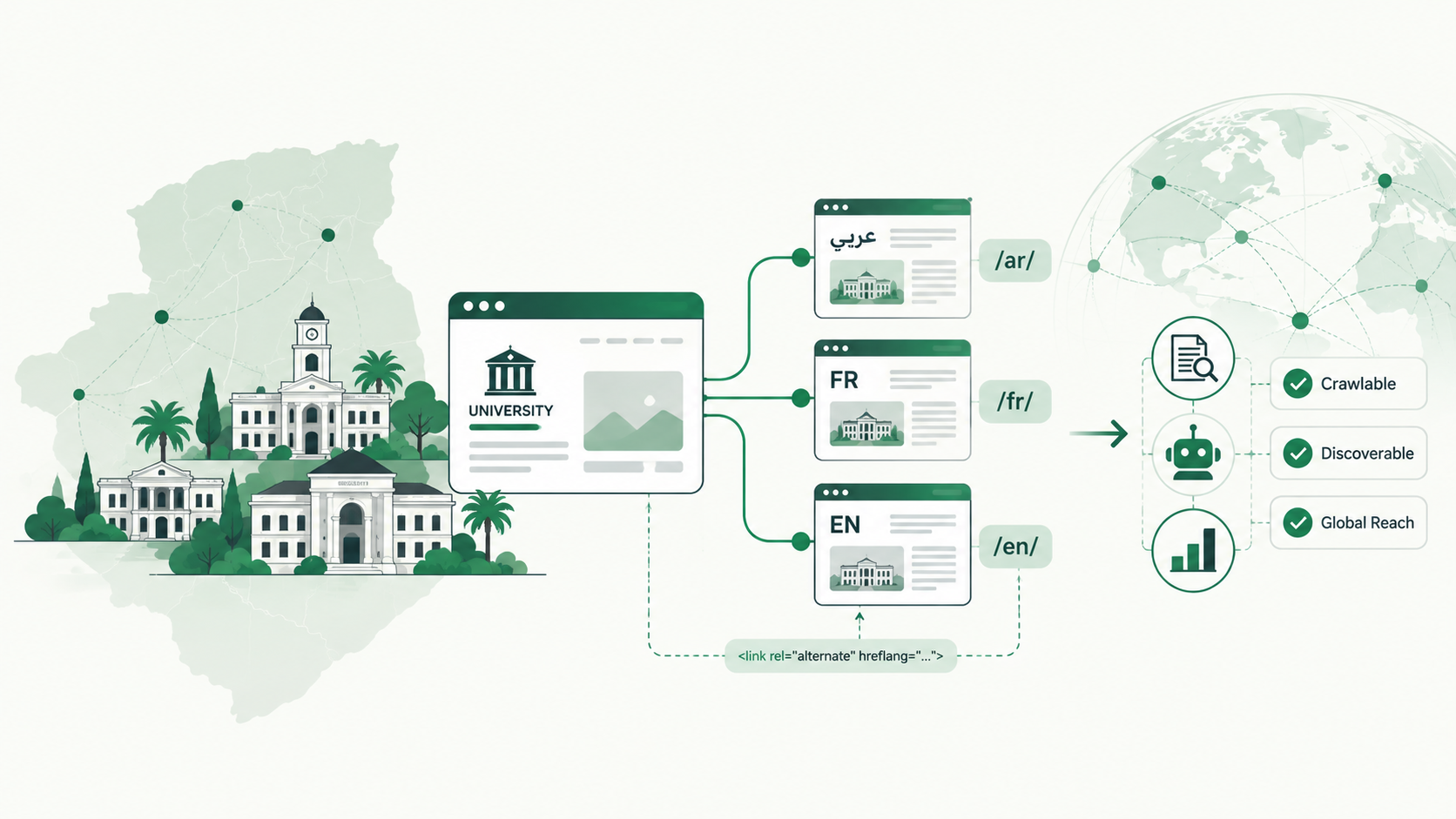
Algeria is a linguistically layered higher-education market: Arabic is the country's constitutional official language, Tamazight has held national/official status since 2016, and French continues to function as the de facto working language of scientific and technical instruction at many public universities, alongside a policy push in recent years to expand English-medium instruction. Google's official guidance on multi-regional and multilingual websites states plainly that search engines will not guess a site's language and region variants on their own — publishers must expose them through explicit, well-structured signals. Webometrics used this as the starting point for an original technical study: how do Algerian public universities actually structure their websites for multiple languages today? On 20 September 2026, Webometrics directly inspected the homepages of a purposive sample of 11 Algerian higher-education institutions across nine regions. Seven of the 11 (63.6%) exposed an explicit Arabic-French-English switcher with distinct URLs for each language. French, not Arabic, was the most common default homepage language (6 of 11, 54.5%). Two institutions — both with a technical or AI-focused profile — defaulted to English. Two institutions showed no dedicated multilingual URL structure at all.
Key Findings
- 7 of 11 sampled institutions (63.6%) — Université des Sciences et de la Technologie Houari Boumediene (USTHB), Université d'Oran 1, Université Ferhat Abbas Sétif 1, Université Badji Mokhtar Annaba, Université Abou Bekr Belkaid Tlemcen, Université Batna 2, and the École Nationale Supérieure d'Intelligence Artificielle (ENSIA) — displayed an explicit on-page switcher offering Arabic, French, and English versions, each with its own distinct URL.
- French was the most common default homepage language, appearing on 6 of 11 sites (54.5%): Université Frères Mentouri Constantine 1, Université Ferhat Abbas Sétif 1, Université Badji Mokhtar Annaba, Université Abou Bekr Belkaid Tlemcen, Université Mouloud Mammeri de Tizi Ouzou (UMMTO), and Université Abderrahmane Mira Béjaïa.
- Arabic was the default homepage language on 3 of 11 sites (27.3%): Université d'Oran 1, Université Batna 2, and Université Saad Dahlab Blida 1.
- English was the default homepage language on 2 of 11 sites (18.2%): USTHB and ENSIA — the two sampled institutions with the strongest science/technology or AI specialization.
- Among the 9 institutions with an identifiable multilingual URL structure, 7 used path-based variants (for example
/en/,/ar/, or/language/en/) and 2 used subdomain-based variants (for examplefr.,eng., oren.prefixes). None of the 11 used the URL-query-parameter approach (for example?lang=en) that Google's official multi-regional-sites guidance explicitly advises against. - 2 of 11 institutions (18.2%) — UMMTO and Université Abderrahmane Mira Béjaïa — showed no dedicated multilingual URL/switcher structure at the point of collection; UMMTO's homepage instead mixed French- and Arabic-language content within shared URLs, with English confined to an isolated Erasmus+ section.
- Université Saad Dahlab Blida 1 offered an English-language switcher but no separately switchable French version was observed, despite French being widely used in Algerian higher-education administration.
Why This Matters for Universities
A university website's language architecture is not a cosmetic choice. It determines which audiences — prospective students searching in Arabic, French-speaking regional applicants, international researchers reading in English, or Tamazight-speaking communities — can find and use the institution's own information without relying on an external translator or a search engine's automatic (and often imperfect) page translation. It also determines whether search engines can correctly index each language version as a distinct, appropriately targeted page rather than as duplicate or ambiguous content. Webometrics' own methodology names "language accessibility" as one of the dimensions considered under the Openness indicator's Accessibility & Digital Inclusion component, and separately recognizes "multilingual digital presence" as part of the Impact indicator's Global & Multilingual Presence component — a reflection of how widely both dimensions matter across the wider research-and-practice literature on institutional web presence, independent of any specific numeric weighting.
What the Authoritative Sources Say
Google Search Central's official documentation on managing multi-regional and multilingual sites states that search engines do not attempt to detect a site's language or regional variants by changing the simulated location of their crawlers; publishers must "explicitly tell Google about any locale or language variation" a site exposes. The same documentation describes three standard approaches to structuring localized content — country-code top-level domains, subdomains on a generic domain, and subdirectories on a generic domain — and explicitly advises against using URL parameters (such as ?loc=de) to signal geotargeting, because they are hard for both users and crawlers to recognize reliably. Google's related guidance on localized versions recommends hreflang annotations as the explicit mechanism for declaring which URL serves which language and region.
The World Wide Web Consortium's Internationalization Activity separately sets out baseline practice for multilingual web content: content should declare its language, provide consistent and discoverable navigation between language versions, and avoid mixing languages within a single URL in ways that make the page's primary language ambiguous to both users and machines.
Neither Google nor W3C issues guidance specific to Algeria or to universities; both describe general web-publishing practice. The university-specific application that follows is Webometrics' own analysis, not a claim made by either source.
Research Question
Among a defined sample of Algerian public higher-education institutions, what language does each university's website present by default, does the site expose a distinct, separately addressable version for other languages, and what URL structure (path, subdomain, or parameter) is used to do so?
Methodology
Collection date: 20 September 2026.
Population: Publicly accessible official websites of Algerian public universities and national higher-education schools.
Sample: A purposive sample of 11 institutions, selected to span multiple regions and institution types rather than to represent a statistically random draw from Algeria's full higher-education system (which comprises several dozen public universities and specialized schools): Université des Sciences et de la Technologie Houari Boumediene (Algiers), Université d'Oran 1 Ahmed Ben Bella (Oran), Université Frères Mentouri Constantine 1 (Constantine), Université Ferhat Abbas Sétif 1 (Sétif), Université Badji Mokhtar Annaba (Annaba), Université Abou Bekr Belkaid Tlemcen (Tlemcen), Université Mouloud Mammeri de Tizi Ouzou (Tizi Ouzou), Université Batna 2 (Batna), Université Saad Dahlab Blida 1 (Blida), Université Abderrahmane Mira Béjaïa (Béjaïa), and the École Nationale Supérieure d'Intelligence Artificielle — ENSIA (Algiers).
Selection rule: Institutions were chosen to cover Algeria's main geographic regions (center, west, east, and Kabylie) and to include both long-established multidisciplinary universities and one newer, specialized national school, so that the sample was not limited to a single institutional type.
Variables recorded for each institution: the language of the homepage as it loads by default; whether an on-page language-switcher element was present and, if so, which languages it offered; the URL or path structure used for each language variant; and whether any language-specific content appeared structurally incomplete relative to the default-language version (for example, content confined to a single section rather than a full parallel site).
Evidence source: Each institution's homepage was retrieved and its visible, rendered content and outbound links were inspected directly at collection time. For Université Frères Mentouri Constantine 1, language-specific URL paths (/index.php/en/... and /index.php/ar/...) were additionally confirmed through indexed search results, since the switcher element itself was not captured in the direct homepage retrieval.
Analysis approach: Descriptive tabulation of default language, switcher presence, and URL-structure type across the sample, interpreted against Google's and W3C's published multilingual-web guidance.
Limitations: disclosed in full below.
Results
| University | Region | Default homepage language | Languages with a distinct URL/switcher | URL structure | Notable observation |
|---|---|---|---|---|---|
| USTHB | Algiers | English | Arabic, French, English | Switcher present; specific language URLs not fully captured | One of two sampled institutions defaulting to English |
| Université d'Oran 1 Ahmed Ben Bella | Oran | Arabic | Arabic, French, English | Path-based (/language/en/, /language/fr/) |
Full three-language, path-based structure |
| Université Frères Mentouri Constantine 1 | Constantine | French | French (default); English and Arabic sections separately indexed | Path-based (/index.php/en/…, /index.php/ar/…) |
Multilingual paths exist and are indexed, but no switcher was visible on direct homepage retrieval |
| Université Ferhat Abbas Sétif 1 | Sétif | French | Arabic, French, English | Subdomain-based (fr., www. for Arabic, eng.) |
Only sampled site splitting all three languages across three separate subdomains |
| Université Badji Mokhtar Annaba | Annaba | French | Arabic, French, English | Path-based (/ar/, /en/) |
— |
| Université Abou Bekr Belkaid Tlemcen | Tlemcen | French | Arabic (root/default), French (/fr), English (/en) |
Path-based | Arabic reachable at the un-prefixed root path rather than a dedicated /ar/ path |
| UMMTO (Tizi Ouzou) | Tizi Ouzou | French, with Arabic content mixed in | No distinct language-variant URLs observed; English limited to an Erasmus+ section | Not applicable | Content mixing rather than a switchable parallel-site structure |
| Université Batna 2 | Batna | Arabic | Arabic, English, French | Path-based (/language/en/, /language/fr/…) |
— |
| Université Saad Dahlab Blida 1 | Blida | Arabic | Arabic, English (no separate French switcher observed) | Subdomain-based (www., en.) |
No distinct French-language switcher despite French's administrative role |
| Université Abderrahmane Mira Béjaïa | Béjaïa | French | None observed | Not applicable | No language-switcher or alternate-language URL structure detected |
| ENSIA | Algiers (national school) | English | Arabic, French, English | Path-based (/ar/, /fr/) |
The only specialized national school in the sample; also defaults to English |
Analysis
Two patterns stand out. First, on the technical dimension Google's guidance treats as most consequential — URL structure — the sampled Algerian universities largely followed recommended practice: of the 9 institutions with any identifiable multilingual URL structure, all used either path-based or subdomain-based variants, and none used the URL-parameter approach Google explicitly discourages. This is a favorable, if narrow, finding: it means that where a language variant exists, it is generally addressable by its own crawlable URL rather than hidden behind a client-side toggle with a single shared address.
Second, on the substantive dimension — which language a visitor sees first — there is no single dominant pattern, and it does not track Arabic's status as Algeria's constitutional official language. French remained the most common default (6 of 11), consistent with its continuing role as the language of instruction in many scientific and technical faculties. Arabic was the default at 3 of 11, and English — not an official or historically administrative language in Algeria — was the default at 2 of 11, both institutions with an explicit science, technology, or artificial-intelligence orientation. This is an association observed within a small purposive sample, not a causal claim about institutional strategy; Webometrics did not interview these institutions about their language-selection rationale, and a different, larger sample could show a different distribution.
The two institutions without a dedicated multilingual URL structure — UMMTO and Béjaïa — illustrate a distinct pattern from the rest of the sample: rather than offering no multilingual content at all, UMMTO's homepage mixed French and Arabic content within the same URLs, which may serve bilingual local audiences reasonably well in practice but does not give search engines or non-bilingual users a clean, separately addressable version in either language.
University Examples
USTHB and ENSIA were the only two sampled institutions whose homepages loaded in English by default, despite English holding no official or historical administrative status in Algeria; both are science, technology, or AI-focused institutions, which may plausibly be oriented toward an international research and student audience, though this study did not test that explanation directly. Université Ferhat Abbas Sétif 1 was the only sampled institution to implement all three languages as fully separate subdomains rather than paths — a structurally distinct but equally valid approach under Google's guidance. These examples are presented as illustrations of observed structural diversity, not as judgments of institutional quality.
Implications for Higher Education
For university web and IT teams, the finding that most sampled institutions already use path- or subdomain-based language URLs — rather than the discouraged query-parameter approach — suggests the main remaining technical gap is less about URL structure and more about completeness and explicit signaling (for example, hreflang annotations, which this study's method could not verify and which would require separate technical auditing). For communications and marketing teams, default-language choice is effectively a statement about primary intended audience; institutions marketing internationally facing programs may want to review whether their default language matches that audience. For institutional leadership, the mixed-content pattern observed at UMMTO is a reminder that bilingual text on a single page is a different (and, for search and accessibility purposes, generally weaker) approach than fully separate, addressable language versions. For research offices and international-relations teams, an English-language version — where one exists — is often the primary point of contact for prospective international collaborators and partners, making its completeness relative to the default-language version worth periodic review.
Recommended Actions
- Audit whether every language version reachable through a switcher is also reachable through a stable, crawlable URL, not only a client-side toggle.
- Add explicit
hreflangannotations to signal language/region relationships between URL variants, consistent with Google's official guidance. - Avoid URL query parameters for language selection.
- Review whether secondary-language versions (particularly English, where present) offer content depth comparable to the default-language version rather than a partial subset.
These are structural, evidence-supported observations, not guarantees of any change in search ranking, visibility, or AI-citation behavior.
For Universities
Universities seeking to better understand their Webometrics results, institutional digital visibility, research presence, or data profile may contact the Webometrics and UNIRANKS Support Team for institutional support and engagement options. Request Institutional Support.
Limitations
This study examined 11 institutions out of Algeria's several dozen public universities and specialized schools; findings describe this purposive sample and should not be generalized to the full national system without a larger, more systematically drawn sample. Data reflect a single collection snapshot on 20 September 2026; website structures change over time. The collection method inspected rendered, visible page content and outbound links; it did not inspect raw HTTP response headers, server-side hreflang markup, or JavaScript-rendered menu elements that may not appear in a simplified content extraction, so an absence of an observed switcher (as recorded for Université Abderrahmane Mira Béjaïa and UMMTO, and the switcher-widget gap noted for Université Frères Mentouri Constantine 1) reflects what this collection method could detect, not a definitive proof that no such feature exists anywhere on the site. The study did not assess translation quality, content-parity depth between language versions, or hreflang implementation, all of which would require separate technical auditing beyond this study's method. Webometrics ranking data was not used to select or weight this sample.
Conclusion
Among the 11 Algerian public higher-education websites examined on 20 September 2026, most (9 of 11) exposed some form of distinct, addressable multilingual URL structure, and where such a structure existed it generally followed the path- or subdomain-based patterns Google's official guidance recommends over URL parameters. At the same time, default-language choice varied considerably and did not align with any single pattern tied to Arabic's official status, and two institutions showed no dedicated multilingual architecture at the point of collection. For an official-language landscape as layered as Algeria's, consistent and explicitly signaled multilingual architecture — not just the presence of a translated page somewhere on the site — is what determines whether Arabic-speaking, French-speaking, and internationally oriented audiences can each reliably find an institution's own information.
Sources
- Google Search Central, "Managing multi-regional and multilingual sites" — developers.google.com/search/docs/specialty/international/managing-multi-regional-sites
- Google Search Central, "Tell Google about localized versions of your page" — developers.google.com/search/docs/specialty/international/localized-versions
- World Wide Web Consortium (W3C), Internationalization Activity — w3.org/International
- Webometrics by UNIRANKS, current methodology (Impact — Global & Multilingual Presence; Openness — Accessibility & Digital Inclusion) — webometrics.org/blog/methodology
- Direct observation of the 11 university websites listed in the Methodology and Results sections, collected 20 September 2026.
Suggested Citation
WEBOMETRICS by UNIRANKS (2026). Which Language Comes First? A Webometrics Study of Multilingual Website Architecture Across Algerian Universities. Webometrics.org, 20 September 2026.
Related Articles