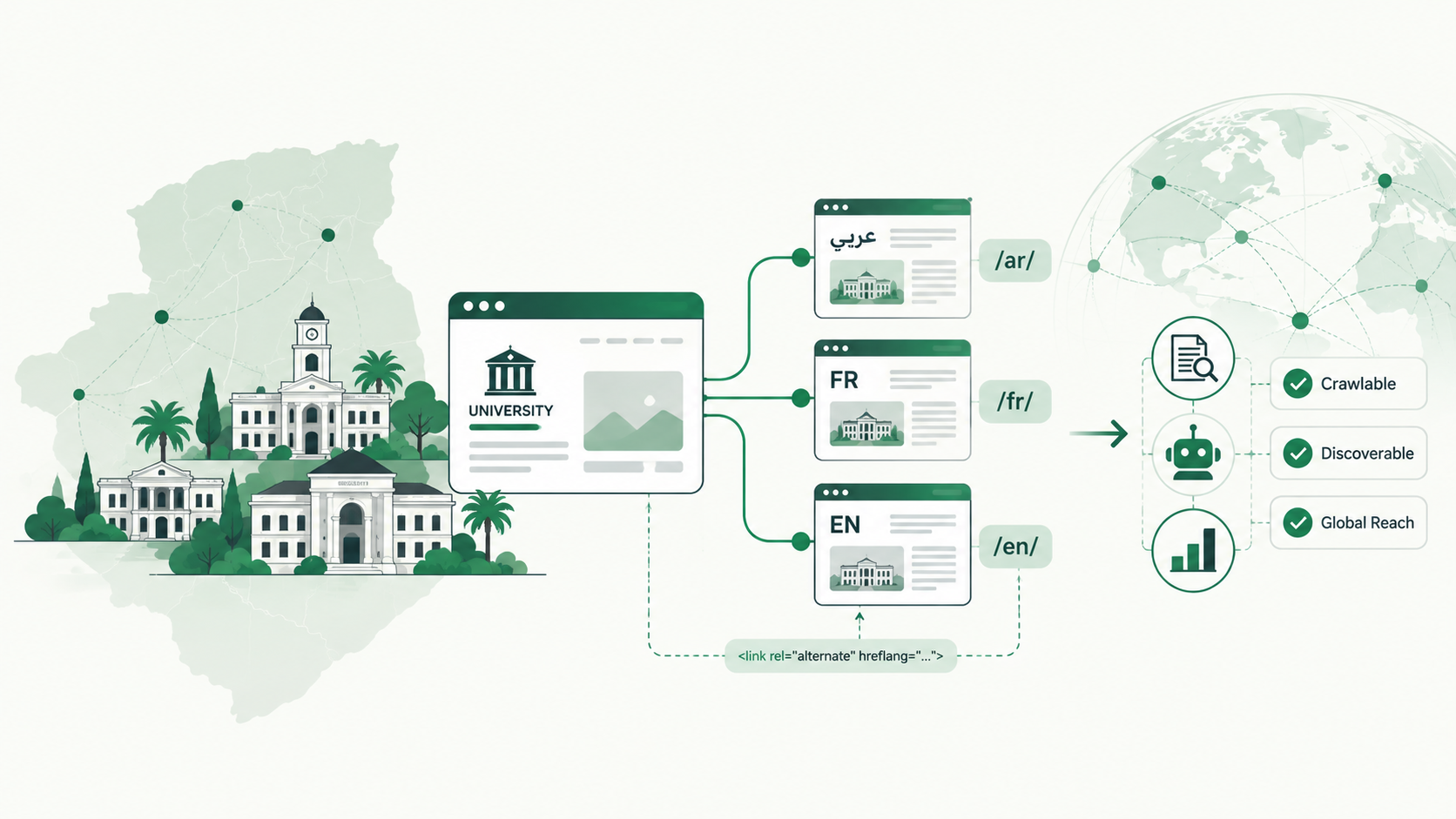
Are University Websites Ready for Visual Search? A Webometrics Study of Image Alt Text, Sitemaps and Structured Data

On 24 September 2026, Google Search Central announced that the Performance report in Search Console now separates “multimodal” search traffic from ordinary text-query traffic. Multimodal traffic is Google’s term for visits triggered by an image rather than a typed query ; through Google Lens, Circle to Search on Android, a direct image upload to Google Search, or Chrome’s right-click “Search this image” feature. The change formalizes image-triggered discovery as its own measured category, alongside the text-query and generative-AI-feature reporting Search Console already provides.
Because Search Console data is private to each site’s own account, Webometrics cannot observe any individual university’s actual multimodal-traffic share. It can, however, examine the public, page-level signals that make an image eligible to surface through those visual-search pathways in the first place: descriptive alternative (alt) text, a dedicated image sitemap, and image-specific structured data such as schema.org’s ImageObject type.
Webometrics examined one purposively selected, image-carrying page ; typically a news, media-relations or press page ; at 17 universities across six world regions, collected on 25–26 September 2026. A determinate result was obtained for 13 of the 17. None of the 13 examined pages carried ImageObject or any other image-specific JSON-LD structured data. Of six sitemaps or sitemap indexes inspected directly, none used the dedicated image-sitemap XML extension that lets a general sitemap describe embedded images to search engines. Six of the 13 pages (46%) exposed a generic Open Graph image tag, a signal built for social-media link previews rather than image search. As Google begins to measure image-triggered search as its own category, the sampled university pages currently show, at most, the lightest layer of image-discoverability signalling, and it appears to arrive mainly as a byproduct of social-sharing metadata rather than a deliberate image-search implementation.
Key Findings
- 0 of 13 examined university pages (0%) carried ImageObject or any other image-specific JSON-LD structured data at the time of collection.
- 0 of 6 sitemaps or sitemap indexes directly inspected (Harvard University, University of Toronto, National University of Singapore, University of Cape Town, University of São Paulo, University of Melbourne) used the dedicated
<image:image>sitemap extension that lets a sitemap describe embedded images to search engines. - 7 of 13 institutions (54%) declared at least one general, non-image sitemap in their robots.txt file; 5 of 13 (38%) declared none; 1 of 13 (ETH Zurich) could not be determined because its robots.txt file could not be retrieved.
- 6 of 13 pages (46%) carried an Open Graph
og:imagetag in the page<head>; University of Toronto, ETH Zurich, University of Helsinki, National University of Singapore, Indian Institute of Science and University of Melbourne ; a metadata signal designed for social-media link previews rather than image search. - Non-empty, apparently descriptive alt text could be read with reasonable confidence on the sampled images at 2 of the 13 institutions (University of Oxford, UNAM); University of Ghana’s story images carried a short institutional abbreviation rather than a content description; the remaining institutions showed empty alt attributes or no image markup in the retrieved content. This variable carries a disclosed reliability limitation (see Methodology).
- 4 of 17 attempted institutions (24%) ; University of Tokyo, University of Nairobi, Cairo University and Seoul National University ; could not be retrieved with a determinate result this cycle and were excluded from the quantified findings below.
Why This Matters for Universities
Universities publish enormous volumes of photography: campus life, admissions, research figures, event coverage and news. Historically, that photography has mattered mainly for how a page looks to a human visitor. Google’s 24 September 2026 announcement is a signal that image-triggered discovery ; someone finding a university’s page because they searched with a photograph rather than a typed query ; is now significant enough for Google to measure and report separately inside Search Console. Image alt text, image sitemaps and image-specific structured data are the observable, page-level mechanisms that make an image identifiable, describable and attributable to an institution in the first place. A university whose images carry none of these signals is not necessarily invisible to visual search, but it is offering search systems less information than a university whose images are properly described and marked up. For institutions that already invest heavily in original photography, research imagery and campus media, these signals are a comparatively low-effort way to make that existing investment more discoverable.
Authoritative Background
Google’s own blog post, “Announcing web multimodal Search performance reporting in Search Console” (Google Search Central Blog, 24 September 2026), states that the new Search-type filter in the Performance report distinguishes “Text” results from “Multimodal” results, where multimodal traffic is any search Google served in response to an image ; through Google Lens, Circle to Search on Android, a direct image upload to Google Search, or Chrome’s “Search this image” feature ; rather than a typed query. Google’s documentation discloses an explicit limitation: no query-string data is available for multimodal rows, because the underlying “query” is an image rather than text. This is separate from Google’s existing note that click and query data also remain unavailable in the generative-AI-features performance report.
Separately from that announcement, Google Search Central’s standing Google Images documentation (last updated 2 March 2026) recommends that publishers write descriptive, contextual alt text ; its own example contrasts a generic or keyword-stuffed alternative with a plain description such as “Dalmatian puppy playing fetch” ; and that they may submit an image sitemap so Google can locate images it might otherwise miss, including images served from a separate domain or CDN via the sitemap’s <image:loc> element. For structured data, Google’s documentation recommends identifying a page’s preferred image either through schema.org markup (using a primaryImageOfPage property or an image attached to the page’s main entity) or through the Open Graph og:image meta tag, and specifically advises against using a generic image, such as a site logo, in that markup.
Schema.org’s own ImageObject reference defines the vocabulary behind this markup. Its properties include contentUrl (the actual image file), caption, width and height, encodingFormat, creator and license, among others, and ImageObject can be attached to a page as a thumbnail, a main entity’s image, or through other structured-data relationships. Google’s separate documentation on image licensing and IPTC photo metadata (last updated 10 December 2025) recommends that a page expressing licensing information pair contentUrl with at least one of license, creator, creditText or copyrightNotice, using either schema.org’s ImageObject markup or equivalent IPTC metadata embedded in the image file itself.
Taken together, these sources define three independent, publicly observable readiness signals for image-triggered discovery: descriptive alt text (accessibility and basic relevance), a properly extended image sitemap (crawl discovery), and ImageObject or equivalent structured data (machine-readable description and, where applicable, licensing). None of the three is confirmed by Google as a ranking factor for the new multimodal Search-type filter itself; Google’s own announcement concerns reporting, not ranking mechanics, and this article does not treat any of these signals as guaranteed to affect a page’s visibility.
Research Question
At a purposively sampled set of universities, do public web pages carrying meaningful photographic content expose the three publicly observable readiness signals associated with image-triggered search discovery ; descriptive alt text, a dedicated image sitemap, and image-specific structured data ; and how consistently are these signals present across regions?
Methodology
Collection dates: 25–26 September 2026.
Population and sampling procedure: Webometrics defined a purposive global sample of major research universities, one per institution, stratified across six world regions (North America, Europe, Asia, Africa, Latin America, Oceania), selected before any page was inspected. For each institution, Webometrics attempted to retrieve one page expected to carry meaningful photographic content ; typically an institutional news, media-relations or press page, consistent with the sampling logic used in Webometrics’ 25 September 2026 VideoObject structured-data study. Seventeen institutions were attempted: Harvard University, University of Toronto, University of Oxford, ETH Zurich, Sorbonne Université, University of Helsinki, University of Tokyo, National University of Singapore, Indian Institute of Science, University of Cape Town, University of Nairobi, Cairo University, Universidad Nacional Autónoma de México (UNAM), University of São Paulo, University of Melbourne, Seoul National University and University of Ghana.
Inclusion/exclusion rule: an institution was included in the quantified findings only if its selected page returned retrievable content and its robots.txt file (or an equivalent determinate result) was obtained. Four institutions failed this rule and were excluded: University of Tokyo and Seoul National University (the selected news pages returned a not-found error on repeated attempts), University of Nairobi (the retrieved content contained only visible article headlines with no underlying markup, so no structured-data or alt-text variable could be assessed), and Cairo University (both the page and its robots.txt file failed to retrieve because of a certificate-verification error). This left 13 institutions with a determinate result.
Variables:
- Presence of an image-specific JSON-LD structured-data block (ImageObject or equivalent schema.org image markup) anywhere in the retrieved page source.
- Presence of an Open Graph
og:imagemeta tag in the page’s<head>. - Presence of a general sitemap declaration in the institution’s robots.txt file, and, where a sitemap or sitemap index could be retrieved directly, whether it (or its top-level index) declared the dedicated image-sitemap XML namespace (
xmlns:image) or contained<image:image>/<image:loc>elements. - Presence of non-empty alt-attribute text on the page’s principal story or feature images, and, where legible, whether that text read as a content description rather than an empty value or a generic label.
Evidence source and tool-reliability note: all page and file content was retrieved directly (not from search snippets) using this session’s web-fetching tool, which converts delivered HTML into a processed summary rather than returning raw markup verbatim. This method reliably distinguished the presence or absence of an Open Graph tag (each institution returned a distinct tag value or a clear absence) and reliably distinguished sitemap files with different root elements, entry counts and URLs. During data collection, the same fetching tool returned an identical, apparently generic example alt-text string for two unrelated institutions’ pages (Harvard University and University of Toronto), which is not plausible as an authentic shared caption and indicates the tool’s summarization step is not reliable for transcribing individual alt-text values verbatim. Consistent with Webometrics’ established practice of narrowing a study’s variable set in the field rather than forcing unreliable data into its findings, alt-text content is reported in this article only as a qualitative, individually caveated observation, and is not included in the article’s core quantified statistics.
Analysis approach: simple counts and proportions across the determinate population (n = 13), with each variable’s denominator stated explicitly. No statistical inference beyond descriptive counting was applied.
Limitations: the sample is purposive, not random or a census, and one page per institution cannot represent an institution’s entire web estate; a different page at the same institution (an admissions page, a research-figures page) could show different results. Sitemap-index files were inspected at the top level only; a dedicated image sitemap nested inside a lower-level child sitemap beneath an index would not have been detected. The alt-text variable carries the reliability limitation described above and should be read as indicative rather than a verified count. Structured data delivered only after client-side JavaScript execution may not appear in the retrieved page source and would be reported here as absent even if present after full rendering, a limitation also disclosed in Webometrics’ 25 September 2026 VideoObject study. Four institutions could not be retrieved this cycle and are excluded rather than assumed to lack the signals studied.
Results
| Institution | Region | Page type sampled | Open Graph og:image | ImageObject / image JSON-LD | Sitemap declared (robots.txt) | Image-sitemap extension (where checked) |
|---|---|---|---|---|---|---|
| Harvard University | North America | News (Gazette) | Not present | Not present | Declared (10 sitemap indexes) | Not used (media-relations index checked) |
| University of Toronto | North America | News | Present | Not present | Declared | Not used |
| University of Oxford | Europe | News | Not present | Not present | Not declared | ; |
| ETH Zurich | Europe | News | Present | Not present | Undetermined | ; |
| Sorbonne Université | Europe | News | Not present | Not present | Not declared | ; |
| University of Helsinki | Europe | News | Present | Not present | Declared | Undetermined (sitemap file fetch failed) |
| National University of Singapore | Asia | News | Present | Not present | Declared | Not used |
| Indian Institute of Science | Asia | News | Present (logo image) | Not present | Not declared | ; |
| University of Cape Town | Africa | News | Not present | Not present | Declared (sitemap index) | Not used |
| UNAM | Latin America | Homepage | Not present | Not present | Not declared | ; |
| University of São Paulo | Latin America | News | Not present | Not present | Declared (sitemap index) | Not used |
| University of Melbourne | Oceania | Newsroom | Present | Not present | Declared (sitemap index) | Not used |
| University of Ghana | Africa | News | Not present | Not present | Not declared | ; |
Excluded (not retrievable with a determinate result): University of Tokyo, University of Nairobi, Cairo University, Seoul National University.
Analysis
The clearest and most reliably observed pattern is the near-total absence of image-specific structured data: none of the 13 institutions examined had an ImageObject block, or any other schema.org image markup, in the delivered page source. This mirrors a pattern Webometrics observed a day earlier in its 25 September 2026 study of VideoObject structured data, where none of eight examined university video pages carried VideoObject markup either. Read together, the two studies suggest that structured-data adoption for rich media ; images and video alike ; remains uncommon among the sampled institutions’ public-facing content pages, independent of the specific schema type involved.
The sitemap results show a similar pattern at a coarser level: a majority of the institutions with a determinate result (7 of 13) do declare a general sitemap, so the basic discovery mechanism search engines use to find pages is reasonably well established. But among the six sitemaps or sitemap indexes Webometrics could inspect directly, none extended that mechanism to describe embedded images specifically. This is consistent with the sitemaps having been generated by standard content-management or plugin defaults (several used typical WordPress-style sitemap-index structures) rather than configured with image-search discovery in mind.
The Open Graph result is the one signal present at close to half of the examined institutions (6 of 13). Open Graph tags are simple to implement and are usually generated automatically by modern content-management themes for social-sharing previews, which likely explains their relatively higher prevalence compared with the two search-oriented signals. However, Google’s own documentation treats og:image as one of two acceptable ways to identify a page’s preferred image (the other being schema.org markup), not as a substitute for image-specific structured data, so its presence does not by itself indicate an image-search-oriented implementation.
The alt-text observation is offered only as a caveated, qualitative note rather than a quantified finding, for the reliability reason disclosed in the Methodology section above. Where legible content could be read with reasonable confidence, it varied considerably: University of Oxford’s and UNAM’s sampled pages showed captions that read as genuine content descriptions tied to specific stories, while University of Ghana’s images carried a short institutional abbreviation rather than a description. This variation, even within a small and unreliably measured subset, suggests that alt-text practice ; where it can be verified ; is inconsistent rather than uniformly absent, and is a plausible candidate for a future, more rigorously tooled study.
None of these patterns should be read as a ranking or visibility judgment. Google has not stated that any of the three signals studied directly determines eligibility for its new multimodal Search-type reporting category, and this study did not measure any institution’s actual multimodal search traffic, which remains private to each site’s own Search Console account.
Implications for Higher Education
For university communications, web and IT teams, the practical implication is that image discoverability currently sits several steps behind text discoverability at most of the institutions sampled. Where a university’s content-management system already supports Open Graph tags automatically, extending that same investment to schema.org ImageObject markup, and to a properly namespaced image sitemap, is a comparatively contained technical change rather than a new content-production burden, because it describes photography the institution has typically already published. For institutional research offices and communications teams managing image-heavy research storytelling ; figures, lab photography, fieldwork documentation ; these signals may be particularly relevant, since such images often accompany content that is otherwise well described in text but not in machine-readable image metadata.
Recommended Actions
Based on the evidence collected, universities seeking to strengthen the public, page-level readiness signals examined in this study could reasonably consider: auditing whether existing content-management templates already emit Open Graph image tags, and if so, extending the same template logic to emit corresponding schema.org ImageObject markup using Google’s documented properties (at minimum contentUrl, paired with caption, creator or license where applicable); confirming whether the institution’s sitemap-generation tool supports the image-sitemap extension and, if it does, enabling it, rather than assuming a general sitemap already covers images; and reviewing alt-text authoring practice on high-traffic image-heavy page types (news, admissions, research) using Google’s own documented example of a specific, contextual description rather than a generic or purely branding-oriented alternative. None of these actions is presented here as a guaranteed improvement to search visibility, ranking or AI-citation outcomes; they are offered strictly as alignment with Google’s own documented recommendations for image discoverability.
Limitations
This study examined one page per institution, not an institution’s full web estate, and its findings describe that single sampled page rather than the institution as a whole. The sample of 13 determinate institutions is purposive and global in spread but is not a random sample and does not claim to represent all universities worldwide. Sitemap indexes were inspected only at their top level; an image-extended child sitemap nested beneath an index would not have been detected by this method. The alt-text variable is disclosed as unreliably measured by this session’s tooling and is reported only qualitatively. Four attempted institutions could not be retrieved this cycle and are excluded rather than assumed to lack the signals studied. Structured data injected only through client-side JavaScript after the initial page load may not appear in the delivered source this method inspected. This study did not have access to any institution’s own Search Console data and cannot report actual multimodal-search traffic for any university.
Conclusion
Google’s 24 September 2026 decision to report image-triggered “multimodal” search as its own category in Search Console formalizes visual search as a distinct, measured discovery channel. Webometrics’ examination of 13 university web pages across six world regions found that none carried image-specific structured data such as schema.org’s ImageObject type, and that none of the six sitemaps or sitemap indexes directly inspected used the dedicated image-sitemap extension, while just under half exposed a generic Open Graph image tag. As image-triggered discovery becomes something search engines measure explicitly, the public, page-level signals that make an image describable and attributable to an institution remain, on this evidence, an early-stage area of implementation for most of the universities sampled.
Explore more Webometrics research on AI and search visibility, or read the current Webometrics methodology.
Frequently Asked Questions
What is “multimodal” search, according to Google?
Google Search Central defines multimodal search traffic as any search Google served in response to an image rather than a typed query ; through Google Lens, Circle to Search on Android, a direct image upload to Google Search, or Chrome’s “Search this image” feature. Google announced dedicated Search Console Performance reporting for this traffic category on 24 September 2026.
Does this study measure how much multimodal search traffic universities actually receive?
No. Multimodal-traffic figures are private to each institution’s own Search Console account and were not available to this study. Webometrics examined only the public, page-level readiness signals ; alt text, image sitemaps and image-specific structured data ; that are associated with image discoverability generally.
Are alt text, image sitemaps and ImageObject structured data confirmed Google ranking factors for multimodal search?
Google has not stated that any of these three signals directly determines eligibility for its new multimodal Search-type reporting category. This article treats them as documented image-discoverability practices, not as confirmed ranking factors, and does not promise a ranking, traffic or visibility improvement from implementing them.
What did Webometrics find about university image sitemaps?
Of six sitemaps or sitemap indexes Webometrics inspected directly, none used the dedicated image-sitemap XML extension that lets a sitemap describe embedded images to search engines, even though most of the same institutions did declare a general (non-image) sitemap.
Sources
- Google Search Central Blog, “Announcing web multimodal Search performance reporting in Search Console,” 24 September 2026 ; developers.google.com/search/blog/2026/09/web-multimodal-in-sc
- Google Search Central, “Google Images Best Practices” (last updated 2 March 2026) ; developers.google.com/search/docs/appearance/google-images
- Google Search Central, “Image License Metadata Structured Data” (last updated 10 December 2025) ; developers.google.com/search/docs/appearance/structured-data/image-license-metadata
- Schema.org, “ImageObject” ; schema.org/ImageObject
- Search Engine Land, “Google Search Console performance reports gets multimodal filter,” 24 September 2026 (secondary corroboration)
- Search Engine Roundtable, “Google Search Console Performance Report Gains Multimodal Search Type Filter,” 24 September 2026 (secondary corroboration)
- Direct inspection of 17 university web pages and their robots.txt/sitemap files, collected 25–26 September 2026
Suggested Citation
Webometrics by UNIRANKS (2026). Are University Websites Ready for Visual Search? A Webometrics Study of Image Alt Text, Sitemaps and Structured Data. Webometrics.org.