Latin America’s 2025 Web Presence in Higher Education: A Country-First Read
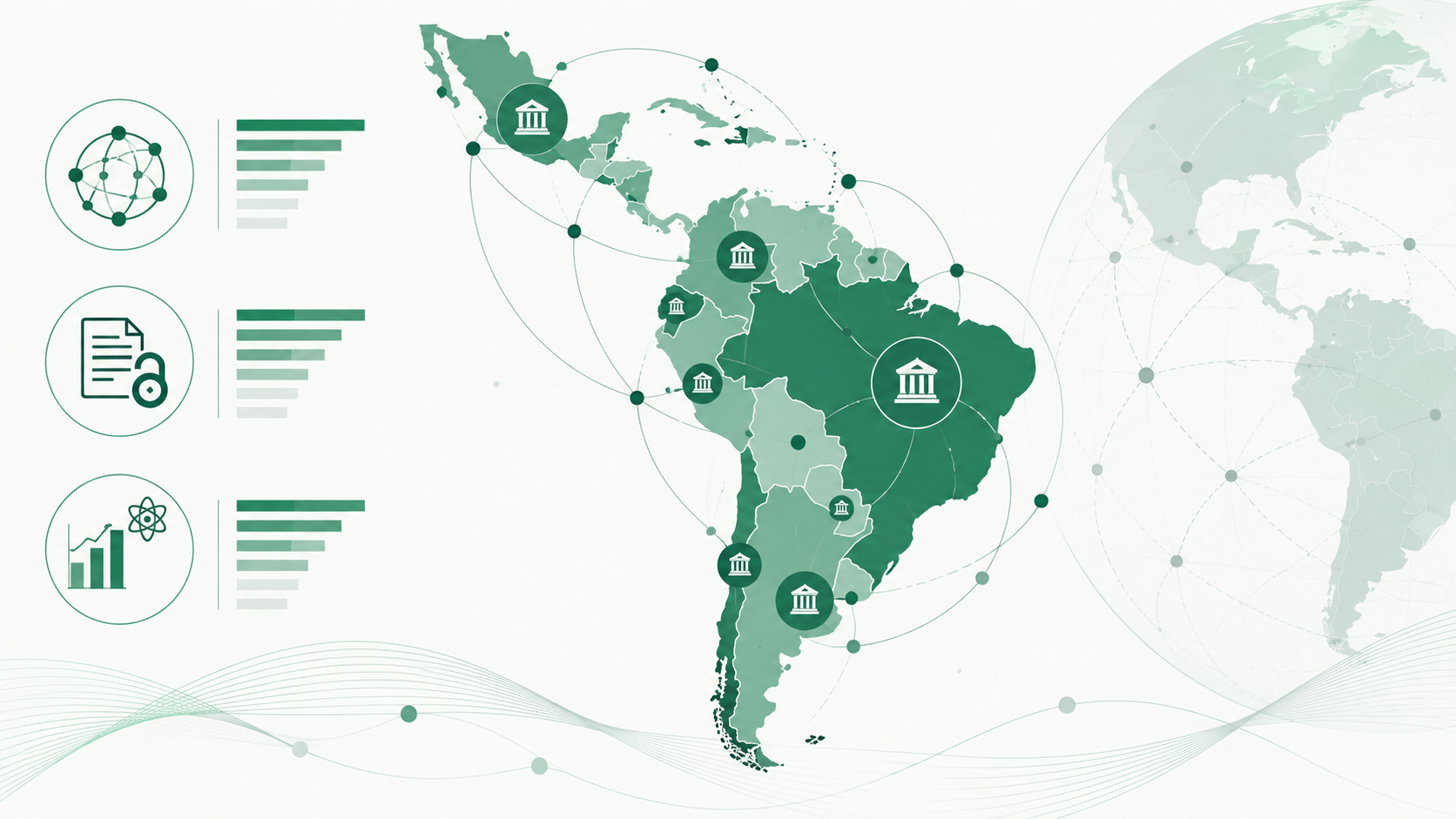
This analysis examines the July 2025 WEBOMETRICS Latin America ranking from a country-level perspective. Rather than reviewing every Institution individually, it uses the highest-placed Institution from each country as a comparative country marker and looks at the regional patterns visible across Impact, Openness, and Excellence.
The analysis is descriptive. A country's highest-ranked Institution should not be interpreted as a complete measurement of the country's entire higher-education system, and differences between countries may reflect institutional scale, research capacity, digital ecosystems, language, infrastructure, and other contextual factors.
Methodology note: This article discusses the July 2025 ranking edition. Indicator definitions and ranking procedures should always be interpreted according to the methodology applicable to the relevant edition. For the current framework, see the WEBOMETRICS Methodology.
How Is This Country-Level Analysis Structured?
For each country, the highest-placed Institution in the July 2025 Latin America ranking is used as a country marker. The article then compares how countries appear across the three principal ranking dimensions:
- Impact: institutional digital visibility, authority, reach, recognition, and influence.
- Openness: the accessibility and discoverability of institutional knowledge, academic content, and public digital resources.
- Excellence: academic, research, technical, and digital quality within the broader institutional presence.
These definitions are deliberately broader than individual technical signals. No single metric should be treated as a complete definition of Impact, Openness, or Excellence.
Top 10 Countries in the July 2025 Latin America Ranking
- Brazil
- Mexico
- Chile
- Argentina
- Colombia
- Peru
- Puerto Rico
- Costa Rica
- Uruguay
- Ecuador
Top 10 Countries by Impact
- Mexico
- Brazil
- Chile
- Argentina
- Colombia
- Peru
- Costa Rica
- Puerto Rico
- Ecuador
- Uruguay
Top 10 Countries by Openness
- Brazil
- Mexico
- Chile
- Argentina
- Puerto Rico
- Peru
- Ecuador
- Costa Rica
- Colombia
- Uruguay
Top 10 Countries by Excellence
- Brazil
- Mexico
- Chile
- Argentina
- Colombia
- Puerto Rico
- Uruguay
- Peru
- Costa Rica
- Ecuador
How Do the Leading Countries Compare Across the Three Indicators?
| Country | Overall position | Impact position | Openness position | Excellence position |
|---|---|---|---|---|
| Brazil | 1 | 2 | 1 | 1 |
| Mexico | 2 | 1 | 2 | 2 |
| Chile | 3 | 3 | 3 | 3 |
| Argentina | 4 | 4 | 4 | 4 |
| Colombia | 5 | 5 | 9 | 5 |
| Peru | 6 | 6 | 6 | 8 |
| Puerto Rico | 7 | 8 | 5 | 6 |
| Costa Rica | 8 | 7 | 8 | 9 |
| Uruguay | 9 | 10 | 10 | 7 |
| Ecuador | 10 | 9 | 7 | 10 |
This comparison highlights an important feature of the ranking: strong overall performance does not require identical positions across all three indicators. Countries can show different relative strengths in Impact, Openness, and Excellence.
Brazil: Strong Performance Across All Three Dimensions
Brazil leads the country-level comparison overall and also holds the strongest position in both Openness and Excellence, while ranking second in Impact.
The consistency of these positions suggests a comparatively broad digital and academic presence among the Brazilian institutions represented at the top of the regional ranking. Rather than being driven by one isolated dimension, Brazil's country marker performs strongly across all three areas considered in this analysis.
Mexico: Regional Leader in Impact
Mexico ranks second overall but holds the leading position in Impact. It also places second in both Openness and Excellence.
This combination indicates particularly strong relative digital visibility and influence while maintaining a high position in public knowledge accessibility and academic or digital quality.
Chile: Consistent Third-Place Performance
Chile occupies third place overall and also ranks third in Impact, Openness, and Excellence.
This is one of the most balanced patterns in the regional comparison. The country's marker does not depend on a single exceptional indicator; instead, its position is consistent across the full three-dimensional framework.
Argentina: Balanced Across the Ranking Framework
Argentina ranks fourth overall and fourth in each of the three principal indicators.
Like Chile, this produces a highly consistent country-level profile. Its relative regional standing appears similar whether the comparison is based on Impact, Openness, or Excellence.
Colombia: Strong Impact and Excellence, Different Openness Position
Colombia ranks fifth overall, fifth in Impact, and fifth in Excellence, while its Openness position is ninth among the ten countries shown.
This difference illustrates why the three indicators are useful when viewed separately. An Institution or country marker can occupy a strong overall position while showing a substantially different relative result in one particular dimension.
Peru: Stable Overall and Impact Position
Peru places sixth overall, sixth in Impact, and sixth in Openness, while ranking eighth in Excellence.
The pattern is relatively stable across the first two dimensions, with a somewhat different comparative position in Excellence.
Puerto Rico: Relative Strength in Openness
Puerto Rico ranks seventh overall but rises to fifth in Openness and sixth in Excellence. Its Impact position is eighth.
Among the countries in this comparison, Puerto Rico therefore shows one of the clearer differences between its overall position and its strongest individual dimension.
Costa Rica: Stronger Relative Position in Impact
Costa Rica ranks eighth overall, seventh in Impact, eighth in Openness, and ninth in Excellence.
Its strongest relative position within this country-level comparison is therefore Impact. The three rankings nevertheless remain relatively close, producing a broadly consistent regional profile.
Uruguay: Excellence Stands Out Relative to Impact and Openness
Uruguay ranks ninth overall and tenth in both Impact and Openness, but rises to seventh in Excellence.
This makes Excellence the clearest relative strength visible in Uruguay's country-level profile within this comparison.
Ecuador: Openness Outperforms Its Overall Position
Ecuador ranks tenth overall, ninth in Impact, seventh in Openness, and tenth in Excellence.
Its Openness position therefore stands out as the strongest relative result among the three principal dimensions.
What Does the Regional Comparison Show?
Several broad patterns are visible in the July 2025 country-level results.
Brazil and Mexico lead the regional comparison
Brazil and Mexico occupy the top two overall positions and also remain first or second across each of the three principal indicators. This suggests strong multidimensional performance rather than dependence on one isolated ranking dimension.
Chile and Argentina show unusually balanced profiles
Chile ranks third in every category, while Argentina ranks fourth in every category. Their overall positions therefore closely reflect their Impact, Openness, and Excellence positions.
Indicator-level differences become more visible below the top four
Countries such as Colombia, Puerto Rico, Uruguay, and Ecuador display larger differences between their overall position and individual indicator positions.
These differences are useful because they show why an overall ranking alone cannot describe the full pattern of institutional digital performance.
What Does Impact Tell Us?
Within the WEBOMETRICS framework, Impact represents the broader digital visibility, authority, reach, recognition, and influence associated with an Institution.
In the July 2025 country comparison, Mexico leads this dimension, followed by Brazil, Chile, Argentina, and Colombia.
These results should be interpreted comparatively. They do not imply that one particular technical signal or type of online activity is solely responsible for an Institution's Impact position.
What Does Openness Tell Us?
Openness considers the accessibility and discoverability of institutional knowledge, academic content, and public digital resources.
Brazil leads the country-level Openness comparison, followed by Mexico, Chile, Argentina, and Puerto Rico.
Openness should not be reduced to document volume or one type of repository signal. It represents a broader dimension of public access and discoverability within the applicable methodology.
What Does Excellence Tell Us?
Excellence represents academic, research, technical, and digital quality within the broader institutional presence.
Brazil leads this dimension in the July 2025 country comparison, followed by Mexico, Chile, Argentina, and Colombia.
As with Impact and Openness, Excellence is multidimensional and should not be interpreted through one isolated academic or technical measure.
Why Should Country-Level Results Be Interpreted Carefully?
This article uses each country's highest-placed Institution as a comparative marker. That is useful for identifying regional patterns, but it is not the same as calculating the average performance of an entire national higher-education system.
A country may have one exceptionally strong Institution while other institutions occupy very different positions. Conversely, another country may have a broader group of institutions performing consistently without placing its highest-ranked Institution near the top.
For system-level analysis, additional measures would be required, such as:
- the number of ranked institutions from each country;
- the distribution of institutions across ranking bands;
- median or mean positions;
- changes across multiple ranking editions; and
- appropriate national higher-education context.
Does a Higher Country Position Mean Its Entire Higher-Education System Is Better?
No.
This country-level comparison is derived from WEBOMETRICS ranking positions and should not be interpreted as a comprehensive judgment of national higher-education quality.
WEBOMETRICS evaluates specific dimensions of institutional digital and academic web presence. It does not directly measure every aspect of teaching, funding, governance, student experience, accreditation, employment outcomes, or national higher-education policy.
What Can Students and Researchers Learn From These Results?
For students, researchers, and other visitors, the country comparison provides context for understanding where some of Latin America's most prominent digital and academic institutional presences are located.
The separate Impact, Openness, and Excellence results also help demonstrate that institutions and national systems can show different strengths depending on the dimension being considered.
These rankings should be used alongside other relevant academic, institutional, accreditation, program, and national information.
Latin America 2025: The Broader Picture
The July 2025 results show a regional hierarchy led by Brazil and Mexico, followed by Chile and Argentina. These four countries occupy the same top-four positions across the overall ranking and each of the three principal indicators.
Below them, the picture becomes more varied. Colombia shows stronger relative positions in Impact and Excellence than in Openness. Puerto Rico performs particularly well in Openness. Uruguay's strongest comparative dimension is Excellence, while Ecuador performs relatively better in Openness.
The pattern reinforces one of the central ideas behind a multidimensional ranking: digital higher-education performance cannot be fully understood through a single number.
Frequently Asked Questions
Which country ranks first in Latin America in this July 2025 analysis?
Brazil holds the highest overall country-marker position in the July 2025 Latin America ranking used for this analysis.
Which country ranks first in Impact?
Mexico holds the leading Impact position among the ten countries included in this country-level comparison.
Which country ranks first in Openness?
Brazil holds the leading Openness position in this comparison.
Which country ranks first in Excellence?
Brazil also holds the leading Excellence position among the countries shown.
Does this ranking compare national higher-education systems directly?
No. This article uses the highest-placed Institution from each country as a country marker. It should not be interpreted as a complete national-system ranking.
Are Impact, Openness, and Excellence based on one metric each?
No. They are broader ranking dimensions that can incorporate multiple validated signals under the applicable WEBOMETRICS methodology.
Methodology
For the current definitions of Impact, Openness, and Excellence and information about data collection, validation, normalization, and ranking integrity, see the WEBOMETRICS Methodology.
Last Updated: September 2026