How Visible Are Egypt's University Research Repositories?
Executive Summary
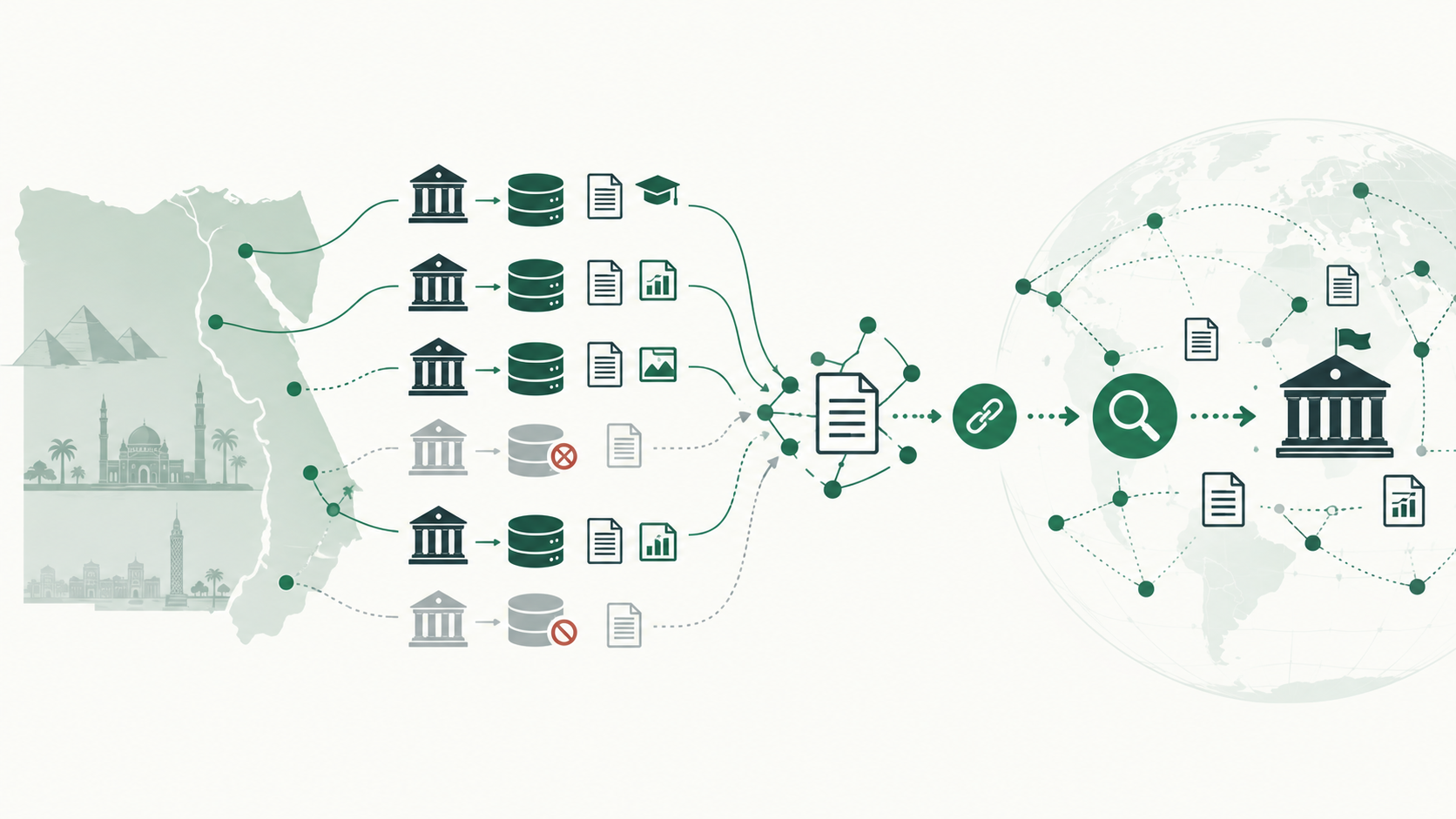
Open science depends on infrastructure that most readers never see directly: institutional repositories, national consortia, and journal registries that determine whether a university's theses, articles, and research outputs can be found, harvested, and cited outside its own campus network. Webometrics examined Egypt's open-science infrastructure in September 2026 at two levels, the national systems Egyptian higher education has built to consolidate access and publishing, and a sample of individual university repositories, to ask how visible and technically accessible this infrastructure currently is. The Directory of Open Access Journals lists 377 journals published by Egypt-based publishers, the large majority hosted by individual university faculties rather than a single national platform. Egypt's principal national digital-library body, the Digital Libraries Unit, has operated a shared university library consortium since 2007. Yet of six national and institutional repository endpoints Webometrics reviewed directly, half could not be retrieved for review at the time of collection, and none of the three that could be reviewed displayed a public item count, persistent identifier, or OAI-PMH reference on its landing page. These findings describe a research infrastructure that is substantial in scope but uneven in the technical signals that let it be discovered and aggregated beyond Egypt's own campuses.
Key Findings
- The Directory of Open Access Journals (DOAJ) indexes 377 journals with a publisher based in Egypt, retrieved via DOAJ's own search API on 18 September 2026, a substantial share of which are hosted by individual faculties of single universities (for example, Alexandria University's Faculty of Sports Education, Beni-Suef University, and the University of Sadat City) rather than through one centralized journal platform.
- Of six national and institutional repository-related endpoints reviewed directly on 18 September 2026, three could not be retrieved for review: the Egyptian Universities Libraries Consortium's unified search portal, Cairo University's e-Repository, and Future University in Egypt's DSpace repository each returned a robots.txt restriction, a connection timeout, or a server error rather than the expected page.
- None of the three national or institutional pages that could be reviewed, the Digital Libraries Unit's descriptive page, the American University in Cairo's Knowledge Fountain, and the Bibliotheca Alexandrina Digital Assets Repository, displayed a public item count, DOI, handle, or explicit OAI-PMH reference in the page content reviewed.
- Egypt's Digital Libraries Unit, the umbrella body for the Egyptian Universities Libraries Consortium (EULC), has operated since 2007 under the Supreme Council of Universities, combining a unified library catalog, a shared digital repository for theses, university e-journal publishing, and journal indexing into a single national structure, rather than each university maintaining a fully independent repository.
- Egypt's national knowledge-access platform, the Egyptian Knowledge Bank (EKB), launched in 2016 and now provides access to more than 3,000 journals and 300,000 books, but functions as a licensed-content aggregation service for participating international publishers rather than an open-access repository of Egyptian-produced research.
- As of August 2025, Egypt had no national open-access policy mandate, according to a review published by MDPI's Open Access Blog that drew on Open Science Community Egypt (OSCE) reporting and a 2024 CoDATA study of North African open-science policy; the same review, citing Clarivate InCites data, reported that the share of Egyptian research output published open access rose from 31% in 2013 to 63% in 2023.
- In Webometrics' own analytics for the 90 days to 17 September 2026, Egypt recorded the highest average engagement time (3 minutes 44 seconds) of any market sending more than 1,000 active users to Webometrics.org, a separate indicator of reader interest that this study's infrastructure findings do not explain and should not be read as connected to.
Why This Matters for Universities
A university's research can be well-produced and still be effectively invisible to the systems that make scholarship discoverable beyond its own institution, including search engines, citation databases, and open-access aggregators such as OpenAIRE, BASE, and CORE, if the repository holding that research cannot be crawled, harvested, or resolved to a stable identifier. For a national higher-education system, the choice between a centralized consortium model and independent per-institution repositories is not just an administrative preference; it shapes how easily that system's research can be aggregated and counted by international open-science infrastructure that increasingly expects each item to carry a persistent identifier and be exposed through a standard protocol such as OAI-PMH. Understanding which model a country has actually built, and whether it currently functions as designed, is a prerequisite for any institution trying to improve its own research visibility.
What the Authoritative Source Says
The Confederation of Open Access Repositories (COAR) and OpenAIRE both define interoperability for research repositories around a small set of technical expectations: a repository should expose its metadata through OAI-PMH, the Open Archives Initiative Protocol for Metadata Harvesting, so that aggregators can harvest records automatically, assign persistent identifiers such as DOIs or handles to individual items, and use a recognized metadata schema so that titles, authors, and dates can be parsed consistently across systems. DOAJ, the Directory of Open Access Journals, applies a comparable but separate standard for journals: a title is indexed only after DOAJ reviews it against its own open-access and editorial-transparency criteria, and DOAJ's own search API allows any journal's country of publication to be queried directly, which is the primary source this study used to establish Egypt's DOAJ-indexed journal count. None of these standards bodies rates or ranks individual repositories; they define the technical baseline that determines whether a repository's contents can be found and reused outside the institution that created it.
Research Question
At both the national and institutional level, how visible and technically accessible is Egypt's open-science and research-repository infrastructure to an outside observer, and does its structure follow the centralized-consortium or independent-repository model?
Methodology
Collection date: 18 September 2026.
Population and sample: this study combined a registry query with direct technical observation of a purposive sample of Egyptian open-science infrastructure. The DOAJ query examined the full population of DOAJ-indexed journals with a publisher located in Egypt (377 records), not a sample. The direct-observation sample comprised six endpoints selected to represent Egypt's two coexisting repository models: national infrastructure (the Digital Libraries Unit's descriptive page on the Supreme Council of Universities' website; the Egyptian Universities Libraries Consortium's unified thesis-search portal) and individual institutional repositories (the American University in Cairo's Knowledge Fountain; the Bibliotheca Alexandrina Digital Assets Repository; Cairo University's e-Repository; Future University in Egypt's DSpace repository). These four institutional repositories were selected because they appear among the small number of Egyptian repositories named in available secondary directory sources (see Limitations); this is a purposive, illustrative sample and does not cover Egypt's full higher-education sector, which includes several dozen public and private universities not examined here.
Data sources: DOAJ's public search API, queried directly for publisher.country:EG; direct review of each of the six national and institutional endpoints listed above; secondary reporting from MDPI's Open Access Blog, a review published in 2025 citing Open Science Community Egypt, a 2024 CoDATA North Africa study, and Clarivate InCites data, for context on Egypt's national open-access policy status and open-access publication share over time; the Supreme Council of Universities' own published description of the Digital Libraries Unit and EULC; and a sourced summary of the Egyptian Knowledge Bank's launch date and scope, cross-checked against UNESCO's own case-study page on EKB.
Variables: DOAJ-indexed journal count and publisher pattern; endpoint accessibility and, where not accessible, the reason encountered; presence of a public item or record count; presence of a DOI or handle identifier; presence of an explicit OAI-PMH reference; described institutional scope and founding date, where stated by the source itself.
Analysis approach: each endpoint was assessed only on what its retrieved content actually showed; an endpoint that could not be retrieved for review is reported as "not assessable" rather than assumed to lack the feature in question, consistent with Webometrics' standard practice for technical web-infrastructure studies.
Limitations: this study reviewed a small, purposive sample of six national and institutional endpoints and a full-population registry query of one database (DOAJ); it does not represent Egypt's complete higher-education repository landscape, which secondary reporting suggests includes at least seven institution-hosted digital repositories nationally as of 2025, a figure Webometrics did not independently verify and attributes to that secondary source rather than to its own count. Three of the six endpoints examined could not be retrieved for review, which may reflect firewall or bot-management configuration rather than the underlying repository's actual content or standards compliance; this is reported as an access limitation, not a judgment of quality. This review relied on rendered page content rather than complete raw HTML source or server headers in every case, so a small number of "not shown" results for OAI-PMH or DOI presence may reflect incomplete visibility into the page rather than genuine absence. The Egypt open-access percentage figures and the national-mandate finding are drawn from a secondary source that itself cites a commercial bibliometric database and a report not directly retrieved by Webometrics; these are reported as attributed secondary findings, not independently verified Webometrics research. Findings reflect a single collection date and may not describe current conditions if systems have since changed.
Results
| Endpoint | Type | Accessible on 18 Sept 2026? | Item count shown | DOI/handle shown | OAI-PMH referenced |
|---|---|---|---|---|---|
| Digital Libraries Unit (Supreme Council of Universities) | National — descriptive/policy page | Yes | Not applicable (descriptive page) | No | No |
| Egyptian Universities Libraries Consortium (EULC), unified thesis-search portal | National — shared repository/catalog | No — request timed out | Not assessable | Not assessable | Not assessable |
| American University in Cairo, Knowledge Fountain | Institutional — bepress Digital Commons platform | Yes | No | No | No |
| Bibliotheca Alexandrina, Digital Assets Repository (DAR) | Institutional/heritage — digitized library collection | Yes | Yes (168,224 books; 749 photos; 2,447 videos; 1,127 audio items) | No | No |
| Cairo University, e-Repository | Institutional — university repository | No — restricted by robots.txt rules | Not assessable | Not assessable | Not assessable |
| Future University in Egypt (FUE), DSpace repository | Institutional — DSpace platform | No — server error (HTTP 523) at time of collection | Not assessable | Not assessable | Not assessable |
DOAJ registry query (full population, not a sample):
| Query | Field queried | Result |
|---|---|---|
| Journals published by an Egypt-based publisher | publisher.country:EG | 377 journals |
| Journals matched on a free-text "country" query | country:EG / country:"Egypt" | 0 (confirms this is not DOAJ's structured field name for publisher location) |
Analysis
The clearest pattern in this study is a gap between the scale of Egypt's DOAJ-indexed journal output and the visibility of its repository infrastructure for other research outputs, such as theses, datasets, and preprints. A journal count of 377 in DOAJ, drawn largely from individual university faculties publishing their own titles, indicates an active and decentralized culture of open-access journal publishing. That pattern did not carry over to the repository endpoints examined: three of the six national and institutional systems tested could not be retrieved for review, and the three that could be reviewed showed no public item count, except the Bibliotheca Alexandrina's heritage collection, which is not a university research repository in the conventional sense, no DOI or handle, and no reference to OAI-PMH, the protocol that lets aggregators such as OpenAIRE, BASE, or CORE harvest a repository's records automatically rather than relying on a human visiting the site directly.
Egypt's approach to consolidating access differs structurally from the country-by-country pattern of independent DSpace or EPrints repositories that recurs in comparable Webometrics technical studies of other national systems. The Digital Libraries Unit's own description positions the Egyptian Universities Libraries Consortium as a single umbrella combining a shared catalog, a shared thesis repository, university e-journal publishing, and indexing, a centralization strategy dating to 2007, well before most current international open-science interoperability expectations were formalized. A centralized model is not inherently less visible than a distributed one; OpenAIRE itself aggregates national consortia in several European countries through exactly this kind of shared-infrastructure approach. What this study observed, however, is that the specific EULC portal tested could not be retrieved for review at the time of collection, which means its actual harvestability could not be verified either way.
The Egyptian Knowledge Bank illustrates a related but distinct point: national investment in knowledge access does not necessarily mean national investment in open-access infrastructure. EKB's scale, more than 3,000 journals and 300,000 books according to its own public description, makes it a significant national resource, but by its own design it aggregates licensed access to commercial publisher content for Egyptian citizens rather than hosting or exposing Egyptian-produced open-access research to the rest of the world. The two systems answer different questions: EKB asks whether Egyptians can read the world's research, while the repository infrastructure this study examined asks whether the world can read Egypt's research. The evidence gathered here speaks more directly to the second question, and on that question, technical accessibility was the limiting factor observed, not stated policy or intent.
University Examples
The American University in Cairo's Knowledge Fountain runs on the bepress Digital Commons platform, a hosted commercial repository service used by many universities internationally; the platform is well documented and its interoperability characteristics are generally understood, but the specific page content reviewed for this study did not surface a visible item count or persistent identifier, which does not necessarily mean the underlying platform lacks that functionality, as bepress installations often expose this information deeper in the site architecture than a homepage review reaches. The Bibliotheca Alexandrina's Digital Assets Repository presented the most quantified content of any endpoint examined, a stated 168,224 digitized books alongside photo, video, and audio collections spanning English, Arabic, and French, but its content is oriented toward heritage and library-collection digitization rather than the theses, articles, and datasets that a conventional university institutional repository would hold, a valuable but different kind of open-science infrastructure than the repository model this study set out to examine.
Implications for Higher Education
For university libraries and IT teams, the most direct and lowest-cost action available is verifying that a repository's landing page, and ideally its record pages, visibly state basic discoverability signals: item counts, DOIs or handles, and a working OAI-PMH base URL, since these are exactly the elements aggregators such as OpenAIRE and CORE rely on to harvest content automatically. For research offices, the finding that three of six national and institutional endpoints in this small sample could not be retrieved for review is worth an internal check: whichever bot-management, firewall, or server configuration caused that should be confirmed not to also be blocking legitimate open-science harvesters and search-engine crawlers, since the two are often treated by the same rules. For national policy bodies, the coexistence of a large DOAJ-indexed journal output with limited visibility into repository-level infrastructure suggests that journal publishing and research-repository infrastructure may be maturing along different timelines within the same national system, a pattern worth investigating with better tooling than a single day's external observation can provide. For communications and digital-strategy teams, EKB's scale is a genuine public-facing achievement worth communicating clearly as a reading-access platform, distinct from, and not a substitute for, a claim of open-access research infrastructure, since the two serve different audiences and different purposes.
Recommended Actions
- Confirm that institutional repository platforms, whether DSpace, EPrints, bepress, or equivalent, expose a working OAI-PMH endpoint and that it is not blocked by the same firewall or bot-management rules that may affect ordinary crawling.
- Where a repository's landing page does not currently display an item count or persistent identifier, consider adding this to the homepage or a clearly linked statistics page, since this is a low-cost, standard practice among internationally harvested repositories.
- Register or verify the repository's listing in an international directory such as OpenDOAR or re3data, and check its records for accuracy, so that the repository's existence is not solely discoverable through direct navigation.
- For national consortium bodies such as EULC, periodically verify that the public-facing search portal is reachable by external automated tools, since an internally functioning system that is not reachable externally cannot be harvested by international open-science aggregators.
- Distinguish, in institutional and national communications, between knowledge-access platforms such as EKB and open-access repository infrastructure, since conflating the two may overstate a system's actual open-access research visibility.
None of these actions is presented as a guarantee of improved search visibility, ranking, or citation outcomes; they reflect standard open-science interoperability practice as defined by COAR and OpenAIRE, not a Webometrics ranking factor.
Limitations
This study examined a small, purposive sample of six national and institutional endpoints, not a random or complete census of Egypt's higher-education repository landscape, and its DOAJ finding, while a full-population query rather than a sample, covers only journal-level open-access infrastructure, not repositories, theses, or datasets. Half of the six endpoints examined could not be retrieved for review, and the reason, a robots.txt restriction, a timeout, or a server error, could not be distinguished from a temporary outage versus a standing configuration within this collection window. This review relied on rendered page content rather than complete raw HTML or HTTP headers, so some findings reported as "not shown" may reflect a partial view of the page rather than confirmed absence. Figures describing Egypt's national open-access publication share over time and its national policy status are drawn from a secondary source that itself relies on a commercial database and a report Webometrics did not directly retrieve; these are reported as attributed secondary findings, not independently verified Webometrics research. This study did not examine repository content at the item level, such as metadata completeness, license statements, or full-text availability, which would require access to systems this study could not reach and is proposed as follow-up research below.
Conclusion
Egypt's open-science infrastructure combines an active, decentralized culture of open-access journal publishing, 377 DOAJ-indexed journals as of 18 September 2026, many hosted directly by individual university faculties, with a national repository and consortium model, built around the Digital Libraries Unit and EULC since 2007, whose external technical accessibility this study could only partly verify. Of six national and institutional endpoints examined directly, half could not be retrieved for review, and none of the remainder displayed the item counts, persistent identifiers, or OAI-PMH references that let a repository's contents be harvested and counted by international open-science infrastructure. These are technical accessibility findings from a single collection date and a small sample, not a judgment of the underlying research itself, and they point toward a specific, low-cost set of actions, verifying harvester access, publishing item counts, and registering with international repository directories, that would let Egypt's substantial research output become more visible to the systems the rest of the world's open-science infrastructure depends on.
Sources
- Directory of Open Access Journals (DOAJ), public search API, queried 18 September 2026 — doaj.org
- Confederation of Open Access Repositories (COAR) — coar-repositories.org
- OpenAIRE — openaire.eu
- Supreme Council of Universities (Egypt), Digital Libraries Unit — scu.eg/en/eksc_units/digital-libraries-unit
- American University in Cairo, Knowledge Fountain — fount.aucegypt.edu
- Bibliotheca Alexandrina, Digital Assets Repository — dar.bibalex.org
- Egyptian Knowledge Bank — UNESCO case study, unesco.org
- MDPI Open Access Blog, "Open Access in Egypt" (2025), citing Open Science Community Egypt, a 2024 CoDATA North Africa open-science policy study, and Clarivate InCites data — blog.mdpi.com
- Webometrics.org internal GA4 analytics, 20 June 2026 to 17 September 2026 (Egypt country-level engagement figures)
Suggested Citation
Webometrics by UNIRANKS (2026). How Visible Are Egypt's University Research Repositories? A Webometrics Study of National and Institutional Open-Science Infrastructure. Webometrics.org, 18 September 2026.
Related Articles