What Is Webometrics? History, Origins and Academic Foundations
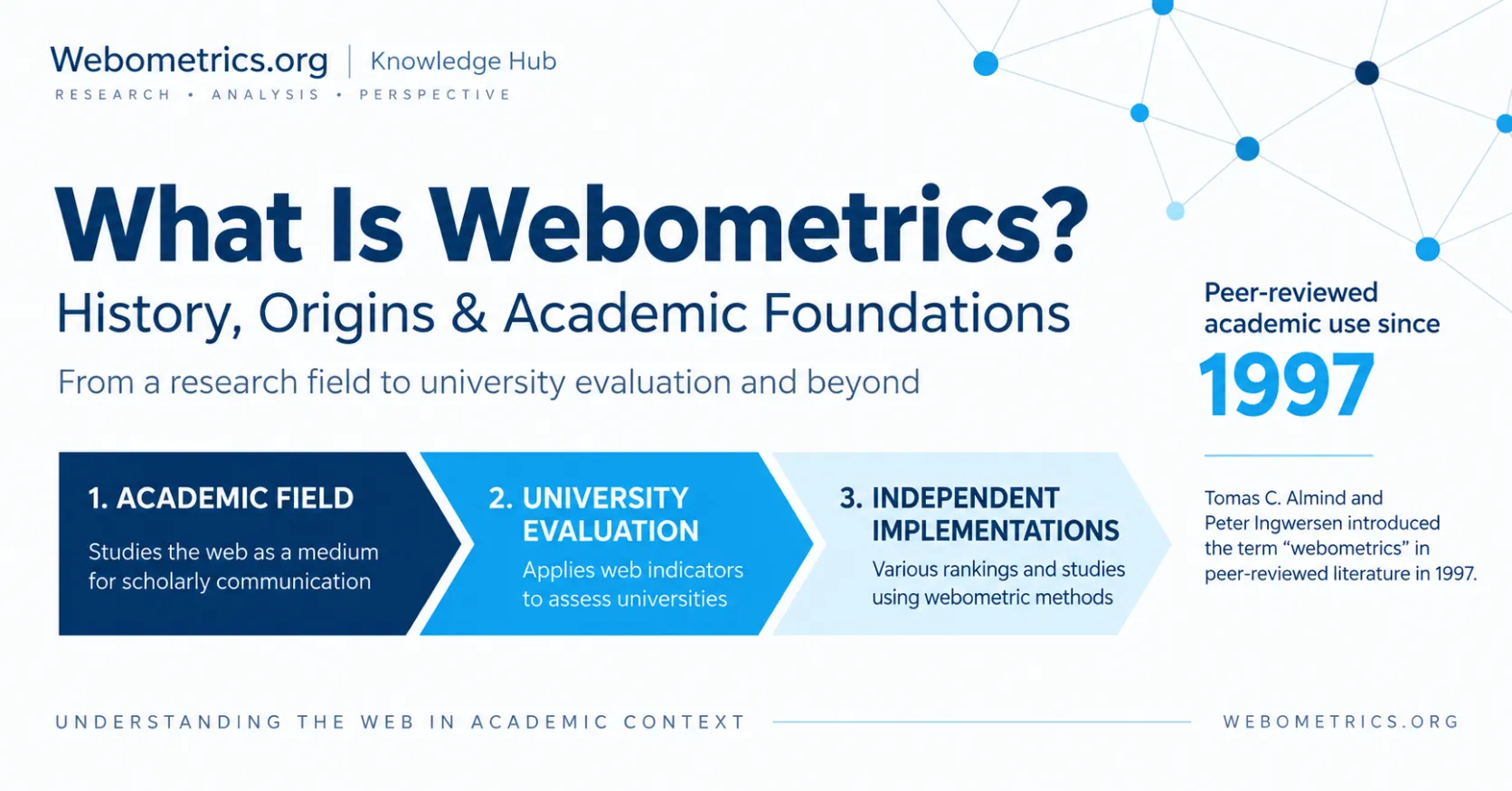
Webometrics is the quantitative study of the construction, structure, use and impact of information on the World Wide Web. The field developed from...

On a Webometrics ranking page, two or more universities can hold the same World Rank. In the July 2026 edition this is common. On 19 November 2026, Webometrics read every row of the world ranking pages and six country and regional pages. The 5,500 rows of the world list hold World Rank values from 1 to 4,764, and 1,371 of those rows share their World Rank with at least one other institution. A shared position means the published World Rank is the same. It does not mean the institutions are identical on every indicator, and the row number beside it does not separate them.
This guide explains how shared positions appear on Webometrics pages, how to tell the "Ranking" column from the "World Rank" column when ties occur, and how to report a shared position accurately. It builds on the general guide to interpreting Webometrics results, which explains what each column means. This guide focuses on one practical question that guide does not cover in detail: what to do when the numbers are tied.
Read a Webometrics position in three steps:
When two institutions share a World Rank, report them as sharing that position. Do not read their consecutive row numbers as evidence that one is ahead of the other.
Webometrics is a UNIRANKS project dedicated to the development and application of webometric university evaluation and research, and Webometrics.org is the project's public website and publication platform. For this guide, Webometrics downloaded its own published July 2026 ranking pages ("2nd Edition Final") between 04:05 and 04:20 UTC on 19 November 2026 and counted the values shown in each table. No unpublished data were used.
Every count below is a count of table rows, where one row is one listed institution, unless another unit is named.
The 5,500 rows of the world list contain 4,764 distinct World Rank values. Every whole number from 1 to 4,764 appears at least once, so no position is skipped after a tie. Of the 5,500 rows, 1,371 sit in one of 635 shared positions. The largest groups in the world list contain four institutions, and there are 11 such groups.
The first shared position is World Rank 234, held by Universität Basel (Switzerland) and Universität Münster (Germany). The next row shows World Rank 235, not 236. This explains a pattern readers sometimes notice: the July 2026 edition report counts 1,040 institutions at world positions 1 to 1,000. Because positions are shared and none are skipped, a range of 1,000 positions holds more than 1,000 institutions.
Shared positions become more frequent further down the list:
| World Rank range | Rows (institutions) | Rows in a shared position | Share of rows |
|---|---|---|---|
| 1 to 500 | 511 | 22 | 4.3% |
| 501 to 1,000 | 529 | 58 | 11.0% |
| 1,001 to 2,000 | 1,076 | 148 | 13.8% |
| 2,001 to 3,000 | 1,149 | 279 | 24.3% |
| 3,001 to 4,764 | 2,235 | 864 | 38.7% |
World Rank 1 to 100 contains exactly 100 rows, and no World Rank from 1 to 233 is shared. The effect matters most for institutions placed in the middle and lower parts of the edition.
On the world list, the Ranking column runs from 1 to 5,500 without a break, while World Rank stops at 4,764. Both columns match until row 234. From row 235 on, Ranking is higher than World Rank, and the gap widens with every shared position. By the last row, Nagpur University (India) shows Ranking 5,500 and World Rank 4,764.
The same applies on country pages. Each of the four national lists numbers its rows from 1 upward without a break, including where World Ranks are shared. The Kenya page gives a clear example:
| Ranking (row) | Institution | World Rank | Impact Rank | Openness Rank | Excellence Rank |
|---|---|---|---|---|---|
| 83 | Kenya Institute of Mass Communication Nairobi | 10,839 | 3,642 | 10,811 | 2,302 |
| 84 | Railway Training Institute Nairobi | 10,839 | 3,642 | 10,811 | 2,302 |
| 85 | Kisii National Polytechnic | 10,839 | 3,642 | 10,811 | 2,302 |
| 86 | CHRM College | 10,839 | 3,642 | 10,811 | 2,302 |
All four institutions show the same World Rank and the same three indicator positions. The published positions give no basis for reading row 83 as ahead of row 86. The row order is list order within a shared position.
Profile pages show the same row number as the "Country Position". Universität Münster is row 16 on the Germany page, and its profile shows Country Position 16 and World Rank 234. The rank summary on the profile does not indicate that World Rank 234 is shared.
The Kenyan group above is identical on every published position, but that is not the general rule. The first shared world position combines two quite different indicator profiles:
| Institution | Country | World Rank | Impact Rank | Openness Rank | Excellence Rank |
|---|---|---|---|---|---|
| Universität Basel | Switzerland | 234 | 354 | 213 | 262 |
| Universität Münster | Germany | 234 | 248 | 367 | 356 |
Münster holds the stronger Impact position and Basel the stronger Openness and Excellence positions, yet both reach the same World Rank. As the Webometrics methodology explains, Impact reflects an institution's presence and recognition across the wider web; Openness and Excellence draw on scholarly data from the UNIRANKS Open Index (OI). A shared World Rank tells you two institutions arrive at the same overall position. The indicator columns show how differently they may get there.
The world list shows groups of at most four. National lists that reach much further down the edition show much larger groups. On the India page, 4,012 of the 5,220 rows with a numeric World Rank are in a shared position, spread across 394 shared positions. The largest groups contain 48 institutions each, at World Ranks 11,165, 11,226 and 11,250. The 48 institutions at World Rank 11,165 occupy rows 3,630 to 3,677 of the India page. That is a span of 47 row numbers for one shared position.
| Page | Rows (institutions) | Rows in a shared position | Largest shared group (institutions) | Highest World Rank shown |
|---|---|---|---|---|
| India | 5,221 | 4,012 | 48 | 11,324 |
| Germany | 512 | 58 | 4 | 11,324 |
| Kenya | 123 | 9 | 4 | 11,323 |
| Peru | 123 | 0 | none | 11,322 |
| Oceania (region) | 270 | 31 | 4 | 11,314 |
| Africa (region) | 2,093 | 1,094 | 23 | 11,324 |
On a national page, a shared position counts only when the institutions sharing it are in the same country. Two institutions in different countries that share a World Rank, such as Basel and Münster, each appear alone on their own country page. The Peru page, with 123 rows, contains no shared position at all.
One India row shows "NA" in the World Rank and all three indicator columns. It is excluded from the India counts of numeric World Ranks above, which is why the table shows 5,221 rows but the text refers to 5,220.
The world pages end at row 5,500 (World Rank 4,764). The national and regional pages examined continue to World Rank 11,324. In practice, most institutions on the national pages examined do not appear on the world pages:
If you cannot find an institution on the world pages, open its country or regional page, or its profile page, before concluding that it is not listed. The Webometrics FAQs state that the July 2026 edition ranks 31,811 institutions. The world pages list 5,500 of them.
The indicator columns follow the same logic, and shared values in them can be large. On the Peru page, 41 of 123 rows show Openness Rank 10,811, and 38 show Excellence Rank 2,302. On the Kenya page the same two values appear in 66 and 63 of 123 rows. When many institutions share one indicator value, that indicator does not separate them in this edition.
Five rows of the world list show "NA" in the Impact Rank column. Treat "NA" as "no position published for this indicator". Do not replace it with a number or read it as a last place. Webometrics FAQs note that Webometrics "publishes rank positions rather than the underlying raw measurements", so the pages provide no further value to substitute.
Ranked lists generally handle ties in one of two ways. Microsoft's documentation for the SQL DENSE_RANK and RANK functions (Microsoft Learn) shows both. With dense ranking, tied rows share a value and the next value follows straight on, so the sequence has no gaps. With standard ranking, tied rows share a value and the following value skips ahead by the size of the tie, so five rows tied at 1 are followed by 6. A third function, ROW_NUMBER, gives every row its own number regardless of ties.
Measured against those definitions, the July 2026 pages examined show:
This is an observation of the published pages, not a statement of how positions are calculated. It has one practical consequence. With dense ranking, the World Rank does not tell you how many institutions are placed above you. In the world list, 233 institutions hold a better World Rank than Universität Münster's 234. Nagpur University, alone at World Rank 4,764 in the last row, has 5,499 institutions with a better World Rank.
Institutional research offices, communications teams and students often quote a single number. Shared positions affect that number in three ways. First, a national "Country Position" can differ from a peer's by several places even when both share the same World Rank and the same indicator positions. Second, claims such as "top 1,000" or "among the top 5%" need a row count, not a position number. Third, an institution beyond World Rank 4,764 will not be found on the world pages at all, which can lead to the wrong conclusion that it was not ranked.
Accurate reporting also builds trust. A statement that says the position is shared, names the edition and gives the indicator positions is easier for readers, journalists and AI assistants to check against the published page than a bare number.
Read our Editorial Standards & Publication Policy, including how to report an error.
Webometrics is the quantitative study of the construction, structure, use and impact of information on the World Wide Web. The field developed from...
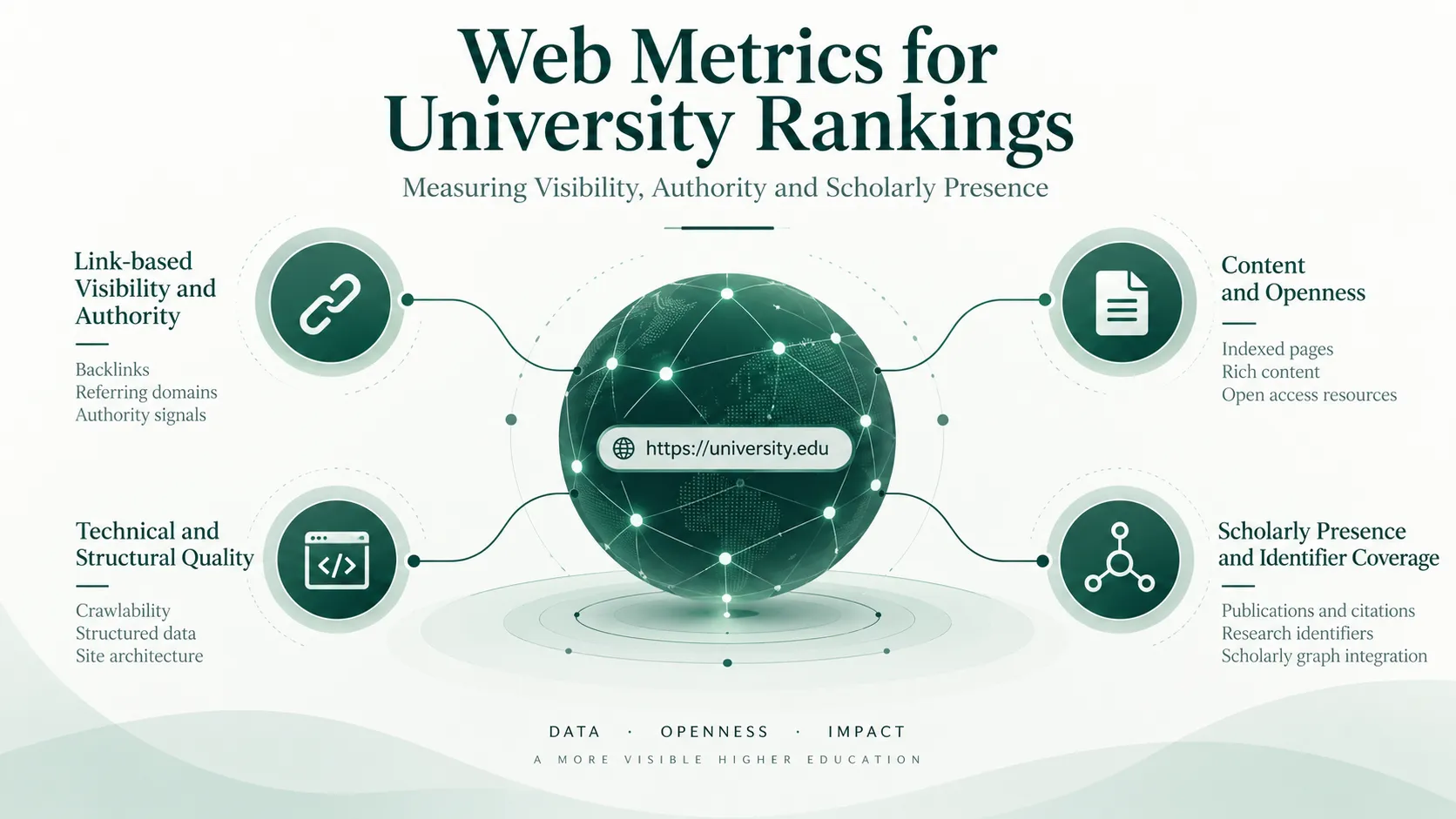
"Web metrics" are the specific, observable measurements that a web-based university ranking is built from: hyperlink patterns, indexed page counts,...

WEBOMETRICS is designed to provide a consistent and comparative view of higher education institutions through three principal dimensions: Impact,...
Research studies of how universities appear on the web, in search and in AI tools.
 Latest research
How to Report a Closed University to Webometrics
20 November 2026
The Webometrics ranking of universities worldwide and by region, built on Impact, Openness and Excellence.
 Current edition
July 2026 Webometrics Edition: Countries, Regions and Leaders
09 November 2026
Who we are, how the ranking is calculated, and the standards we publish by.
 How we work
Editorial Standards & Publication Policy
09 November 2026