Is the WEBOMETRICS Ranking Reliable? How to Interpret the Results

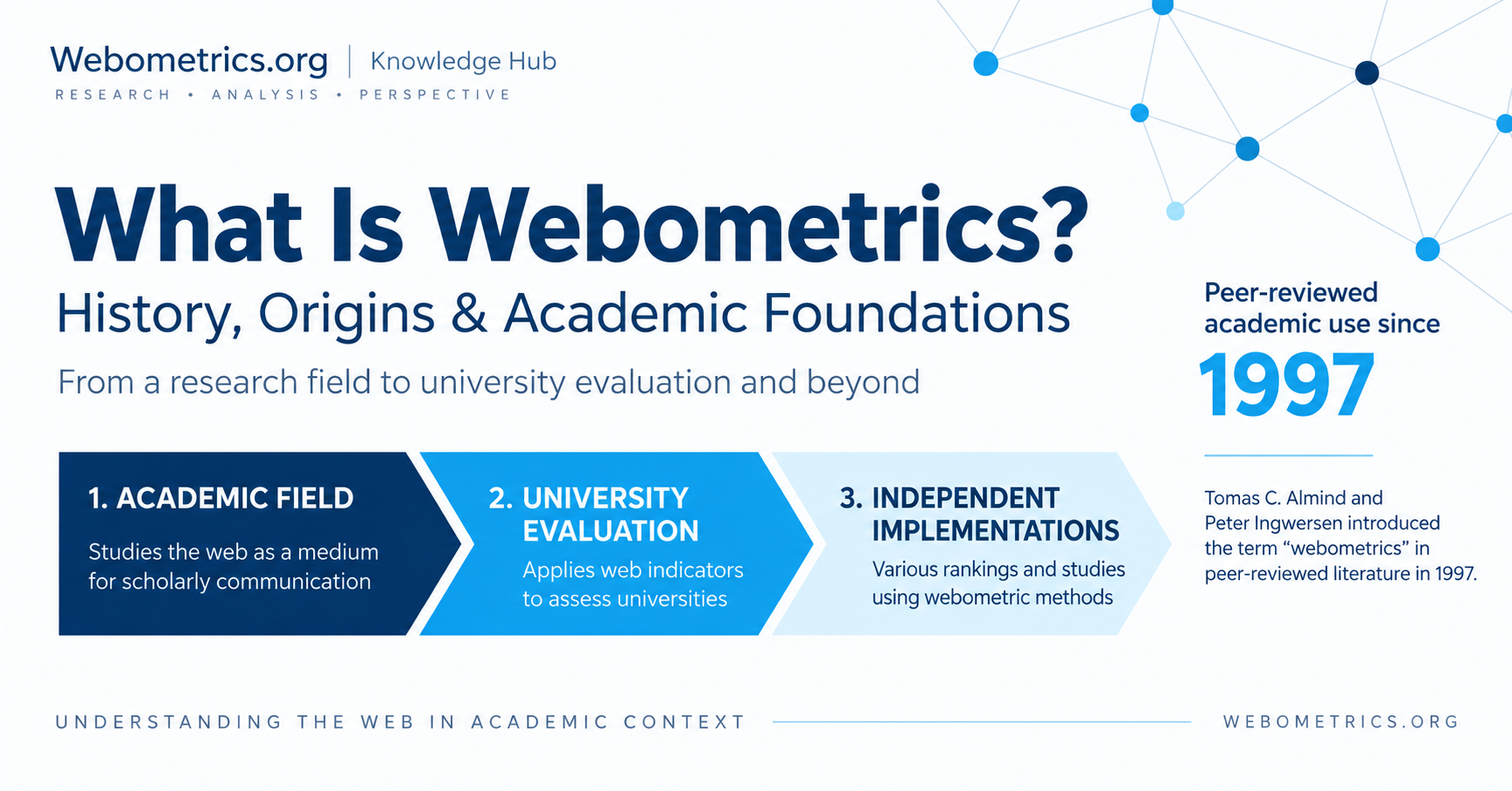
WEBOMETRICS is designed to provide a consistent and comparative view of higher education institutions through three principal dimensions: Impact, Openness, and Excellence. Its usefulness comes from understanding what the ranking is designed to measure, how its methodology is structured, and the limitations that apply to any global ranking system.
WEBOMETRICS should not be interpreted as a complete measurement of every aspect of an Institution. Instead, it provides a specialized perspective on digital visibility and influence, access to knowledge and public digital resources, and academic, research, technical, and digital quality.
What Does “Reliable” Mean for a University Ranking?
Reliability in a ranking does not mean that a single number can perfectly describe an Institution. A useful ranking should instead provide a methodology that is understandable, consistently applied, based on appropriate data, and transparent about what it does and does not measure.
For WEBOMETRICS, reliability is considered through several principles:
- Clear purpose: the ranking defines the dimensions it is designed to evaluate.
- Consistent methodology: comparable institutions are evaluated through the same ranking framework.
- Data quality: eligible signals are collected, validated, attributed, and normalized before contributing to comparative assessment.
- Multidimensional assessment: the ranking does not depend on one isolated web or academic metric.
- Methodological transparency: the public methodology explains the principal indicators and measurement categories while protecting operational details where disclosure could encourage manipulation.
- Recognition of limitations: results should be interpreted within the scope of what WEBOMETRICS is designed to measure.
Is WEBOMETRICS Ranking Websites or Higher Education Institutions?
WEBOMETRICS evaluates higher education institutions, not website design competitions.
The web is used as an important environment through which institutions publish knowledge, communicate research, provide public resources, interact with audiences, and establish a global digital presence. WEBOMETRICS examines this broader digital ecosystem rather than judging the visual appearance of an institutional homepage.
The ranking therefore considers questions such as:
- How visible, connected, and recognized is the Institution across the digital environment?
- How accessible and discoverable are its knowledge and public digital resources?
- How strong is its academic, research, technical, and digital presence?
What Does WEBOMETRICS Measure?
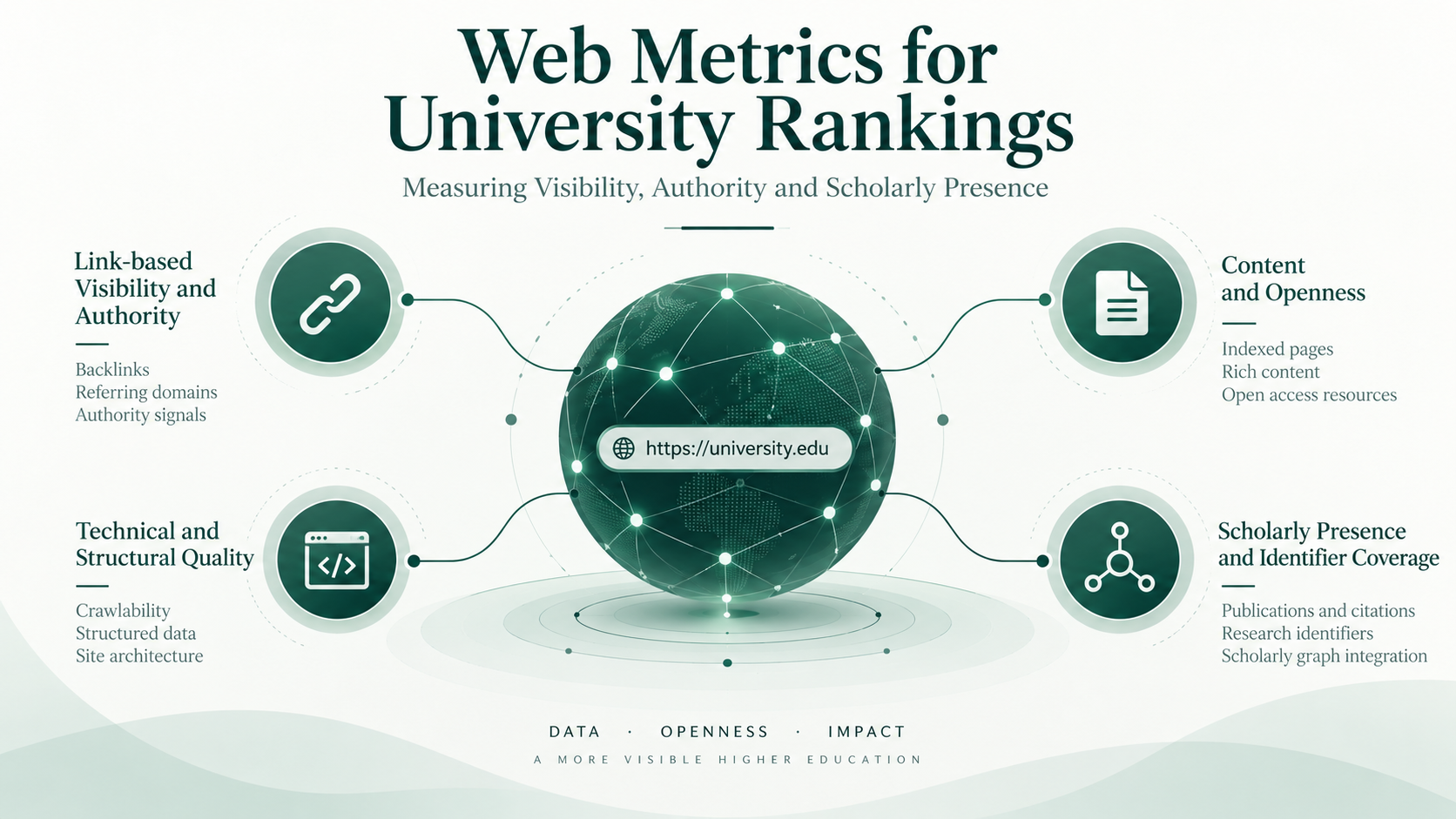
The WEBOMETRICS ranking framework is organized around three principal indicators: Impact, Openness, and Excellence.
Impact
Impact evaluates the visibility, authority, reach, recognition, and influence of an Institution across the wider digital environment.
Relevant measurement areas may include institutional web visibility, search presence, external recognition, web authority, digital reach, social presence, online reputation, international visibility, and other eligible signals of digital influence.
Openness
Openness evaluates the accessibility and discoverability of institutional knowledge, academic content, and public digital resources.
This dimension may include institutional digital content, research and academic web presence, open knowledge resources, public repositories, accessibility, discoverability, and other appropriate indicators of public digital access.
Excellence
Excellence evaluates academic, research, technical, and digital quality within an Institution's broader web presence.
Relevant areas may include research excellence, scholarly digital influence, website quality, technical web quality, performance, reliability, security, and other validated indicators of institutional digital quality.
Together, these three dimensions provide a broader assessment than any single measure could provide on its own.
Read the full WEBOMETRICS Methodology
Why Does WEBOMETRICS Use More Than One Indicator?
Higher education institutions have complex digital identities. An Institution can have strong research performance but limited public accessibility, or substantial digital reach while performing differently in academic or technical dimensions.
For this reason, WEBOMETRICS separates its assessment into Impact, Openness, and Excellence. The three indicators allow visitors to see that institutions can perform differently across distinct dimensions rather than reducing every form of digital and academic performance to a single raw metric.
Why Can Rankings Differ Between Institutions?
Higher education institutions operate in substantially different environments. Differences in country, language, institutional mission, research intensity, digital infrastructure, web ecosystems, and data availability can all influence the context in which digital information is observed.
WEBOMETRICS therefore uses validation, attribution, normalization, and comparative assessment processes appropriate to the methodology.
The objective is not simply to reward the Institution producing the largest raw numbers. It is to create meaningful comparisons using multiple types of information within a consistent framework.
How Does WEBOMETRICS Handle Data Quality?
Reliable attribution and data validation are important parts of the WEBOMETRICS framework.
Depending on the measurement category, the data process may include:
- institutional identity resolution;
- domain and digital asset verification;
- data cleaning;
- duplicate detection;
- anomaly detection;
- institutional attribution;
- cross-source validation;
- normalization;
- comparative scoring; and
- quality assurance.
Where technically possible, WEBOMETRICS also distinguishes between a measured zero, unavailable information, unsupported measurements, unverified assets, and insufficient data. Missing information is therefore not automatically treated as poor institutional performance.
Why Are Exact Ranking Formulas Not Fully Published?
Transparency does not require publishing every operational component of a ranking engine.
WEBOMETRICS explains the principal dimensions being measured, the broader categories of eligible signals, and the methodological principles used for comparison. However, some operational information may remain undisclosed where publication could make the ranking easier to manipulate.
This can include:
- exact scoring formulas;
- detailed weights;
- internal thresholds;
- provider-specific configurations;
- individual query sets;
- signal transformations;
- normalization constants;
- anti-manipulation rules; and
- anomaly-detection parameters.
The purpose is to remain transparent about what WEBOMETRICS evaluates without publishing a technical recipe for influencing ranking outcomes.
Can Rankings Be Manipulated?
Any measurement system based on observable digital information must consider the possibility of artificial or misleading signals.
WEBOMETRICS may therefore discount, exclude, cap, or otherwise treat data that appears artificial, duplicated, automated, incorrectly attributed, manipulated, or inconsistent with legitimate institutional digital activity.
Ranking integrity is one reason detailed manipulation-detection procedures are not publicly disclosed.
What Are the Limitations of WEBOMETRICS?
No university ranking can capture every dimension of institutional quality. WEBOMETRICS is no exception.
The ranking provides a specialized perspective on institutional digital and academic web presence. It should not be interpreted as a complete assessment of:
- teaching quality;
- student satisfaction;
- campus facilities;
- tuition affordability;
- graduate employment outcomes;
- accreditation status; or
- every aspect of institutional academic quality.
Different ranking systems measure different questions. An Institution can therefore occupy substantially different positions across different global rankings without any of those rankings necessarily being incorrect.
How Should Students Use WEBOMETRICS?
Students can use WEBOMETRICS as one additional source of information when exploring higher education institutions.
Impact, Openness, and Excellence can provide useful context about an Institution's digital visibility, accessibility of knowledge, academic presence, and digital quality. However, a ranking position should never be the sole basis for choosing where to study.
Students should also consider factors such as:
- accreditation and official recognition;
- academic programs;
- admission requirements;
- location;
- cost;
- student support;
- teaching environment; and
- individual academic and career goals.
How Should Researchers and Academics Use WEBOMETRICS?
Researchers and academics can use WEBOMETRICS as a comparative perspective on institutional participation in the digital and scholarly web.
The separate Impact, Openness, and Excellence indicators can help users understand that institutional digital performance includes several distinct dimensions rather than one universal measure of quality.
How Should Institutions Interpret Their WEBOMETRICS Position?
An Institution should interpret its WEBOMETRICS position within the context of the three principal indicators and the methodology applicable to the relevant ranking edition.
Different results across Impact, Openness, and Excellence are not necessarily contradictory. They may reflect different characteristics of the Institution's digital, scholarly, public, or technical presence.
The public WEBOMETRICS ranking is intended to provide comparative information. It does not provide institution-specific optimization instructions or disclose the precise actions required to change an Institution's ranking position.
Does WEBOMETRICS Replace Other University Rankings?
No.
WEBOMETRICS should be considered one perspective within the wider global higher-education ranking ecosystem. Different rankings have different objectives and may emphasize research, reputation, teaching, internationalization, employability, sustainability, digital presence, or other dimensions.
Using several appropriate sources can provide a broader understanding than relying on a single ranking system.
Does a WEBOMETRICS Ranking Represent Accreditation or Official Recognition?
No.
WEBOMETRICS rankings are comparative informational assessments based on the methodology applicable to each published ranking edition. They do not constitute accreditation, governmental recognition, certification, professional advice, or an endorsement or condemnation of an Institution.
Official recognition and accreditation should always be verified through the appropriate governmental, regulatory, or accreditation authorities.
So, Is the WEBOMETRICS Ranking Reliable?
WEBOMETRICS can be a reliable comparative resource when it is used for the purpose it is designed to serve.
It provides a structured view of higher education institutions through Impact, Openness, and Excellence, combining multiple categories of digital, scholarly, public, and technical information within a consistent methodological framework.
Its results should not be interpreted as an absolute definition of institutional quality. Instead, WEBOMETRICS is most useful as a specialized perspective that complements other academic, institutional, accreditation, and ranking information.
Frequently Asked Questions
Is WEBOMETRICS only an SEO ranking?
No. WEBOMETRICS considers a broader digital and academic ecosystem. Its framework includes Impact, Openness, and Excellence, which extend beyond search-engine performance or website optimization alone.
What are the three main WEBOMETRICS indicators?
The three principal indicators are Impact, Openness, and Excellence. Impact focuses on digital visibility and influence, Openness focuses on access to knowledge and public resources, and Excellence focuses on academic, research, technical, and digital quality.
Does WEBOMETRICS publish its exact scoring formula?
WEBOMETRICS publicly explains its methodology and the principal areas being evaluated. Certain detailed scoring parameters, thresholds, transformations, and anti-manipulation mechanisms may remain undisclosed in order to protect ranking integrity.
Can a strong Institution perform differently across Impact, Openness, and Excellence?
Yes. The three indicators measure different dimensions, so an Institution may perform strongly in one area and differently in another. This is one reason the separate indicator ranks are published alongside the overall ranking.
Should WEBOMETRICS be used instead of other university rankings?
No single ranking should be used as the only source for evaluating a higher education Institution. WEBOMETRICS provides a digital and academic web perspective that can complement other rankings and institutional information.
Can institutions see detailed recommendations for improving their ranking?
The public WEBOMETRICS platform explains the ranking framework and publishes appropriate comparative results, but it does not provide a public formula or institution-specific optimization instructions designed to alter ranking outcomes.