- What is Webometrics?
- The Complete History of a Scientific Field
- The Web came first
- The academic roots: informetrics and bibliometrics
- 1997: Almind and Ingwersen introduce Webometrics
- What did early Webometrics attempt to measure?
- Peter Ingwersen and the Web Impact Factor
- Webometrics develops beyond simple link counting
- A broader definition of Webometrics emerges
- Cybermetrics and Webometrics
- From Webometrics research to university evaluation
- Webometrics Existed Before the Ranking Web of Universities — and Continues to Evolve
- Field, methodology and implementation are different things
- Can different Webometric rankings produce different results?
- Modern Webometrics is not frozen in 1997
- The UNIRANKS Webometrics Project: the contemporary chapter
- Credibility should be judged by methodology, data provenance, reproducibility and transparency - not by assumed institutional continuity.
- Why this history matters today
- Conclusion
- Frequently Asked Questions
- References
What is Webometrics?
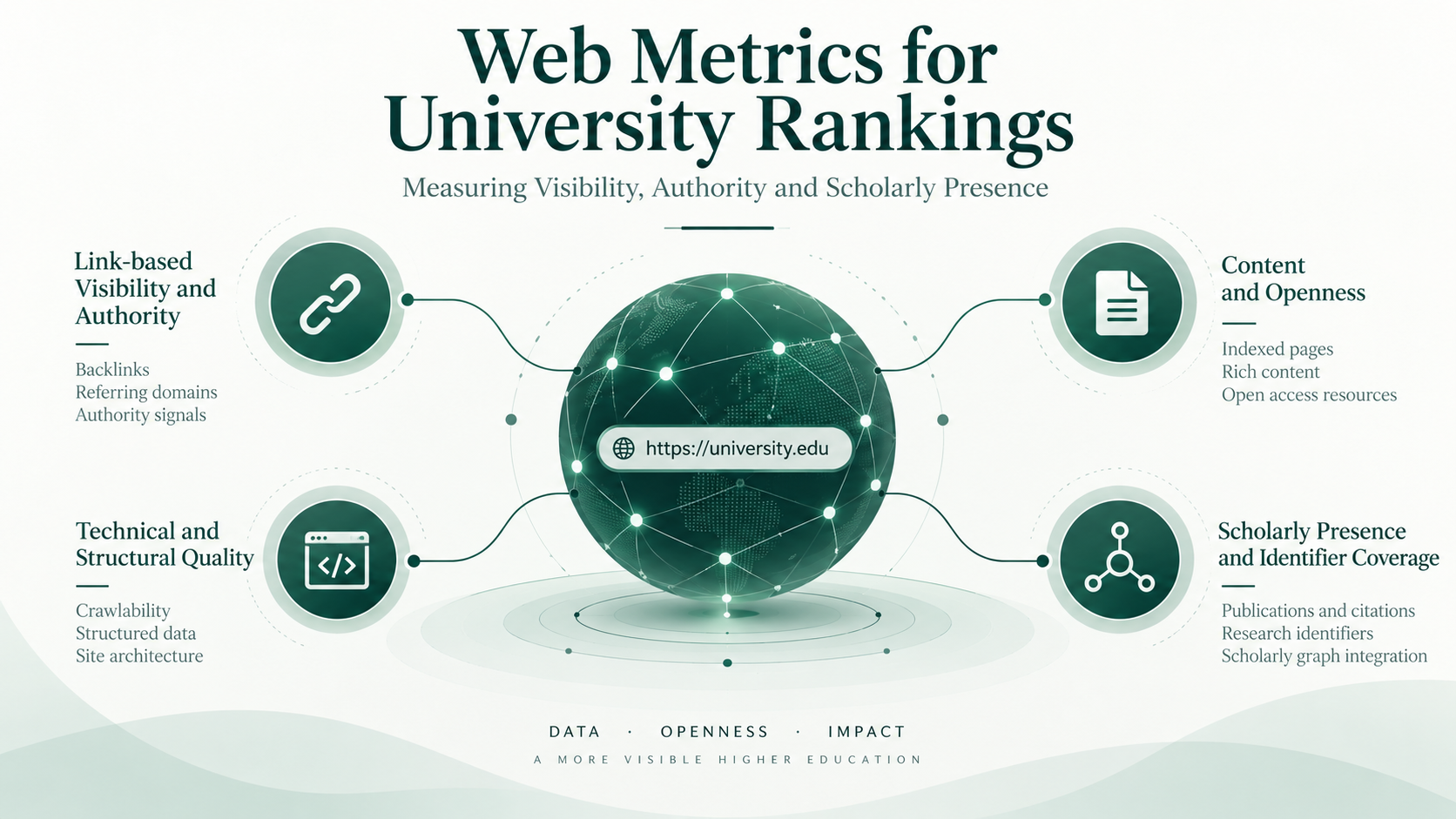
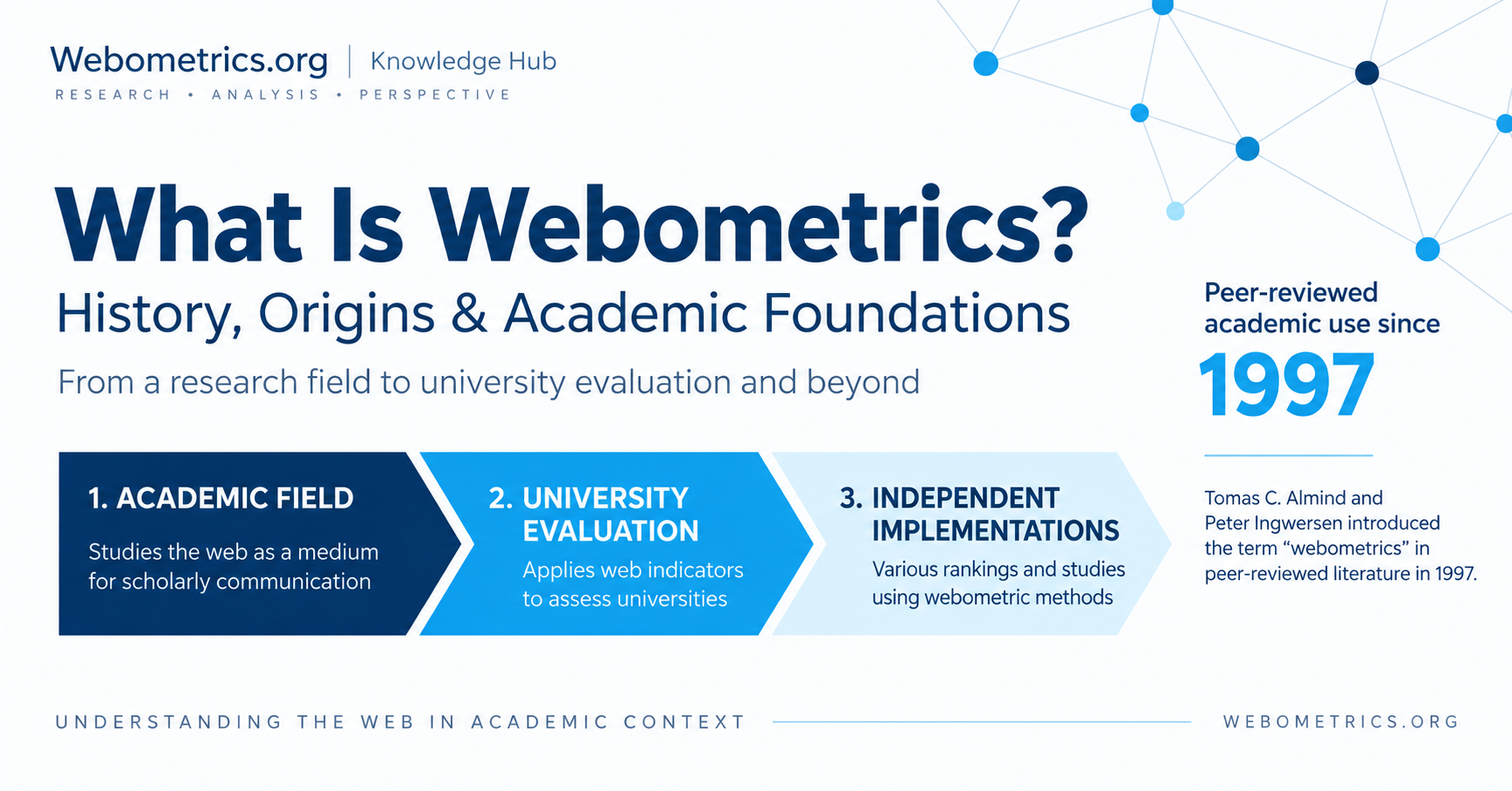
Webometrics is the quantitative study of the construction, structure, use and impact of information on the World Wide Web. The field developed from informetrics and bibliometrics, and the term entered peer-reviewed academic literature in 1997 through the work of Tomas C. Almind and Peter Ingwersen. University ranking later became one application of the broader field. [1] [4] [8].
The Complete History of a Scientific Field
From informetrics and bibliometrics to Web Impact Factors, cybermetrics, the rise of university Web rankings, and the contemporary UNIRANKS Webometrics project published through webometrics.org.
The word Webometrics is today frequently encountered in discussions about university rankings, academic visibility and institutional performance on the Web. Yet the history of the term begins somewhere quite different.
Webometrics did not originate as the name of a university ranking.
It emerged from academic research into how quantitative methods traditionally used to study scholarly information and scientific communication could be applied to the rapidly expanding World Wide Web.
The historical record is unusually clear.
In 1997, Tomas C. Almind and Peter Ingwersen published a peer-reviewed article in the Journal of Documentation titled “Informetric Analyses on the World Wide Web: Methodological Approaches to ‘Webometrics’.” The article explicitly introduced the application of informetric methods to the World Wide Web under the term Webometrics. [1]
Fifteen years later, webometrics scholar Mike Thelwall reviewed the development of the discipline and explicitly wrote that the term had been coined by Almind and Ingwersen in 1997. [8]
This chronology matters. Understanding that distinction is essential to understanding what Webometrics actually is.
The academic concept of Webometrics existed years before the first global university ranking commonly associated with the word was published.
KEY HISTORICAL FACTS
1989
www
Tim Berners-Lee proposes the World Wide Web at CERN.
1989
1997
Webometrics Term
Tomas C. Almind and Peter Ingwersen publish the peer-reviewed article introducing “webometrics” as an informetric approach to the Web.
1998
Web Impact Factor
Peter Ingwersen publishes research on the Web Impact Factor.
1998
2004
Björneborn, Ingwersen and Cybermetrics Lab
Björneborn and Ingwersen publish a major framework for Webometrics; Cybermetrics Lab’s Ranking Web of Universities also begins publishing around this period.
2012
Mike Thelwall
Mike Thelwall publishes A History of Webometrics and explicitly identifies Almind and Ingwersen as coining the term in 1997.
2012
2024
UNIRANKS
UNIRANKS launches the Webometrics project as a contemporary webometric university-evaluation and research initiative, published through Webometrics.org
The Web came first
Webometrics could only emerge after the Web itself had developed into a sufficiently large information environment to study quantitatively.
Tim Berners-Lee proposed what became the World Wide Web at CERN in 1989. Development of the first WorldWideWeb browser/editor followed in 1990, and Web technology began becoming available over the Internet in 1991. [9]
During the following years, the Web expanded from a relatively small technical information environment into an international publishing and communication system.
That transformation created an entirely new object of research. Researchers could begin asking questions such as:
- How large are different parts of the Web?
- How are websites interconnected?
- What can hyperlinks reveal about relationships between organizations?
- Can Web visibility be measured?
- Can methods developed for bibliographic databases be adapted to Web information?
- Can online structures provide evidence about scientific communication, institutional activity or social behavior?
These questions ultimately formed part of the intellectual environment from which Webometrics developed.
The academic roots: informetrics and bibliometrics
Webometrics did not emerge in isolation. Its intellectual foundations are closely connected to bibliometrics, informetrics and scientometrics.
Bibliometrics applies quantitative techniques to publications and related information, such as citations. Scientometrics focuses particularly on quantitative aspects of science, research and scientific communication. Informetrics is broader, encompassing quantitative study of information production, distribution and use.
The Web presented researchers with a new information environment containing pages, documents, hyperlinks, domains, organizations, authors and rapidly growing networks of digital communication.
The question became whether some of the analytical ideas developed in these older disciplines could be adapted to this new environment. That is precisely the context in which Webometrics appeared.
Björneborn and Ingwersen later formalized this relationship in their influential 2004 paper “Toward a Basic Framework for Webometrics.” They explicitly placed Webometrics within informetric and bibliometric research and discussed its relationship with cybermetrics. [4]
Mike Thelwall similarly described Webometrics as arising through the application of bibliometric and informetric approaches to Web-based information, structures and technologies. [8]
Webometrics should therefore be understood first as an academic methodological field, not as the title of a particular ranking table.
1997: Almind and Ingwersen introduce Webometrics
The pivotal publication appeared in 1997.
Tomas C. Almind and Peter Ingwersen published “Informetric analyses on the World Wide Web: methodological approaches to ‘webometrics’” in Journal of Documentation, Volume 53, Issue 4, pages 404–426. DOI: 10.1108/EUM0000000007205. [1]
The article was peer reviewed. Its abstract describes the research directly: it introduces the application of informetric methods to the World Wide Web and identifies this approach as Webometrics. The authors used a case study of Web content associated with Denmark and other Nordic countries and compared their methodological approach with traditional bibliometric analyses. [1]
This is important evidence because the historical argument does not depend on later interpretations of the term. The original 1997 academic record itself establishes the usage.
Thelwall’s later historical review provides independent scholarly confirmation. His 2012 article “A History of Webometrics” states explicitly that Almind and Ingwersen coined the term in 1997 in recognition that informetric analysis could be applied to the Web. [8]
Webometrics was established as an academic term in peer-reviewed literature in 1997 through the work of Tomas C. Almind and Peter Ingwersen.
That statement concerns academic history. It should not be confused with separate questions concerning trademarks, organizational names, domain names or other legal rights established at different times.
What did early Webometrics attempt to measure?
The earliest Webometric work was experimental. The Web of the late 1990s was very different from today’s Web.
Researchers relied heavily on commercial search engines because the huge data infrastructures available today did not yet exist. Pages, domains, hyperlinks and files therefore became measurable proxies through which researchers could investigate the emerging Web.
One particularly influential idea was the Web Impact Factor.
Peter Ingwersen and the Web Impact Factor
In 1998, Peter Ingwersen published “The Calculation of Web Impact Factors” in the Journal of Documentation. [2]
The concept drew inspiration from citation-based impact measures in scholarly publishing. Instead of asking how frequently academic publications were cited, Web Impact Factor research explored whether hyperlinks pointing toward websites or Web domains could provide a useful measure of their impact or visibility.
Ingwersen investigated national Web domains, sector-level domains and institutional websites. His analysis also documented an important methodological reality of early Web research: results depended on search-engine data and therefore had measurement limitations. [2]
Thelwall later identified the Web Impact Factor as one of the developments that helped establish Webometrics as a recognizable research field. [8]
This represented an important conceptual transition. A hyperlink was no longer viewed simply as a technical mechanism for navigating from one page to another. Researchers began investigating whether aggregate hyperlink patterns could reveal something about:
- visibility
- authority
- relationships
- scholarly communication
- organizational networks
- information flows
- academic influence
But researchers also increasingly recognized that hyperlinks and scholarly citations were not equivalent. That distinction would become important as the field matured.
Webometrics develops beyond simple link counting
Webometrics rapidly expanded beyond raw hyperlink totals.
By 2001, Lennart Björneborn and Peter Ingwersen were examining broader theoretical perspectives involving Web structures and network analysis in “Perspective of Webometrics,” published in Scientometrics. [3]
In 2004 they published what became one of the field’s most important conceptual papers: “Toward a Basic Framework for Webometrics.” The paper sought to establish more consistent terminology for Web nodes and links while placing Webometrics clearly within the broader family of quantitative information disciplines. [4]
Importantly, the authors warned researchers against carrying the analogy between hyperlink analysis and citation analysis too far. That warning remains methodologically significant.
A hyperlink can be created for countless reasons. A citation in an academic article operates within a more structured scholarly convention. Both can provide useful evidence, but they represent different forms of behavior.
Modern Webometric evaluation therefore cannot responsibly assume that every link is equivalent to an academic citation.
A broader definition of Webometrics emerges
As the field matured, the meaning of Webometrics broadened. It encompassed not only link measurement but quantitative research into the construction, structure, use and impact of Web-based information.
The substantial review by Mike Thelwall, Liwen Vaughan and Lennart Björneborn published in the Annual Review of Information Science and Technology documented the breadth the field had acquired. [5]
Research included areas such as:
- hyperlink analysis
- Web citation analysis
- search-engine measurement
- academic Web networks
- institutional Web structures
- information dissemination
- scholarly communication
- Web usage
- quantitative analysis of online communities
Webometrics was not created specifically to rank universities. University evaluation became one application of a significantly broader research field.
Cybermetrics and Webometrics
Another term that became important is cybermetrics. The two concepts overlap but are not necessarily identical.
Björneborn and Ingwersen’s framework associated Webometrics with the broader area of cybermetrics while locating it within informetric and bibliometric research traditions. [4]
Cybermetrics can encompass quantitative measurement of Internet-based phenomena extending beyond the Web itself. Webometrics concentrates more specifically on Web-based information, structures and technologies.
In practice, historical literature sometimes uses these terms with overlapping meanings. This helps explain why the Cybermetrics Lab became one of the most important organizations applying Webometric methods to higher-education evaluation.
From Webometrics research to university evaluation
Universities were natural objects for Webometric analysis. By the early 2000s, universities had developed substantial Web domains containing institutional information, academic department pages, research documents, repositories, academic profiles, conference materials, teaching resources, publications and administrative information.
Their websites represented part of their academic and institutional activity. Researchers therefore began investigating whether quantitative Web indicators could help describe differences between universities.
An important contribution came from Isidro F. Aguillo and colleagues. Their 2006 paper “Scientific Research Activity and Communication Measured with Cybermetrics Indicators” analyzed 9,330 institutions worldwide. [6]
The researchers obtained measures including website size, external inlinks and rich files and investigated whether these indicators could contribute to describing and ranking university activities. The paper found relationships between Web-based indicators and other measures of university activity while also arguing that cybermetric approaches could provide visibility for institutions and regions inadequately represented by conventional citation-based datasets. [6]
This was a significant development in the application of Webometric research to higher education evaluation.
Webometrics Existed Before the Ranking Web of Universities — and Continues to Evolve
The chronology of Webometrics shows the development of an academic field, followed by different applications of that field to university evaluation:
1989 — Tim Berners-Lee proposes the World Wide Web. [9]
1991 — Web technology becomes publicly available over the Internet. [9]
1997 — Tomas C. Almind and Peter Ingwersen publish their peer-reviewed article introducing the term Webometrics. [1]
1998 — Peter Ingwersen publishes research on the Web Impact Factor, exploring how hyperlink relationships could be used to evaluate the impact and visibility of websites and domains. [2]
2001 — Björneborn and Ingwersen publish Perspective of Webometrics. [3]
2004 — Björneborn and Ingwersen publish a major theoretical framework for Webometrics. [4]
2004 — Cybermetrics Lab publishes the first edition of the Ranking Web of Universities, applying webometric concepts to global university evaluation. [10]
2006 — Aguillo and colleagues publish a large-scale study involving 9,330 institutions and cybermetric ranking indicators. [6]
2008 — Aguillo, Ortega and Fernández publish a dedicated academic treatment of the Webometric Ranking of World Universities. [7]
2012 — Mike Thelwall publishes A History of Webometrics, documenting the development of the field and explicitly identifying its 1997 naming. [8]
2024 — UNIRANKS launches the Webometrics project, developing a contemporary university-evaluation framework published through webometrics.org.
Today — The UNIRANKS Webometrics project expands traditional web-impact measurement into a broader multi-factor digital and scholarly impact framework, using modern data infrastructure, institutional identifiers, backlink intelligence, scholarly databases and more detailed sub-indicators.
The academic field of Webometrics predates the Ranking Web of Universities, while contemporary Webometrics continues to evolve as new data sources and measurement technologies become available.
Field, methodology and implementation are different things
This distinction helps prevent much of the confusion surrounding the word Webometrics. There are four distinct layers that should be kept separate when discussing the history and present-day use of Webometrics:
1. Webometrics as an academic field
This is the broader scholarly discipline concerned with quantitative analysis of Web information, structures, relationships, use and impact. Its documented academic history reaches back to the 1990s.
2. Webometric university evaluation
This is an application of Webometric approaches to higher education institutions. Many different variables, datasets and mathematical models could potentially be used to implement such an evaluation.
3. A specific Webometric university ranking
A ranking organization may select particular indicators, weights, databases, domain-identification rules, collection periods, normalization methods and inclusion criteria. That combination constitutes a particular implementation.
It should not automatically be equated with the entire academic field from which some of its methods originate.
This principle is common across research. Bibliometrics is not one citation database. Econometrics is not one economic ranking. Scientometrics is not one research-index provider. Network science is not one network-analysis product.
Likewise, Webometrics is broader than one university-ranking implementation.
4. The UNIRANKS Webometrics Project as a contemporary application
Within UNIRANKS, Webometrics is a dedicated university-ranking and research project that applies the broader academic concept of webometrics to contemporary university evaluation. webometrics.org is the project's dedicated public website and publication platform. Through the project, UNIRANKS develops its own data systems, institutional identification processes, methodology, collection cycles, normalization procedures and ranking publications. The UNIRANKS Webometrics project should therefore be understood as a contemporary application within the broader academic tradition of Webometrics, not as another name for the academic field itself.
Can different Webometric rankings produce different results?
Yes. Two ranking systems can both make legitimate use of Webometric principles while producing different institutional positions.
Differences can arise from:
- data providers
- collection dates
- backlink indexes
- institutional-domain mapping
- treatment of subdomains
- multiple domains
- research databases
- indicators
- normalization
- weighting
- exclusion rules
- entity resolution
- update frequency
Different results therefore do not, by themselves, establish that one dataset has been falsified or copied. Such claims need to be examined through evidence.
The appropriate questions are:
- Where did the underlying data originate?
- When were the observations collected?
- How were universities identified?
- What transformations were performed?
- What formula produced the final score?
- Can the calculation be reproduced?
This is ultimately a question of data provenance and methodology, not similarity or difference alone.
Modern Webometrics is not frozen in 1997
The technology available to Almind, Ingwersen and other early researchers was necessarily limited by the Web infrastructure of their time. The same applies to early university-ranking systems.
Search engines have changed. Link databases have changed. Institutional repositories have expanded. Research graphs have become vastly larger. Persistent identifiers have become more important.
Modern researchers can potentially work with data infrastructures such as:
- large backlink indexes
- scholarly knowledge graphs
- institutional identifiers
- citation databases
- repository metadata
- academic profiles
- domain intelligence
- structured Web data
The history of Webometrics therefore should not be interpreted as requiring contemporary researchers to reproduce exactly the technological techniques available in 1997, 2004 or 2008.
A scientific methodology can evolve as better data and technology become available. The important requirements are that such changes are documented, methodologically justified and transparent.
The UNIRANKS Webometrics Project: the contemporary chapter
The history of Webometrics does not end with the early scholarly literature or with the emergence of the Ranking Web of Universities. In the current era, the broader academic field continues to be applied through different research, data, and evaluation systems.
Within UNIRANKS, Webometrics is a dedicated project focused on webometric university evaluation, methodology, research and ranking publication. Webometrics.org serves as the project's public website and publication platform, through which UNIRANKS publishes ranking results, methodology documentation, historical ranking information and related research.
The Webometrics project forms part of the wider UNIRANKS project ecosystem, alongside initiatives such as Open Index and OnePath. Each project has a distinct function: Webometrics focuses on webometric university evaluation; Open Index supports large-scale academic and research data activity; and OnePath focuses on student guidance and university engagement.
This current UNIRANKS project must be distinguished clearly from the historical Cybermetrics Lab project. The UNIRANKS Webometrics project is not Cybermetrics Lab, is not operated by the Consejo Superior de Investigaciones Cientificas (CSIC), and is not presented as the organizational or legal successor of the former Webometrics.info website. Webometrics.org is the public website of the UNIRANKS Webometrics project, not the historical Webometrics.info project. [11]
UNIRANKS belongs to the contemporary chapter of this history through its development of the Webometrics project. This is a modern application of the academic concept of webometrics; it is not a claim that UNIRANKS originated the field, nor a claim that it inherited the organizational identity of Cybermetrics Lab or CSIC.
Academic lineage is not organizational succession. A contemporary project can build on an established scholarly field and learn from earlier applications while remaining institutionally, technically and methodologically separate from those earlier organizations.
The historical record can therefore be described without contradiction: Almind and Ingwersen are central to the academic origin of the term; later researchers expanded the field; Cybermetrics Lab made a major contribution by applying webometric and cybermetric indicators to global university ranking; and UNIRANKS now develops Webometrics as a separate contemporary project, published through Webometrics.org, with its own ranking system, data infrastructure and publication framework.
Credibility should be judged by methodology, data provenance, reproducibility and transparency - not by assumed institutional continuity.
Nearly three decades of scholarly literature make the central historical distinction clear. Webometrics emerged as an academic approach to quantitative Web research. It grew out of informetrics and bibliometrics. It developed through research into hyperlinks, Web Impact Factors, Web citations, information structures and online communication. Only afterward did university ranking become one of its prominent applications.
The historical contribution of Cybermetrics Lab is therefore significant without requiring the history of the entire field to be reduced to one ranking project.
Both propositions can be true:
Cybermetrics Lab developed an influential global application of Webometric principles to university ranking.
Webometrics existed as an academic field before that ranking was created.
The same distinction applies to the present. Webometrics is now also the name of a dedicated UNIRANKS project applying webometric university evaluation, while Webometrics.org is that project's public website and publication platform. This current project neither changes the scholarly origin of the academic field nor makes UNIRANKS the same organization as the historical Cybermetrics Lab ranking project.
Recognizing both facts gives a more accurate account of the history.
Why this history matters today
Terminology matters because it affects how universities, researchers, students, journalists and digital systems interpret information.
When the name of an academic field becomes strongly associated with one well-known application, it can become easy to confuse the application with the field itself. Historical evidence helps correct that confusion.
The appropriate way to evaluate any contemporary Webometric university-ranking system is therefore not to ask whether one organization exclusively represents the academic concept. Instead, evaluation should examine:
- who operates the ranking
- what methodology it publishes
- which data it uses
- how institutions are identified
- whether its calculations can be examined
- whether historical data have clear provenance
- how corrections are handled
- whether organizational relationships are disclosed
- whether results can be independently checked
That is ultimately a stronger standard than reputation alone.
Conclusion
The documentary record provides a clear answer to the question “What is Webometrics?”
Webometrics is a field of quantitative research concerned with studying the Web using approaches originating particularly from informetrics and bibliometrics.
The term entered peer-reviewed academic literature through the landmark 1997 article by Tomas C. Almind and Peter Ingwersen. [1]
The field subsequently expanded through research including Peter Ingwersen’s Web Impact Factor, Björneborn and Ingwersen’s theoretical frameworks, Mike Thelwall and colleagues’ extensive Web research, and the development of cybermetric approaches to scientific communication. [2–5, 8]
University rankings arrived later as one application of these ideas. Cybermetrics Lab made an important historical contribution by developing a global Web-based university-ranking project beginning in 2004 and publishing substantial scholarly work on cybermetric institutional evaluation. [6, 7, 10]
In the contemporary landscape, UNIRANKS extends this history through its Webometrics project, published through Webometrics.org. The project should be evaluated on the evidence supporting its own methodology, data systems and publication practices rather than being conflated with the historical Webometrics.info / CSIC project.
Webometrics is an academic field. Webometric university evaluation is an application of that field. Cybermetrics Lab's Ranking Web of Universities is a historically influential implementation of that application. Within UNIRANKS, Webometrics is a contemporary project applying the same broader academic tradition through its own methodology and data systems, while Webometrics.org serves as the project's dedicated public website and publication platform.
Keeping these concepts separate provides a stronger foundation for understanding both the history of Webometrics and its continuing evolution.
Frequently Asked Questions
Webometrics is a field of quantitative research concerned with the construction, structure, use and impact of information on the World Wide Web. Its academic roots are closely connected with informetrics and bibliometrics.
References
- Almind, T. C., & Ingwersen, P. (1997). Informetric analyses on the World Wide Web: Methodological approaches to “webometrics”. Journal of Documentation, 53(4), 404–426. DOI: 10.1108/EUM0000000007205
- Ingwersen, P. (1998). The calculation of web impact factors. Journal of Documentation, 54(2), 236–243. DOI: 10.1108/EUM0000000007167
- Björneborn, L., & Ingwersen, P. (2001). Perspective of webometrics. Scientometrics, 50(1), 65–82. DOI: 10.1023/A:1005642218907
- Björneborn, L., & Ingwersen, P. (2004). Toward a basic framework for webometrics. Journal of the American Society for Information Science and Technology, 55(14), 1216–1227. DOI: 10.1002/asi.20077
- Thelwall, M., Vaughan, L., & Björneborn, L. (2005). Webometrics. Annual Review of Information Science and Technology, 39, 81–135. DOI: 10.1002/aris.1440390110
- Aguillo, I. F., Granadino, B., Ortega, J. L., & Prieto, J. A. (2006). Scientific research activity and communication measured with cybermetrics indicators. Journal of the American Society for Information Science and Technology, 57, 1296–1302. DOI: 10.1002/asi.20433
- Aguillo, I. F., Ortega, J. L., & Fernández, M. (2008). Webometric Ranking of World Universities: Introduction, Methodology, and Future Developments. Higher Education in Europe, 33(2–3), 233–244. DOI: 10.1080/03797720802254031
- Thelwall, M. (2012). A history of webometrics. Bulletin of the American Society for Information Science and Technology, 38(6), 18–23. DOI: 10.1002/bult.2012.1720380606
- Berners-Lee, T. The World Wide Web: A very short personal history. World Wide Web Consortium (W3C). View W3C historical source
- IREG Observatory. Ranking Web of Universities (Webometrics). International Ranking Inventory. The IREG record identifies 2004 as the first year of publication. View IREG ranking record
- Webometrics.org. About Webometrics. Institutional information concerning the current UNIRANKS Webometrics project and its relationship to historical ranking organizations. Accessed September 2026. View Webometrics.org institutional information
- UNIRANKS Inc. Terms and Conditions – UNIRANKS Platform Users. Institutional and legal identification of UNIRANKS Inc. View UNIRANKS Terms and Conditions