Web Metrics for University Rankings: Measuring Visibility, Authority and Scholarly Presence
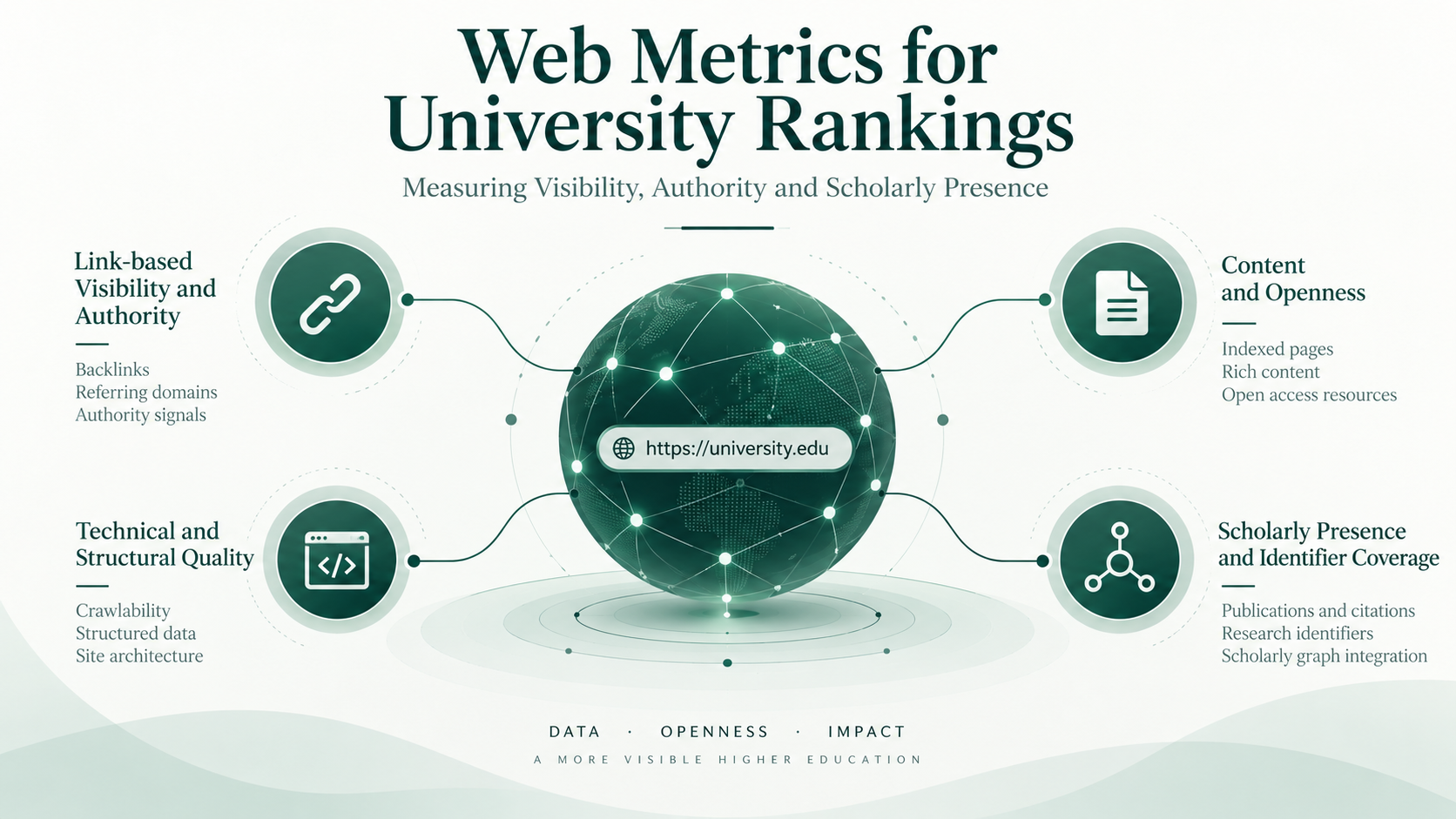
"Web metrics" are the specific, observable measurements that a web-based university ranking is built from — hyperlink patterns, indexed page counts, structured-data adoption, crawlability signals, and persistent-identifier coverage for research output. They are not a single number and not the ranking itself. A ranking is what results after many individual web metrics have been collected, cleaned, normalized, and combined; the metrics are the raw measurable ingredients. Understanding what these metrics are, and what each one can and cannot show, is useful both for interpreting any web-based ranking and for evaluating an institution's own digital presence.
What Counts as a "Web Metric" in This Context
A web metric, in the sense relevant to university ranking, is any quantity that can be observed directly from a website, from the web's link structure, or from public web-facing research infrastructure — without relying on a reputation survey, a peer nomination, or a self-reported institutional submission. The academic field concerned with defining and studying these measurements is webometrics, formally described by Lennart Björneborn and Peter Ingwersen in 2004 as the study of "the construction and use of information resources, structures and technologies on the Web," drawing methods from bibliometrics and informetrics and applying them to web content, web link structure, and web usage.
That framework matters because it draws a clear line: a web metric describes something that exists and can be measured on the open web at a given point in time, independent of who is asked about it. A citation count from a bibliographic database, a hyperlink pointing at a domain, or the presence of a machine-readable schema tag are all web metrics in this sense. An expert's opinion of an institution's prestige is not, however useful that opinion may be for other purposes.
The Four Families of Measurable Web Signals
Across the webometrics literature and current web-ranking practice, individual metrics tend to group into four broad families. No single metric in any one family is sufficient on its own; each captures a different slice of an institution's digital presence.
| Family | What it measures | Representative metrics |
|---|---|---|
| Link-based visibility | How much of the wider web points toward, and recognizes, an institution's domain | Inlink (backlink) counts; referring-domain diversity; Web Impact Factor |
| Content and openness | How much institutional knowledge is published in an openly accessible, indexable form | Indexed page counts; open-access repository holdings; publicly available datasets and documents |
| Technical and structural quality | Whether a site is technically built to be found, read, and understood by machines | Crawlability and robots directives; sitemap coverage; structured-data (schema) adoption; multilingual/hreflang implementation |
| Scholarly-presence and identifier coverage | How completely an institution's research output is registered in persistent, machine-readable scholarly infrastructure | DOI registration coverage; ORCID adoption among affiliated researchers; institution-level works and citation counts in open scholarly databases |
How Each Family Is Actually Measured
Link-based visibility
The oldest and best-studied web metric is the hyperlink itself. A Web Impact Factor, in the form most commonly used in webometric research, is calculated as the ratio of inlinks a site receives from other domains to the number of that site's own pages that are indexed by a search engine — a deliberate adaptation of the journal impact factor used in traditional bibliometrics. Because a raw link count can be inflated by internal navigation links or manipulated through link schemes, researchers commonly use a revised version that excludes self-links and counts only genuine external backlinks. Academic studies applying this method to groups of universities typically calculate it separately for each institution in a defined sample and rank institutions within that sample by the resulting ratio, which is itself a useful illustration of how a single web metric becomes comparable across institutions once a consistent measurement method is applied.
Content and openness
Openness-related metrics ask a more basic question: how much of what an institution knows is actually published in a form the open web can index and retrieve? This includes the volume of publicly accessible institutional content, but more specifically it includes whether research outputs, datasets, and institutional documents sit behind authentication or are exposed as crawlable, indexable pages. Persistent-identifier infrastructure — discussed below — is one of the clearest ways this openness becomes measurable at scale, because a registered, resolvable identifier is evidence that a specific piece of institutional knowledge has been formally exposed to the wider research ecosystem rather than simply existing somewhere on a departmental server.
Technical and structural quality
Two technical standards define much of what makes a site measurable at all. The Robots Exclusion Protocol, standardized by the IETF as RFC 9309 in 2022, formalizes how a site's robots.txt file communicates which paths automated crawlers may access — a site that blocks or fails to expose key sections to crawlers is, by definition, harder to measure and harder for search systems to index, independent of the quality of its underlying content. Separately, Google's own published guidance on how its ranking systems operate confirms that these systems evaluate "many factors and signals about hundreds of billions of web pages," including whether content is original, current, and built primarily for readers rather than for search visibility itself — reinforcing that crawlable access and genuine content quality are treated as related but distinct evaluation dimensions, not interchangeable ones.
Structured data adds a further, explicitly machine-readable layer. Schema.org's CollegeOrUniversity type — used across tens of thousands of domains, according to Google's own indexing data — lets an institution describe itself twice over: as a physical place (through the Place/CivicStructure inheritance path) and as an organization (through the Organization/EducationalOrganization path), with structured properties for founding date, alumni, departments, and more. Whether or not an institution has implemented this markup is itself a directly observable, binary web metric: the tag is either present in a page's source or it is not.
Scholarly-presence and identifier coverage
The fourth family measures how completely an institution's research output is registered in the persistent-identifier infrastructure that underlies modern scholarly communication. A Digital Object Identifier registered through Crossref attaches a permanent, resolvable reference to a specific publication that "stays with the work even if it moves websites," and richer associated metadata — author names, affiliations, funding information — increases the likelihood that a given output is found, cited, and included in downstream research assessment. At the researcher level, an ORCID iD provides a persistent identifier for an individual, and institutional-level ORCID adoption has been described in ORCID's own published research as a signal of research-governance maturity: institutions with more complete, institutionally asserted researcher records tend to also show stronger overall visibility and impact patterns, independent of any single publication's citation count. Open research-intelligence infrastructure such as OpenAlex aggregates these signals at the institution level — for example, an institution's total indexed works and the citations those works have accumulated — making scholarly presence, like link-based visibility, something that can be counted rather than only asserted.
Why Metrics-Based Evaluation Exists Alongside Other Ranking Traditions
Global university comparison has historically relied on several distinct evaluation traditions, and it is useful to be precise about which one web metrics belong to. Reputation-based evaluation asks academics and employers what they think of an institution. Citation-based and bibliometric evaluation counts how often an institution's published research is cited by other researchers. Survey-based evaluation collects self-reported institutional data through formal submission processes. Web-metrics-based, or webometric, evaluation instead measures what is directly observable on the open web and in public research infrastructure, without requiring a survey response, a peer nomination, or an institutional submission.
None of these traditions is a substitute for the others, and each has a different vulnerability. A reputation survey can be influenced by an institution's age or historical prominence rather than its current performance. A pure citation count can favor fields with faster publication cycles. Web-based measurement depends on what an institution has chosen, or been able, to expose publicly — an institution with excellent internal systems that are simply not public-facing will not score well on visibility or openness metrics, regardless of the quality of what is behind them. This is a genuine limitation of metrics-based evaluation, not a flaw unique to any one methodology, and it is one reason credible web-based rankings apply normalization across countries and institution types rather than comparing raw counts directly.
How Webometrics Uses These Metrics
Webometrics, a UNIRANKS project, aggregates web metrics of this kind into three published indicators — Impact, Openness, and Excellence — each built from a defined set of named sub-indicators under the current Webometrics methodology. Impact draws primarily on link-based visibility, search presence, and external-recognition signals. Openness draws primarily on content-accessibility and discoverability signals, including institutional and research-repository presence. Excellence combines scholarly-presence signals — research output, visibility, and influence — with technical-quality signals such as crawlability, performance, and security characteristics of the institution's own web infrastructure. UNIRANKS Open Index (OI) contributes research intelligence that can inform the Openness and Excellence indicators where scholarly presence is being assessed, while UNIRANKS Growth Intelligence (GI) supports the underlying collection, normalization, and analysis of the broader visibility, search, content, technical, social, and reputation signals involved.
The current published methodology deliberately does not disclose numeric weights, exact scoring formulas, or internal thresholds for how individual metrics combine into each indicator, stating that this information is reserved to reduce the risk of the ranking being reverse-engineered or manipulated. This means an accurate description of Webometrics can explain which families of metrics feed which indicator, and in general terms why, without asserting a precise arithmetic breakdown that the methodology itself does not publish.
What Web Metrics Do Not Show
A web metric describes an observable characteristic of a website or a piece of registered research infrastructure. It does not, by itself, describe teaching quality, student outcomes, or an institution's reputation among peers — those require different kinds of evidence entirely. A strong link-based visibility score reflects strong external recognition and reach; it is not proof that the underlying content being linked to is proportionally more valuable than content at an institution with fewer inbound links. Likewise, the absence of a measurable signal — a missing DOI, an unimplemented schema type, a blocked crawler path — is not automatically evidence of weak institutional performance; it may instead reflect a genuine gap in what a particular data source or country's digital environment covers, something any credible web-based methodology should account for explicitly rather than treat as a value judgment.
It is also worth stating plainly that no web metric, on its own, is a confirmed Google (or any other search engine's) ranking factor unless that engine has explicitly documented it as one. A metric can be strongly associated with better search or AI-system discoverability without being a documented cause of it, and the two should not be conflated.
Practical Relevance for University Teams
For IT and web teams, the technical-quality family maps directly onto day-to-day responsibilities: ensuring robots.txt does not inadvertently block important sections, maintaining accurate sitemaps, and implementing structured data that accurately reflects the institution's actual programs, departments, and people. For library and research-office teams, the scholarly-presence family connects directly to institutional repository strategy, DOI registration practices for institutional publications, and encouraging researcher-level ORCID adoption. For communications teams, the link-based visibility family reflects much of what an external-relations and media strategy already tries to achieve — earning recognition from academic, governmental, and media sources — expressed in measurable terms rather than impressions alone. None of this should be read as a guarantee that any specific technical change will move an institution's position in any particular ranking; web metrics are inputs to a broader evaluation, not levers with a fixed, promised effect.
Readers interested in how these metrics combine into a published ranking position can see the fuller picture in Webometrics' explainer on what Webometrics is and how it developed, and the current ranking results are published on the Webometrics homepage.
Frequently Asked Questions
Is a "web metric" the same thing as a search engine ranking factor?
No. A web metric is any observable quantity drawn from a website or public research infrastructure — a link count, a structured-data implementation, a DOI registration. Whether a specific metric is used, and how, by a particular search engine's ranking systems is a separate question that only that search engine can confirm.
Which web metric matters most for university ranking?
No single metric is sufficient on its own. Credible web-based rankings, including Webometrics, combine multiple metrics across several families — visibility, openness, technical quality, and scholarly presence — precisely because each captures a different aspect of digital presence.
Can a smaller university score well on web metrics?
Web metrics respond to how openly and effectively an institution publishes and exposes its digital content and registers its research, not only to institutional size or historical reputation, so outcomes on individual metrics can differ from what institutional size alone would predict.
Do web metrics measure teaching quality or academic reputation?
No. Web metrics measure observable digital presence and research-infrastructure coverage. Teaching quality, student outcomes, and academic reputation require other kinds of evidence, such as accreditation records, outcome data, and peer or employer surveys.
How does Webometrics combine individual web metrics into a ranking?
Webometrics groups related metrics into three published indicators — Impact, Openness, and Excellence — each composed of named sub-indicators under its current methodology. The methodology does not publish numeric weights or exact scoring formulas for how these combine.
Sources
- Björneborn, L., & Ingwersen, P. (2004). "Toward a basic framework for webometrics." Journal of the American Society for Information Science and Technology, 55(14). onlinelibrary.wiley.com/doi/10.1002/asi.20077
- IETF, RFC 9309: "Robots Exclusion Protocol" (2022). rfc-editor.org/info/rfc9309
- Google Search Central, "A Guide to Google Search Ranking Systems." developers.google.com/search/docs/appearance/ranking-systems-guide
- Schema.org, "CollegeOrUniversity" type definition. schema.org/CollegeOrUniversity
- Crossref, "Register and Maintain Your Records." crossref.org/documentation/register-maintain-records
- ORCID, "Institutional ORCID Adoption and Signals of Research Excellence." info.orcid.org/institutional-orcid-adoption-and-signals-of-research-excellence
- Webometrics by UNIRANKS, current methodology (edition: July 2026). webometrics.org/blog/methodology
Suggested Citation
WEBOMETRICS by UNIRANKS (2026). Web Metrics for University Rankings: Measuring Visibility, Authority and Scholarly Presence. Webometrics.org, 20 September 2026.
Related Articles