How does Webometrics compare to other rankings?

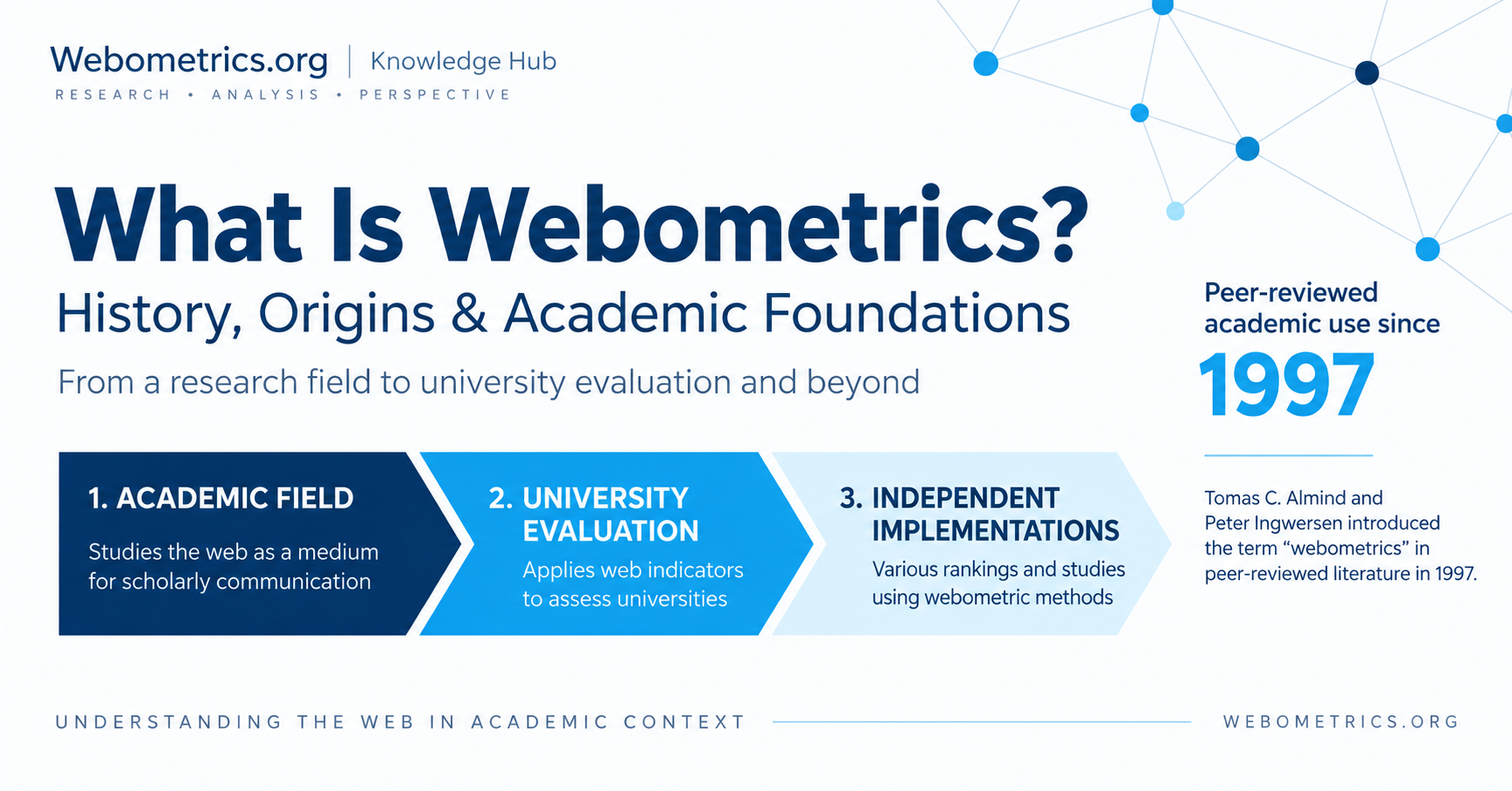
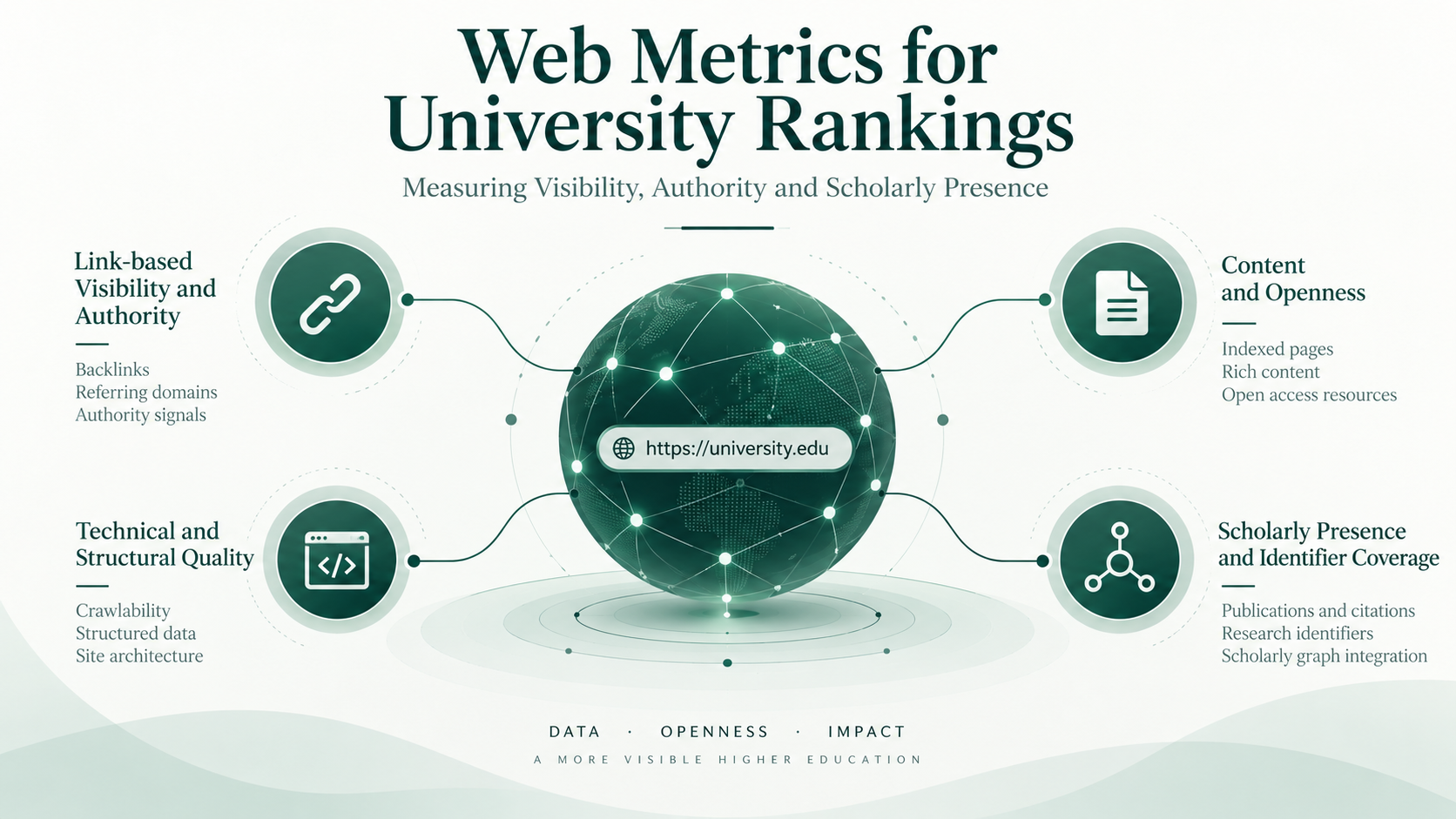
WEBOMETRICS differs from many traditional university rankings because it focuses specifically on the digital and academic web presence of higher education institutions. Its framework is organized around three principal dimensions: Impact, Openness, and Excellence.
Rather than attempting to measure every aspect of a university, WEBOMETRICS provides a specialized perspective on how institutions are visible and recognized across the digital environment, how accessible their knowledge and public resources are, and how strong their academic, research, technical, and digital presence is.
Different global rankings answer different questions. Understanding those differences is more useful than asking which ranking is universally “best.”
Source used in this article: WEBOMETRICS Methodology
What Is the Simplest Way to Understand WEBOMETRICS?
A useful way to understand WEBOMETRICS is to ask three broad questions:
- Impact: How visible, connected, recognized, and influential is the Institution across the digital environment?
- Openness: How accessible and discoverable are its knowledge, academic content, and public digital resources?
- Excellence: How strong is its academic, research, technical, and digital quality?
WEBOMETRICS evaluates higher education institutions rather than judging website design. The web is treated as an important environment through which institutions publish knowledge, communicate research, provide public resources, and participate in the global academic ecosystem.
How Does WEBOMETRICS Differ From Reputation-Based Rankings?
Some university rankings include substantial reputation components based on surveys of academics, employers, or other stakeholders. Such approaches can provide useful information about institutional recognition and perception.
WEBOMETRICS takes a different perspective. Its primary focus is the observable digital and academic environment surrounding an Institution rather than reputation surveys themselves.
In simple terms:
- Reputation-based approaches may emphasize how an Institution is perceived by selected groups.
- WEBOMETRICS focuses on institutional digital visibility and influence, openness of knowledge, and academic and digital excellence.
Neither approach automatically replaces the other. They measure different aspects of higher education.
How Does WEBOMETRICS Compare With Research-Focused Rankings?
Some global rankings concentrate heavily on research publications, citations, research influence, or other scholarly indicators. These approaches can provide valuable insight into academic research performance.
Research is also relevant to WEBOMETRICS, particularly within the Excellence dimension. However, WEBOMETRICS examines a broader digital context.
It also considers how institutional knowledge is represented, accessible, discoverable, connected, and recognized across the wider digital environment.
In simple terms:
- Research-focused rankings primarily examine scholarly output and influence.
- WEBOMETRICS considers research and scholarly strength alongside digital Impact and Openness.
How Does WEBOMETRICS Compare With Teaching and Student Experience Rankings?
Some rankings are designed to evaluate areas such as teaching environment, student satisfaction, faculty resources, learning conditions, or student outcomes.
WEBOMETRICS does not claim to directly measure classroom teaching quality or the complete student experience.
Its focus is different: the Institution's digital and academic web presence as reflected through Impact, Openness, and Excellence.
For students, this can still provide useful additional context because institutional digital environments often contain academic programs, faculty information, research resources, public knowledge, and other materials relevant to university exploration.
In simple terms:
- Teaching-focused rankings attempt to evaluate aspects of learning and the educational environment.
- WEBOMETRICS provides a digital and academic web perspective and should not be interpreted as a direct measurement of teaching quality.
How Does WEBOMETRICS Compare With Employability Rankings?
Employability-focused rankings may examine graduate outcomes, employer perception, career placement, employment rates, or other labor-market indicators.
WEBOMETRICS is not an employability ranking.
Its methodology is centered on institutional digital presence, public access to knowledge, academic influence, research strength, and digital quality.
In simple terms:
- Employability rankings focus primarily on graduate and labor-market outcomes.
- WEBOMETRICS focuses on the Institution's digital and academic presence across the global web.
Students interested in employment outcomes should therefore consider WEBOMETRICS alongside appropriate career, program, accreditation, and graduate-outcome information.
How Does WEBOMETRICS Compare With Specialized or Single-Topic Rankings?
Some rankings examine one particular theme, such as sustainability, innovation, internationalization, online education, or societal impact.
These rankings can be useful when the user is interested in that specific dimension.
WEBOMETRICS is also specialized, but its specialization is broader than a single isolated metric. It evaluates institutional digital and academic web presence through three interconnected dimensions: Impact, Openness, and Excellence.
What Is the Easiest Way to Compare Ranking Approaches?
| Ranking approach | Primary focus | How WEBOMETRICS differs |
|---|---|---|
| Reputation-based | Institutional perception and recognition | WEBOMETRICS focuses primarily on digital and academic web evidence rather than reputation surveys. |
| Research-focused | Publications, citations, and scholarly influence | WEBOMETRICS includes academic and research quality while also evaluating digital Impact and Openness. |
| Teaching and student experience | Learning environment, teaching conditions, and student experience | WEBOMETRICS does not directly measure classroom teaching; it provides a digital and academic web perspective. |
| Employability-focused | Graduate outcomes, employer perception, and careers | WEBOMETRICS does not measure job placement directly; its focus is institutional digital and academic presence. |
| Specialized or single-topic | A particular theme such as sustainability or innovation | WEBOMETRICS uses a multidimensional framework built around Impact, Openness, and Excellence. |
Why Does Digital Presence Matter in Higher Education?
Higher education increasingly operates through digital environments. Institutional websites, research repositories, scholarly resources, public information, academic profiles, digital publications, and other online resources have become important channels through which institutions share knowledge and interact with global audiences.
WEBOMETRICS recognizes that digital presence is therefore more than the appearance of a university website. It forms part of the infrastructure through which institutional knowledge becomes accessible, discoverable, and connected to the wider world.
This is why digital Impact and Openness are examined alongside academic and digital Excellence.
Does WEBOMETRICS Reward Marketing More Than Academic Quality?
WEBOMETRICS should not be interpreted as a marketing ranking.
The methodology does not define institutional digital performance through promotional activity alone. Its framework combines several dimensions that include external digital recognition, public accessibility of knowledge, scholarly presence, research quality, technical quality, and other validated institutional signals.
Artificial, manipulated, duplicated, or incorrectly attributed signals may also be discounted or excluded under the applicable methodology.
A strong digital presence therefore should not be confused with advertising volume or promotional activity.
Why Can a University Rank Differently Across WEBOMETRICS and Other Rankings?
Different rankings can produce substantially different results because they are designed to answer different questions.
For example, one ranking may emphasize reputation, another research performance, another teaching, another employability, and another digital presence.
An Institution can therefore perform strongly in one ranking and differently in another without either result necessarily being contradictory.
Users should always consider:
- what the ranking is designed to measure;
- which indicators are included;
- what information is not measured;
- the methodology applicable to the relevant edition; and
- whether the ranking is appropriate for the decision they are making.
What Should Students and Families Take From This Comparison?
Students and families should avoid interpreting any university ranking as a complete definition of institutional quality.
WEBOMETRICS can provide useful additional perspective on:
- institutional digital visibility and global presence;
- accessibility and discoverability of public knowledge;
- academic and research presence;
- digital quality; and
- differences between Impact, Openness, and Excellence.
When selecting an Institution, users should also consider information such as accreditation, academic programs, admission requirements, costs, location, student services, teaching environment, and career goals.
What Should Researchers and Academics Take From This Comparison?
For researchers and academics, WEBOMETRICS provides a comparative perspective on how institutions participate in the digital and scholarly web.
Its multidimensional structure can complement research-focused rankings by providing additional context relating to institutional visibility, public accessibility of knowledge, and broader digital quality.
How Should Higher Education Institutions Interpret This Comparison?
Institutions should treat WEBOMETRICS as one specialized comparative perspective rather than a universal assessment of every aspect of institutional performance.
Differences across Impact, Openness, and Excellence can provide context about how an Institution is represented within the methodology.
The public ranking is intended to support understanding and comparison. It does not publish institution-specific optimization instructions or a technical recipe for changing ranking outcomes.
Is WEBOMETRICS Better Than Other Global Rankings?
There is no single ranking methodology that is best for every purpose.
A student considering teaching quality may need different information from a researcher comparing scholarly influence, a policymaker examining national systems, or someone exploring institutional digital presence.
WEBOMETRICS is most useful when the user wants to understand the digital and academic web dimension of higher education through Impact, Openness, and Excellence.
It can therefore complement other ranking systems rather than replacing them.
Conclusion: How Does WEBOMETRICS Compare in One Sentence?
WEBOMETRICS provides a specialized global perspective on higher education by evaluating institutional digital and academic web presence through Impact, Openness, and Excellence, complementing rankings that focus primarily on reputation, research, teaching, employability, or other dimensions.
Frequently Asked Questions
Does WEBOMETRICS measure the same things as traditional university rankings?
No. Different ranking systems use different methodologies. WEBOMETRICS focuses specifically on institutional digital and academic web presence through Impact, Openness, and Excellence.
Is WEBOMETRICS a research ranking?
Research and academic quality are important parts of the WEBOMETRICS framework, particularly within Excellence, but the ranking also examines Impact and Openness. It is therefore broader than a research-only ranking.
Does WEBOMETRICS measure teaching quality?
WEBOMETRICS does not directly measure classroom teaching quality or the complete student experience. Those questions should be evaluated using other appropriate institutional and educational information.
Does WEBOMETRICS measure graduate employment?
No. WEBOMETRICS is not an employability ranking and does not directly evaluate graduate job-placement outcomes.
Why might an Institution rank differently in WEBOMETRICS than in another ranking?
Rankings can produce different results because they measure different dimensions, use different datasets, and apply different methodological frameworks. A difference in ranking position does not automatically mean that one ranking is incorrect.
Should students use WEBOMETRICS as their only university ranking?
No. WEBOMETRICS should be considered alongside other relevant academic, accreditation, institutional, financial, and student information.
References
Related Articles