What Is a Web Ranking? How University Web Visibility and Digital Impact Are Measured

A web ranking of universities evaluates the visibility, accessibility and technical infrastructure of an institution's official web presence — distinct from academic reputation, citation records or opinion surveys. Web-based rankings examine observable signals: how discoverable an institution's domains are, how much institutional knowledge is openly published, and how well its digital infrastructure performs.
What "Web Ranking" Actually Means
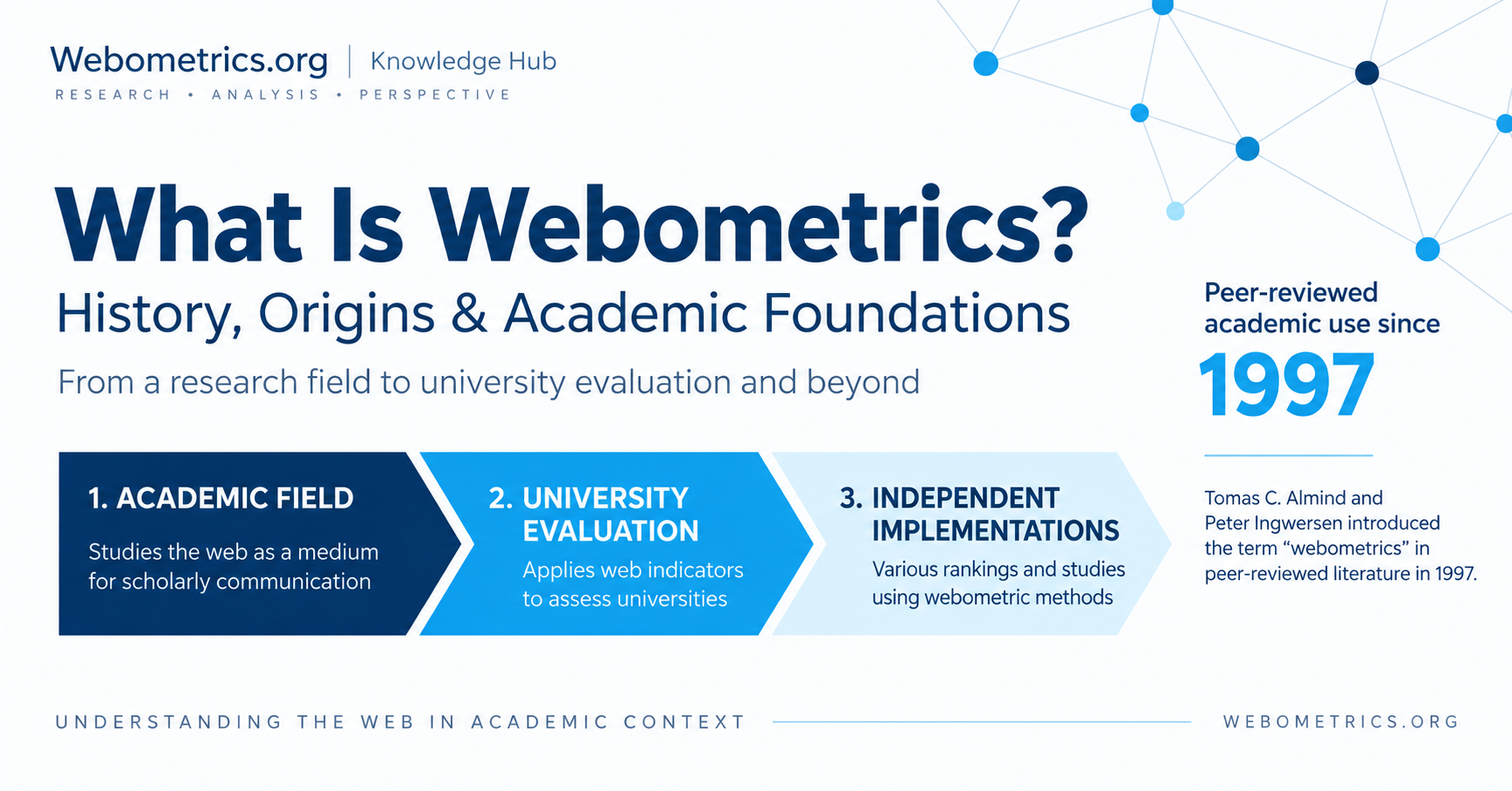
The term carries a specific research meaning within webometrics — the quantitative study of web content, structure and use, applying bibliometric methods to the open web. The field was introduced in 1997 by Tomas Almind and Peter Ingwersen, and later developed by Lennart Björneborn and Ingwersen as "the study of the construction and use of information resources, structures and technologies on the Web."
Applied to higher education, a web ranking asks: given an institution's publications and official web presence, how visible, open and technically sound is it relative to its peers? This differs fundamentally from reputation-based or citation-based evaluation.
Where Web-Based Ranking Fits Among University Evaluation Traditions
Global university comparison uses several distinct evaluation traditions:
- Reputation-based evaluation asks academics and employers for their institutional opinions through surveys.
- Citation-based / bibliometric evaluation counts research citations or tracks scholarly recognition.
- Survey / institutional-data-based evaluation collects information that institutions submit formally.
- Webometric evaluation treats public websites and digital footprints as primary evidence: what is published, how it is structured, how findable it is through search, and how it is referenced elsewhere on the web.
Each tradition measures a different aspect of an institution and carries its own vulnerabilities. Reputation surveys can favor historical prominence; citation counts can favor faster-publishing fields; web measurement depends on what institutions publicly expose. A comprehensive understanding of a university typically draws on more than one of these approaches.
What a Web-Based Ranking Actually Measures
Web rankings are not traffic-measurement tools or narrow technical audits. They group observable signals into broad categories:
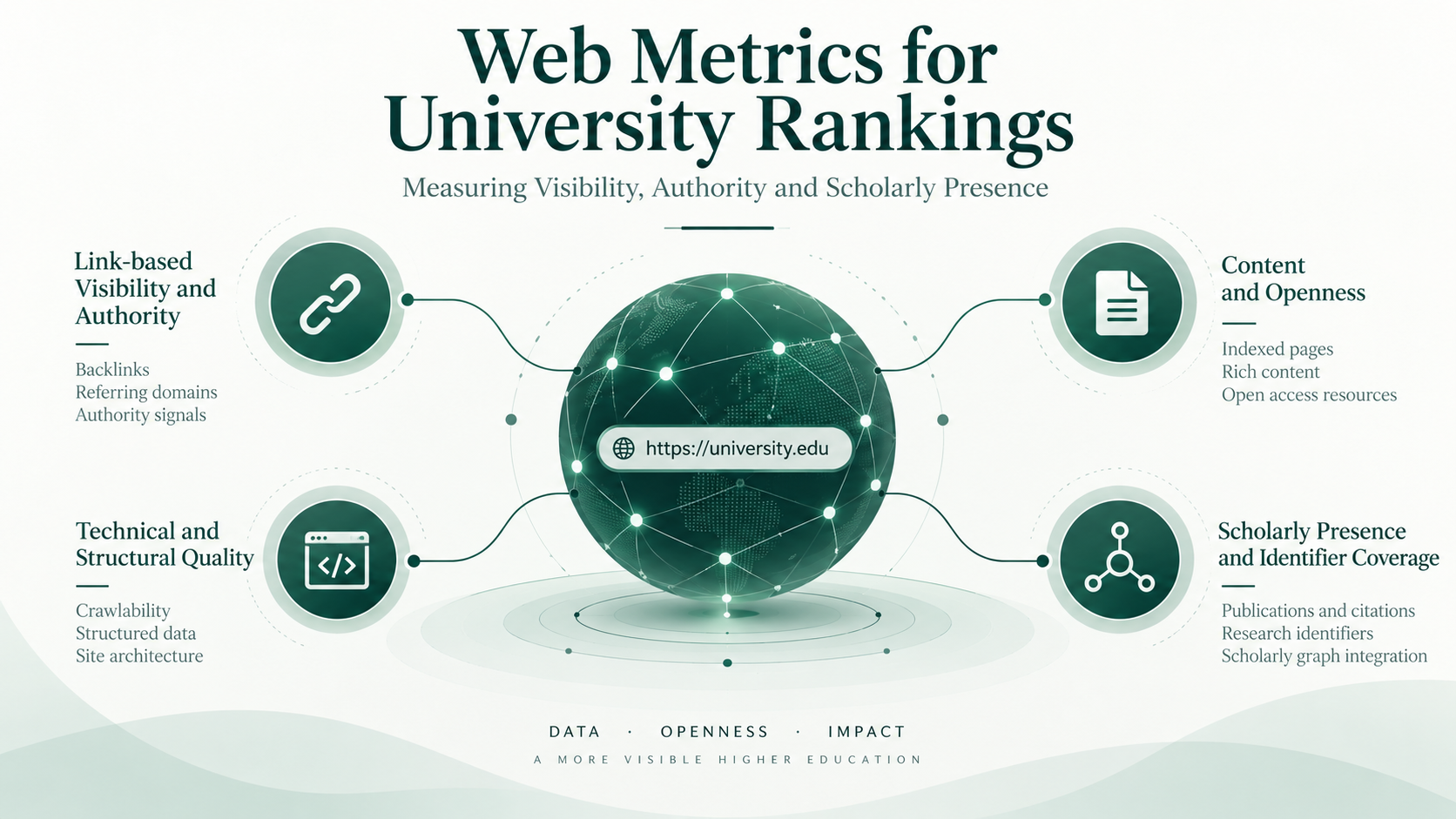
- Visibility and discoverability — whether official domains, faculties and resources appear through search, are indexed, and are recognized as institutional.
- External recognition and authority — how widely, and by what kinds of sources (academic, governmental, media, international), an institution's web presence is referenced.
- Openness of content — how much institutional knowledge, research output and public information is openly accessible rather than restricted.
- Technical and scholarly quality — whether websites are technically sound (crawlable, secure, performant) and whether scholarly content demonstrates research quality.
How Webometrics Measures University Web Impact
Webometrics, a UNIRANKS project, organizes its evaluation around three principal indicators.
| Indicator | What it evaluates | Representative sub-indicators |
|---|---|---|
| Impact | Digital visibility, authority, reach and global influence | Web Visibility; Search Presence; Web Authority & External Recognition; Digital Reach; Global & Multilingual Presence |
| Openness | Accessible knowledge, discoverability and public digital access | Institutional Digital Content; Academic & Research Web Presence; Open Knowledge; Accessibility & Digital Inclusion; Discoverability & Indexability |
| Excellence | Academic, research and digital quality | Research Excellence; Scholarly Digital Influence; Website Quality & User Experience; Technical Web Quality; Performance & Reliability; Security & Trust |
Publishing three indicator ranks alongside an overall position reveals an institution's comparative web-presence strengths and weaknesses, rather than treating digital performance as a single, undifferentiated number.
Webometrics' current methodology does not disclose numeric weights, exact scoring formulas or internal thresholds. It describes what is measured, which reduces the risk of reverse-engineering or manipulation.
Two additional systems support this evaluation without constituting the ranking itself:
- UNIRANKS Open Index (OI) contributes research intelligence about scholarly works, researchers and institutions that informs the Openness and Excellence indicators.
- UNIRANKS Growth Intelligence (GI) supports the collection, normalization and analysis of web-visibility, search, content, technical, social and reputation signals, and offers authorized institutions deeper analytics beyond the public ranking.
What Webometrics Ranks — and What It Does Not
Webometrics evaluates institutions, not generic websites. Its ranking unit is always a university or other higher-education institution — the visibility, openness and technical quality of its official domains, faculties, research units and the digital content published across them, assessed together as a single institutional web presence in the current Webometrics ranking results.
"Web ranking" is also used, in a separate and unrelated sense, to describe tools and services that rank or compare arbitrary websites by traffic volume, backlink counts or commercial search-visibility scores, regardless of subject matter. Webometrics is not a tool of that kind. It does not measure site traffic, does not rank commercial or personal websites, and does not offer a general-purpose website-ranking or SEO-checking service.
This distinction matters for readers who arrive at university web rankings with a general interest in "website ranking": the indicators described above — Impact, Openness and Excellence — apply specifically to how a higher-education institution's web presence functions as a whole, not to any single webpage's popularity or search performance in isolation.
Interpreting a Web Ranking Position
A web ranking position indicates how an institution's public digital presence compares with others on the measured dimensions at the time of collection. It does not independently indicate teaching quality, how employers regard a degree, or personal student fit — questions that other evaluation traditions and sources, such as accreditation records and student surveys, are better placed to address.
A web ranking should not be read to imply certain things:
- A strong Impact score reflects visibility and external-recognition patterns; it does not necessarily prove proportionally stronger underlying research or teaching.
- Large, well-established institutions naturally accumulate greater web visibility over time than smaller specialist institutions with comparably strong research or teaching.
- The absence of strong measurable web signals does not automatically indicate weak institutional performance; it may reflect measurement-coverage gaps for specific countries, platforms or languages.
Limitations of Web-Based University Rankings
Web-based rankings share several important limitations.
Dependence on public observation. Institutions with strong internal systems that are simply not exposed publicly will not score highly on openness measures, even where the underlying substance is comparable.
National digital-environment sensitivity. Internet penetration, dominant search engines, languages and the maturity of a country's higher-education web infrastructure all vary, which requires normalization for fair global comparison rather than simply rewarding the largest or most digitally mature markets.
Web presence versus institutional substance. Web rankings represent one lens among several university-comparison traditions — reputation-based, citation-based, survey-based. None fully captures institutional quality, and each faces methodological critique in the higher-education literature.
Snapshot nature. Web presence changes through site redesigns, new content, or technical-infrastructure changes, so a ranking position reflects a measurement period rather than a permanent attribute.
Why This Matters for Higher Education
For university leadership, web rankings provide a periodic external signal for comparing institutional digital footprints with peers — useful as one input among several, not as a proxy for academic quality.
For web and IT teams, the indicator categories — visibility, openness, technical quality — map closely onto day-to-day responsibilities: search accessibility, content publication, and site performance and security.
For libraries and research offices, the Openness indicator's focus on accessible knowledge and open research presence connects directly to institutional repository strategy and open-access publishing decisions.
For communications and marketing teams, Impact-related measures — visibility, external recognition, multilingual and international presence — describe measurable expressions of communication strategy.
For prospective students and researchers, web rankings can indicate how findable and usable an institution's public information is, though subject-specific evaluation, accreditation information and direct engagement with the institution should complement rather than replace them.
What's Next for Web-Based University Evaluation
Two trends are likely to shape how web-based rankings evolve.
Expanding discoverability. Universities are increasingly found, summarized and cited through AI-assisted search and answer systems that depend on much the same underlying signals — crawlable, well-structured, clearly attributed content — that web-ranking indicators already evaluate.
Structured-data expansion. As institutional knowledge moves toward structured, machine-readable formats — persistent research-output identifiers, structured institutional data, openly published datasets — the practical difference between "search-engine visibility" and "AI-system visibility" narrows, making the underlying openness and technical-quality signals increasingly relevant to institutional strategy.
Frequently Asked Questions
Is a web ranking the same as a ranking based on academic reputation or research citations?
No. Web rankings evaluate an institution's public web presence — visibility, openness and technical/scholarly digital quality. Reputation-based rankings rely on academic or employer opinion surveys, and citation-based rankings rely on bibliometric records; both measure something different from web rankings and are not directly interchangeable with them.
Does a strong web ranking mean a university is academically better?
Not by itself. It means the institution's web presence performs comparatively well on the measured dimensions. Academic quality is better assessed through subject-specific evaluation, accreditation, and direct engagement with a program.
Can a smaller or lesser-known university perform well in a web-based ranking?
Web-based indicators respond to how openly and effectively an institution publishes and exposes digital content, not exclusively to size or historical reputation, which can produce outcomes that differ meaningfully from reputation-based evaluation. Webometrics' methodology applies normalization intended to support comparison across institutions operating in different digital environments.
What does "Impact" mean in a web ranking context?
In Webometrics' methodology, Impact refers to digital visibility, authority, reach and global influence — an institution's web-presence discoverability, how often it is referenced, and how it is recognized — not general reputation or website traffic volume.
How often is a web-based university ranking updated?
This depends on the publication schedule of the specific ranking. Webometrics' current public edition is July 2026; ranking providers generally state their current edition on their own methodology pages.
Sources
- Björneborn, L., & Ingwersen, P. (2004). "Toward a basic framework for webometrics." Journal of the American Society for Information Science and Technology, 55(14). onlinelibrary.wiley.com/doi/10.1002/asi.20077
- Webometrics by UNIRANKS, current methodology (edition: July 2026). webometrics.org/blog/methodology
Suggested Citation
WEBOMETRICS by UNIRANKS (2026). What Is a Web Ranking? How University Web Visibility and Digital Impact Are Measured. Webometrics.org, updated 27 September 2026.