What Do Impact, Openness and Excellence Mean in the Webometrics Ranking?

The Webometrics ranking evaluates every institution it covers through three published indicators: Impact, Openness, and Excellence. Impact measures how visible, connected, and recognized a university is across the wider digital ecosystem. Openness measures how effectively it makes its knowledge, information, and digital resources publicly available and discoverable. Excellence measures the quality and strength of its scholarly and technical digital presence. Webometrics does not publish numeric weights showing how the three combine into a single score; instead, it reports an overall World Rank alongside a separate Impact Rank, Openness Rank, and Excellence Rank, so that a reader can see exactly where an institution performs strongly and where it does not, rather than working backward from one blended number.
This distinction matters because the three terms are sometimes used loosely, and because earlier public descriptions of the methodology (including a previously circulated 50/10/40 percentage split) are no longer part of the current, live Webometrics methodology. This article explains what each indicator actually measures, what it is built from, and — just as importantly — what it does not tell a reader about an institution.
Webometrics as a Web-Based Evaluation Method
Webometrics by UNIRANKS is a UNIRANKS project dedicated to the development and application of webometric university evaluation and research, and Webometrics.org is the project’s dedicated public website and publication platform. UNIRANKS started the Webometrics project in 2024. The current published edition, as of this review, is July 2026, and Webometrics states that it ranks more than 37,000 institutions worldwide.
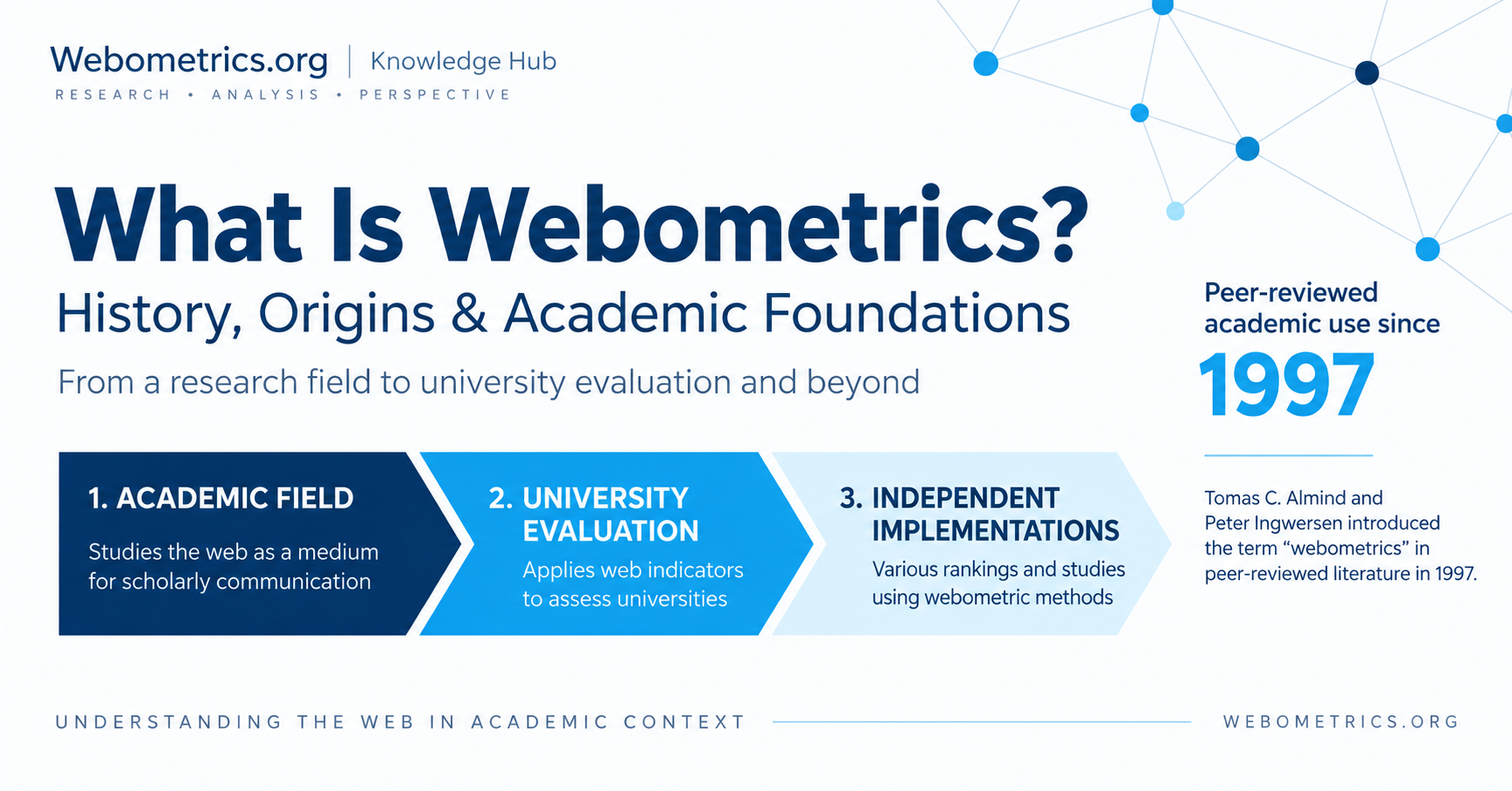
The underlying approach belongs to a defined academic field. Webometrics, in the scholarly sense, was formally outlined by Lennart Björneborn and Peter Ingwersen in 2004 as the study of "the construction and use of information resources, structures and technologies on the Web," applying methods drawn from bibliometrics and informetrics to web content, web link structure, and web usage. That distinction is useful for readers evaluating any web-based ranking: a webometric indicator describes something that can be directly observed on the open web at a given point in time — a link, an indexed page, a published dataset, a technical characteristic of a site — rather than something collected through a reputation survey or a self-reported institutional submission.
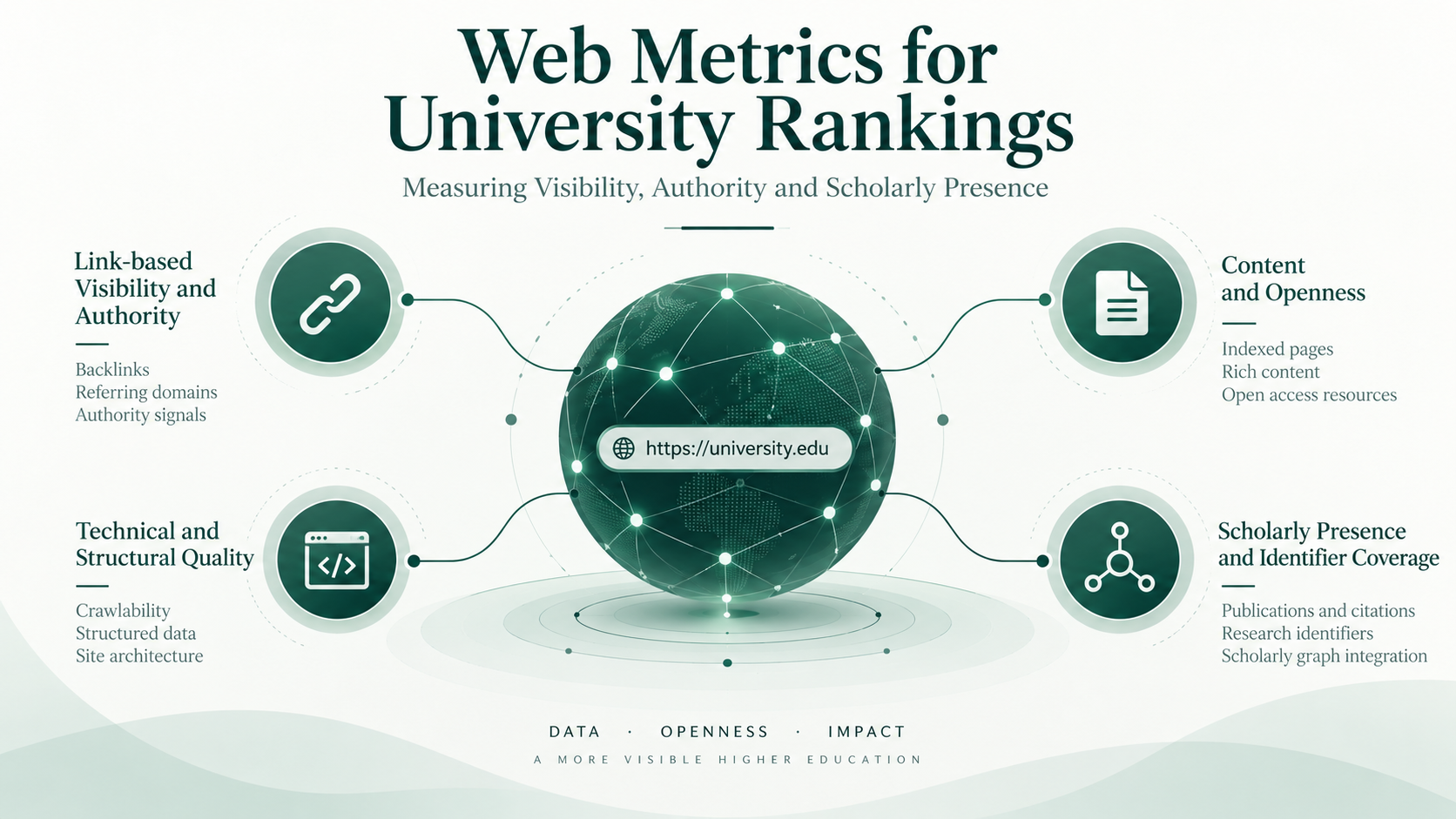
Webometrics organizes its web-based observations into three principal indicators. Each is built from a set of named sub-indicators, described below using the terms published in the current methodology.
Impact: Digital Visibility, Authority, Reach and Global Influence
Impact measures how strongly an institution is present and recognized across the wider digital ecosystem — not simply whether it publishes information online, but whether that information can be discovered, referenced, reached, and engaged with by audiences beyond the institution itself.
| Named indicator | What it covers |
|---|---|
| Web Visibility | Overall institutional web visibility, including official domains, faculties and academic units, important institutional sections, and academic resources; geographic and international visibility; institutional discoverability. |
| Search Presence | Search-engine visibility; indexed institutional presence; branded and relevant non-branded visibility; academic-content discoverability; institutional entity recognition; international and multilingual search visibility. |
| Web Authority & External Recognition | External references and referring websites; diversity and relevance of referring sources; academic, government, and educational references; media references; international references. |
| Digital Reach | Website reach and audience visibility; digital demand; geographic distribution; international audiences; content consumption and engagement patterns. |
| Social Presence & Influence | Verified institutional presence on social platforms; audience reach; publishing activity; engagement and community interaction; institutional mentions; multimedia reach; cross-platform presence. |
| Online Reputation & Digital Recognition | Independent mentions; news and media coverage; academic, government, and educational references; authoritative directories and knowledge platforms; institutional entity references. |
| Global & Multilingual Presence | International web visibility and recognition; geographic diversity; multilingual digital presence; cross-border academic visibility. |
| Distributed & Multimedia Presence | Video and audio content, podcasts, digital publications, presentations, recorded lectures, and other institutional multimedia channels, where reliably attributable to the institution. |
Webometrics states explicitly that raw volume alone does not determine an institution’s Impact score: signals that are artificial, repetitive, manipulated, anomalous, or otherwise unreliable may be normalized, discounted, capped, or excluded. In practice, this means Impact should not be read as a proxy for website traffic, and a single link-building or social-media tactic should not be assumed to move the indicator on its own — the current methodology does not confirm any single tactic as a determinant of the score.
Openness: Accessible Knowledge, Discoverability and Public Digital Access
Openness measures how effectively an institution makes its knowledge, information, and digital resources publicly available, accessible, and discoverable.
| Named indicator | What it covers |
|---|---|
| Institutional Digital Content | Institutional information, academic programs, faculties and departments, news and events, articles and publications, educational resources, public reports and documents. |
| Academic & Research Web Presence | Institutional repositories; research portals and centers; research projects; scholarly publications; researcher profiles; faculty academic presence; open-access resources; conference materials. |
| Open Knowledge | Open-access scholarly works; institutional repositories; open educational resources; public research outputs and datasets; academic documents and reports. |
| Accessibility & Digital Inclusion | Digital and content accessibility; semantic structure; navigation accessibility; mobile access and device compatibility; language accessibility; inclusive access to institutional information. |
| Public Digital Services & Interaction | Admissions and application information; academic and student information services; public inquiry systems; communication tools; online learning resources; public support services. |
| Discoverability & Indexability | Public discoverability and indexability; information architecture; resource accessibility; institutional content organization. |
It is worth being precise about scope here, because "openness" is also a much broader term in higher-education policy. UNESCO’s Recommendation on Open Science describes open science as a set of principles and practices intended to make scientific research "accessible to everyone" while being produced in an "inclusive, equitable and sustainable" way, built around values that include quality and integrity, collective benefit, equity and fairness, and diversity and inclusiveness. That is a policy and values framework spanning research culture, funding, infrastructure, and international cooperation. Webometrics’ Openness indicator is narrower and specifically observable: it measures whether an institution’s knowledge and digital resources are actually exposed, structured, and reachable on the open web at the time of measurement. A university can advance open-science policy in ways that are not fully captured by web-based observation, and conversely, a well-indexed, highly discoverable website is evidence of effective digital openness, not a complete assessment of an institution’s research-openness culture. The two concepts are related but should not be treated as interchangeable when interpreting a ranking result.
Where scholarly presence specifically is being assessed, UNIRANKS Open Index (OI) can contribute research intelligence used to identify, validate, and understand scholarly digital resources. OI and Webometrics remain distinct systems: OI provides research intelligence, while Webometrics evaluates digital presence and web influence.
Excellence: Academic, Research and Digital Quality
Excellence measures the quality and strength of an institution’s scholarly and technical digital presence, combining scholarly excellence with digital and technical excellence.
| Named indicator | What it covers |
|---|---|
| Research Excellence | Scholarly output; research influence and visibility; highly influential research; academic recognition; researcher contributions; institutional research strength. |
| Scholarly Digital Influence | Academic recognition; scholarly references; research visibility and authority; connections between institutions, researchers, and scholarly works. |
| Website Quality & User Experience | Information architecture; navigation; mobile usability; responsive presentation; content organization; page experience; availability of essential institutional information. |
| Technical Web Quality | Crawlability; technical accessibility; web standards; website structure; resource availability; mobile compatibility; structured information; technical consistency. |
| Performance & Reliability | Loading performance; responsiveness; resource efficiency; website availability and reliability; mobile performance; delivery performance. |
| Security & Trust | Secure connections; certificate characteristics; secure web delivery; domain consistency; technical trust; infrastructure integrity. |
Webometrics states plainly that it evaluates publicly observable security and technical characteristics only — it does not perform intrusive penetration testing and does not access restricted institutional infrastructure or private systems. This is a meaningful boundary for readers to understand: the Security & Trust component of Excellence reflects what is visible from outside an institution’s network, not a full security audit.
Because Excellence blends scholarly signals with technical-quality signals, a lower Excellence rank does not mean an institution’s research is weak. It may instead reflect technical-quality factors — site performance, structural consistency, or security configuration — that are separate from research strength but combined within this single indicator. Readers who want to isolate research-specific performance should look at Research Excellence and Scholarly Digital Influence rather than the Excellence indicator as a whole, while recognizing that Webometrics does not publish a further breakdown of these named indicators individually within the public ranking.
How the Three Indicators Relate to Each Other
Impact, Openness, and Excellence measure different aspects of institutional digital performance, and an institution can perform strongly in one and less strongly in another. Publishing three separate indicator ranks, alongside an overall World Rank, gives a clearer picture than a single undifferentiated score would.
- Impact asks: how visible, recognized, connected, and influential is the institution across the web?
- Openness asks: how accessible, discoverable, and publicly available are its knowledge and digital resources?
- Excellence asks: how strong is the academic, research, and technical quality of its digital presence?
The current Webometrics methodology does not publish numeric weights, exact scoring formulas, internal thresholds, or signal-level details for how these indicators are calculated or combined, stating that this information is deliberately reserved to reduce the risk that the ranking could be reverse-engineered or manipulated. A previously circulated description of the methodology referenced specific percentage weights for the three indicators; that description is not part of the current, live methodology and should not be treated as current fact. Readers should rely on the published indicator ranks themselves rather than an assumed arithmetic formula.
Beyond the public ranking, UNIRANKS Growth Intelligence (GI) provides authorized institutions with deeper analytics, historical intelligence, benchmarking, and recommendations drawn from the same broader categories of visibility, search, content, technical, social, and reputation signals — but these detailed, institution-specific views are intentionally kept separate from the public ranking itself. Access to Growth Intelligence does not purchase or guarantee a higher Webometrics position; rankings remain based on the applicable methodology and validated measurement data.
Why These Indicators Matter for Universities
For university leadership and communications teams, Impact reflects much of what an external-relations and global-outreach strategy already aims to achieve — recognition from academic, governmental, and media sources — expressed as an observable, comparable indicator rather than an internal impression. For library, repository, and research-office teams, Openness connects directly to decisions about which institutional content is published in indexable form, how research repositories are structured, and how discoverable public-facing academic resources actually are. For research offices and IT teams jointly, Excellence spans both scholarly output visibility and the technical condition of the institution’s own web infrastructure — crawlability, performance, and security posture among them.
None of this should be read as a promise that a specific technical or communications change will move an institution’s position in the ranking by a predictable amount. The indicators describe observable digital-presence characteristics; they are not levers with a guaranteed, quantified effect, and Webometrics does not publish tactical, step-by-step instructions for improving a ranking position.
What the Indicators Do Not Tell You
Each indicator has a defined, bounded scope, and it is worth being explicit about what falls outside it.
None of the three indicators measures teaching quality, curriculum design, student outcomes, or in-person campus experience directly; these require different kinds of evidence, such as accreditation records, outcome data, or survey instruments designed for that purpose. A comparatively lower score on one indicator does not mean an institution performs poorly overall, since each indicator captures only one dimension of digital presence. Nor is the absence of a measurable signal automatically evidence of weak institutional performance: Webometrics notes that data coverage varies across countries, platforms, and data sources, and that missing or insufficient data is treated differently from a confirmed zero value. Finally, because institutions operate in substantially different digital environments — internet penetration, language, national search markets, and platform adoption all vary — Webometrics applies normalization intended to support meaningful global comparison rather than simply rewarding the institution with the largest raw numbers; even so, no set of web-based indicators fully removes the underlying structural differences between digital environments.
Frequently Asked Questions
Do Impact, Openness, and Excellence have published percentage weights?
No. The current Webometrics methodology does not publish numeric weights for the three indicators. An institution’s position depends on its performance across many underlying signals within each indicator, combined through a methodology that deliberately does not disclose exact scoring formulas.
Does a high Impact rank mean a university receives a lot of website traffic?
Not directly. Impact measures digital visibility, authority, reach, and recognition across multiple named indicators — including search presence, external recognition, and social presence — rather than website traffic volume alone, and Webometrics normalizes or discounts signals it identifies as artificial or unreliable.
Is a strong Excellence rank the same as a strong global academic reputation?
No. Excellence combines scholarly signals (research output, visibility, and influence) with technical signals (website quality, technical standards, performance, and security). A reputation survey and an Excellence rank measure related but distinct things.
Is Webometrics’ Openness indicator the same as "open science"?
They are related but not identical. Open science, as described in UNESCO’s Recommendation on Open Science, is a broader set of values and practices spanning research culture and policy. Webometrics’ Openness indicator specifically measures whether an institution’s knowledge and digital resources are observably accessible and discoverable on the open web.
How often does Webometrics update these indicators?
Webometrics describes itself as an evolving methodology; UNIRANKS may periodically introduce new digital indicators, retire obsolete measurements, or refine data sources and normalization between editions. The current published edition referenced in this article is July 2026.
Where can a university see its own Impact, Openness, and Excellence ranks?
These are published alongside the overall World Rank on the current Webometrics results.
Conclusion
Impact, Openness, and Excellence are Webometrics’ three published indicators, each built from a defined set of named sub-indicators and each answering a different question about an institution’s digital presence: how visible and recognized it is, how accessible and discoverable its knowledge is, and how strong its scholarly and technical digital quality is. Webometrics does not publish numeric weights for how these combine, and it reports each indicator separately, alongside an overall World Rank, so that the underlying picture — where an institution is strong, and where it is not — remains visible rather than compressed into a single number. Readers who want the fuller background on how Webometrics developed as a project can see what Webometrics is and how it evolved, and the complete indicator definitions are maintained on the current Webometrics methodology page.
Sources
- Webometrics by UNIRANKS, current methodology (edition: July 2026). webometrics.org/blog/methodology
- Björneborn, L., & Ingwersen, P. (2004). "Toward a basic framework for webometrics." Journal of the American Society for Information Science and Technology, 55(14). onlinelibrary.wiley.com/doi/10.1002/asi.20077
- UNESCO, Recommendation on Open Science. unesco.org/en/open-science/about
Suggested Citation
WEBOMETRICS by UNIRANKS (2026). What Do Impact, Openness and Excellence Mean in the Webometrics Ranking? Webometrics.org, 21 September 2026.
Related Articles