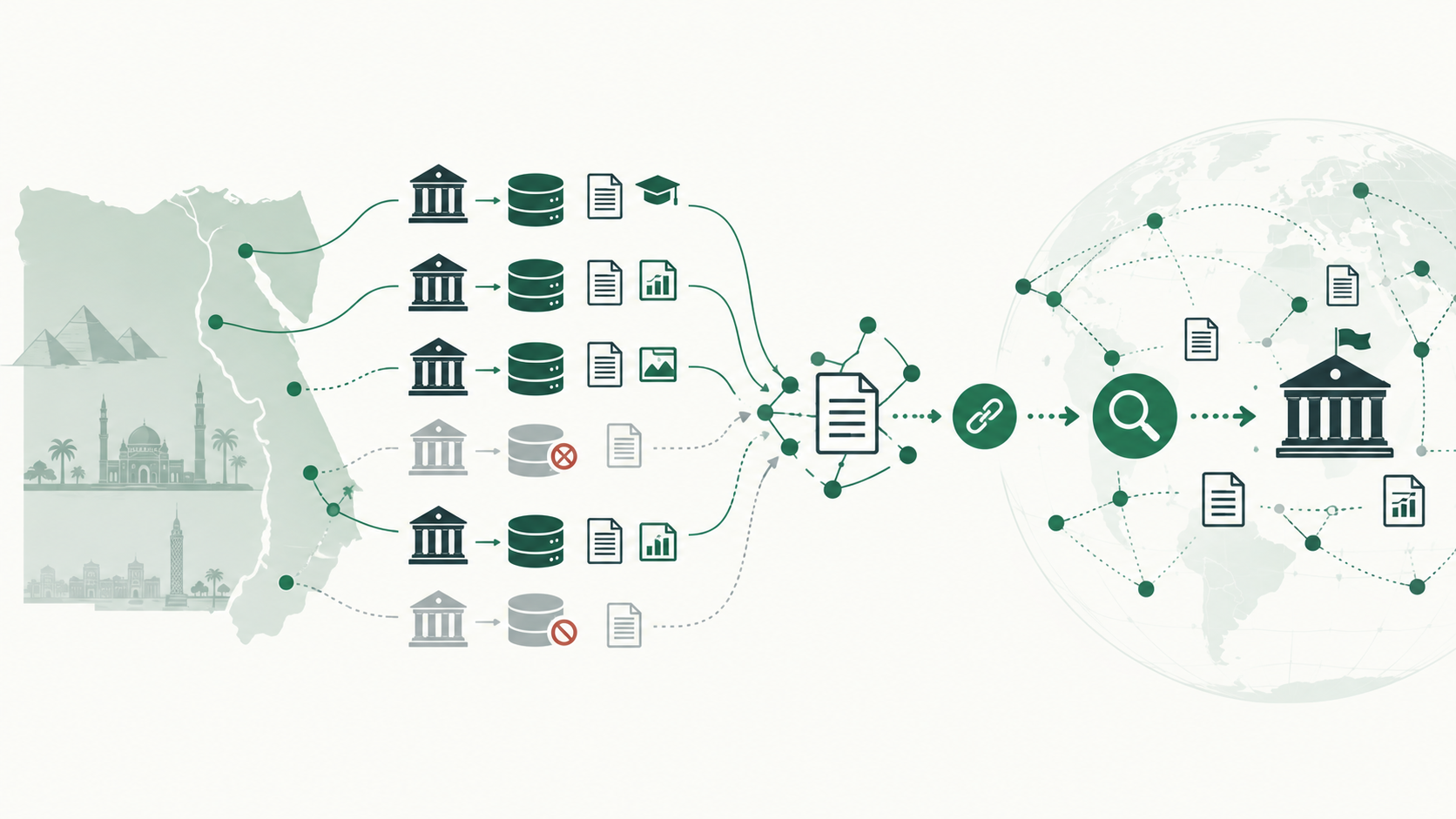
Where Does Greek University Research Data Live? A DataCite Study

Webometrics examined DataCite, the international registration agency for research data DOIs, for all 25 Greek public higher education institutions listed by the Hellenic National Academic Recognition and Information Center (DOATAP) as of 28 September 2026. Across the 25 institutions, DataCite dataset records matching an institution's name ranged from zero to 259, and five institutions accounted for 633 of the 1,047 matched records found (60.5 percent). In a closer look at the sampled records for those five largest institutions, only the University of Patras showed records registered through a Greek institutional repository infrastructure; the rest were registered almost entirely through the general purpose international repository Zenodo.
Key Findings
Webometrics searched DataCite's public API for each of the 25 DOATAP listed Greek public universities, filtering for the dataset resource type, on 28 September 2026.
- Matched dataset DOI records ranged from 0 (Athens School of Fine Arts) to 259 (Aristotle University of Thessaloniki) across the 25 institutions studied.
- Ten of the 25 institutions (40 percent) returned fewer than 10 matched dataset DOI records, including one institution with zero.
- Five institutions, Aristotle University of Thessaloniki (259), University of Patras (124), National and Kapodistrian University of Athens (92), National Technical University of Athens (81) and University of Crete (77), together accounted for 633 of the 1,047 total matched records (60.5 percent), while representing 5 of the 25 institutions studied (20 percent).
- In a detailed sample of 49 records drawn from these five largest institutions, 44 (89.8 percent) were registered through Zenodo, figshare or one specialist repository; the remaining 5, all from the University of Patras, were registered through HEAL Link's Research Data Repository, a Greek national academic library infrastructure.
- A separate query for all dataset records registered through HEAL Link's Research Data Repository, across every institution nationally, returned 51 total records on DataCite, meaning the University of Patras sample alone accounted for a meaningful share of that national total.
- Of the same 49 sampled records, 45 (91.8 percent) carried a publication year of 2025 or 2026; the remaining 4 (all from the University of the Aegean) were dated 2021. None of the 49 sampled records predated 2021.
Why This Matters for Universities
A dataset DOI is a persistent, resolvable identifier assigned to a specific research dataset, distinct from the DOI assigned to the journal article or conference paper that describes it. Depositing a dataset with a DOI is one of the ways a university can make its research data findable, citable and reusable independently of the article it may accompany, which is the practical meaning behind the FAIR data principles, Findable, Accessible, Interoperable and Reusable, now widely referenced in European research policy. Horizon Europe, the European Union's main research funding programme, requires funded projects to maintain a data management plan and states that "the research data of EU funded projects must be FAIR." Where and how a university's data DOIs are registered, through its own institutional infrastructure, a national consortium, or an international general purpose repository, is a visible, checkable signal of how that data management commitment is being carried out in practice.
Authoritative Background
DataCite is the international, non profit DOI registration agency for research outputs including datasets, software and other non textual research objects. It describes its purpose as ensuring "that research outputs and resources are openly available and connected so that their reuse can advance knowledge." Universities, libraries, national consortia and general purpose repositories such as Zenodo can each become a DataCite "client," meaning an organisation authorised to mint DOIs and attach descriptive metadata, including titles, creators, publication year, resource type and, where supplied, affiliation information.
In Greece, HEAL Link, the Hellenic Academic Libraries Link, operates a DataCite client under the symbol HEALLINK.DATAREP, described in DataCite's own client record as the "HEALLINK Research Data Repository," established as an active DataCite client in 2019 under the DOI prefix 10.26255. HEAL Link is the national consortium of Greek academic and research libraries and already supports scholarly communication infrastructure for Greek higher education, distinct from Zenodo, which is operated by CERN and accepts deposits from researchers and institutions worldwide regardless of national affiliation.
Within the Webometrics methodology, Openness measures how effectively an institution makes its knowledge, information and digital resources publicly available, accessible and discoverable, and its Academic and Research Web Presence and Open Knowledge components explicitly cover public research datasets and open access resources. Read the full explanation of what Impact, Openness and Excellence measure in the Webometrics ranking. Where scholarly presence is being assessed, UNIRANKS Open Index (OI) can contribute research intelligence as a separate, distinct analytical layer; this article does not draw on OI data and is based entirely on the original DataCite evidence collected below.
Research Question
Among Greece's 25 DOATAP listed public higher education institutions, how many dataset DOIs does DataCite show attributable to each institution, and through which registration infrastructure, an institutional or national client, or a general purpose repository, are those datasets predominantly registered?
Methodology
Collection date: 28 September 2026.
Population: All 25 Hellenic public higher education institutions (Anotata Ekpaideutika Idrymata) listed on the official register of the Hellenic National Academic Recognition and Information Center (DOATAP), the Greek government body responsible for recognizing higher education qualifications. This list was cross checked against the Wikipedia list of universities in Greece for name consistency; no institution or figure in this article is drawn from Wikipedia alone. This is a census of the defined population, not a sample of it.
Data source: DataCite's public REST API (api.datacite.org/dois), queried directly by this research session.
Search method: For each institution, Webometrics submitted an unqualified, quoted full text query for the institution's official English language name, filtered to the dataset resource type, and recorded the total match count returned in the API's own metadata. For the five institutions with the highest match counts, Webometrics additionally retrieved the first 9 or 10 individual records to inspect each record's registering DataCite client and publication year.
Variables recorded: total matched dataset DOI count per institution; registering DataCite client (institutional, national or general purpose) for the sampled records of the five largest institutions; publication year for the same sampled records; and, as a national comparison point, the total dataset record count registered through HEAL Link's Research Data Repository client across all institutions combined.
Why a full text query rather than a structured affiliation identifier query: DataCite's metadata schema allows a dataset record to carry a structured, Research Organization Registry (ROR) linked affiliation identifier for each creator. Webometrics attempted to query this structured field directly. During testing, these field qualified queries did not filter the result set as expected; two consecutive calls using the same field qualified query returned inconsistent, extremely large totals that matched the platform wide total for all DataCite records rather than a filtered count, indicating the query was not being applied by the API in this session. Because this could not be resolved reliably, Webometrics used DataCite's general, unqualified query field instead, which returned consistent, plausible totals when tested and re tested. This is disclosed as a methodological limitation below.
Limitations:
- The unqualified full text query can produce false positives and false negatives, for example where an institution's name appears in unrelated text, or where a record uses a Greek language name, an acronym or a department level name instead of the full official English name.
- Because the study could not reliably query DataCite's structured, ROR linked affiliation identifier field, it cannot report what share of each institution's dataset records carry a machine validated affiliation identifier, only which DataCite client registered the sampled records, a related but different piece of metadata.
- The registering client and publication year were inspected only for a sample of 54 records concentrated in the six institutions with the highest match counts, not for all 1,047 matched records across all 25 institutions.
- DataCite's index changes continuously; two nearly simultaneous platform wide total queries made during this session returned different totals seconds apart, confirming the figures in this article reflect a snapshot taken on 28 September 2026.
- This study covers DataCite registered datasets only. Research data deposited without a DOI, registered through Crossref, or held in a repository without persistent identifiers is outside the scope of this study.
- A DataCite dataset DOI count measures registered, attributable data publication activity. It is not a measure of the volume or quality of research a university conducts, and it is not a Webometrics ranking indicator in itself.
Results
Table 1 shows the matched dataset DOI record count for each of the 25 institutions studied.
| Institution | Matched dataset DOI records |
|---|---|
| Aristotle University of Thessaloniki | 259 |
| University of Patras | 124 |
| National and Kapodistrian University of Athens | 92 |
| National Technical University of Athens | 81 |
| University of Crete | 77 |
| University of the Aegean | 73 |
| Agricultural University of Athens | 64 |
| University of Thessaly | 46 |
| University of Ioannina | 41 |
| University of West Attica | 37 |
| International Hellenic University | 30 |
| University of Macedonia | 30 |
| University of Piraeus | 19 |
| University of Western Macedonia | 20 |
| Democritus University of Thrace | 14 |
| Athens University of Economics and Business | 9 |
| Hellenic Open University | 7 |
| Technical University of Crete | 7 |
| Hellenic Mediterranean University | 4 |
| Ionian University | 3 |
| Panteion University of Social and Political Sciences | 3 |
| University of Peloponnese | 3 |
| Harokopio University of Athens | 2 |
| School of Pedagogical and Technological Education | 2 |
| Athens School of Fine Arts | 0 |
Table 2 shows the registration infrastructure found in the sampled records of the six institutions inspected in detail.
| Institution | Records sampled | Via HEAL Link (institutional/national) | Via Zenodo, figshare or other |
|---|---|---|---|
| Aristotle University of Thessaloniki | 5 | 0 | 5 |
| University of Patras | 9 | 5 | 4 |
| National and Kapodistrian University of Athens | 10 | 0 | 10 |
| National Technical University of Athens | 10 | 0 | 10 |
| University of Crete | 10 | 0 | 10 |
| University of the Aegean | 10 | 0 | 10 |
| Total sampled | 54 | 5 (9.3%) | 49 (90.7%) |
Analysis
The concentration shown in Table 1 is consistent with a pattern Webometrics has observed in other national studies of digital and scholarly infrastructure: a small number of research intensive institutions account for a disproportionate share of measurable activity, while a substantial share of the population, in this case 10 of 25 institutions, shows minimal or no matched dataset DOI activity under this search method. This does not mean the other 15 institutions produce no research data. It means that, under this study's search method and on this collection date, DataCite does not return a dataset DOI record whose text matches their full institutional name in meaningful volume. Some of the lower counts likely reflect institutional scale and disciplinary mix; several of the lowest count institutions are specialized in fine arts, pedagogical and technical teacher education, or social and political sciences, fields where dataset deposition is less established practice than in the natural and technical sciences that dominate the highest count institutions.
The registration infrastructure finding in Table 2 is a more specific and, within the Webometrics inventory, a new kind of observation. Among the institutions inspected in detail, only the University of Patras showed sampled records registered through Greece's own academic library consortium infrastructure, HEAL Link's Research Data Repository. The others, including Aristotle University of Thessaloniki and National and Kapodistrian University of Athens, showed sampled records registered exclusively through Zenodo, an international, CERN operated, general purpose repository that accepts deposits from any researcher worldwide, or, in one case at the National Technical University of Athens, figshare, a commercial general purpose repository. This suggests that, for most of the largest Greek research universities studied, the practical routing of dataset DOI registration, at least among the records sampled, currently runs through international general purpose infrastructure rather than a Greek national one, even though a national alternative operated by HEAL Link exists and is actively registering DOIs.
The national total of 51 dataset records registered through HEAL Link's Research Data Repository, set against the University of Patras sample alone showing 5 of 9 records through that same client, indicates the University of Patras is not a marginal user of that infrastructure. Whether other Greek institutions with lower overall dataset counts are using HEAL Link's infrastructure more, proportionally, than the largest institutions sampled here is a question this study's sample size cannot answer, and is flagged as a follow up opportunity below.
The publication year finding, 45 of 49 sampled records dated 2025 or 2026, together with HEAL Link's Research Data Repository having become an active DataCite client only in 2019, is consistent with dataset DOI registration being a comparatively recent and still developing practice among the Greek public universities studied, rather than a long established one. This is an observation about registration activity visible to this study, not a claim about when Greek universities began producing research data.
Implications for Higher Education
For Greek university research offices, library staff and open science officers, these findings offer a concrete external check on data management practice: whether a search of the kind performed in this study returns dataset DOI records under the institution's name, and if so, through which infrastructure. Where an institution's data management plans commit to depositing research data in a trusted repository, as Horizon Europe requires of EU funded projects, this study offers one way to verify, externally, that deposits carrying the institution's name are visible in DataCite's public index and to see which registration route colleagues are actually using in practice.
For HEAL Link and Greek research policy makers more broadly, the gap between the national infrastructure's modest total of 51 records across all institutions and the far larger number of Zenodo hosted records attributable to individual universities is a specific, checkable data point for discussing where national research data infrastructure is, and is not yet, the default choice for Greek researchers depositing data with a DOI.
Recommended Actions
Webometrics does not promise that any specific action will improve a university's Webometrics ranking, search visibility or AI citation rate. The following are evidence supported observations, not guarantees.
- Research offices can periodically query DataCite directly for their own institution's name, in the way this study did, to see what a public, automated search currently returns, and compare it with their own internal record of deposited datasets.
- Where an institution deposits data through Zenodo or another general purpose repository, adding a complete, correctly spelled institutional affiliation, and where possible a ROR identifier, to each creator record improves the chance that future, more targeted searches of DataCite's structured metadata will correctly attribute that dataset.
- Where a national or institutional repository infrastructure exists, as it does through HEAL Link in Greece, research offices may wish to understand why researchers are, or are not, using it relative to international alternatives, as a factual input to institutional data management planning, independent of any Webometrics ranking consideration.
Limitations
The limitations set out in the Methodology section apply to every figure in this article. In summary: the study used an unqualified text search rather than a validated structured affiliation query, due to a field qualified query reliability problem encountered and disclosed during this session; it sampled registration infrastructure and publication year for 54 records out of 1,047 total matches, concentrated in the six institutions with the highest overall counts; and it measures DataCite registered dataset DOIs only, not the full universe of Greek university research data.
Conclusion
Across Greece's 25 DOATAP listed public higher education institutions, DataCite shows a wide and concentrated range of matched dataset DOI records, from zero to 259, with five institutions accounting for 60.5 percent of all matches found. Within the largest institutions sampled in detail, dataset DOI registration currently runs mostly through the international general purpose repository Zenodo rather than Greece's own HEAL Link infrastructure, with the University of Patras as the one clear exception among the institutions studied in depth. As Greek universities continue to implement the FAIR data commitments attached to EU funded research, this snapshot offers a documented, dated baseline against which later observations, by Webometrics or by Greek institutions themselves, can be compared.
Explore the current Webometrics university rankings for Greece, based on the July 2026, 2nd Edition Final results, for the full set of Impact, Openness and Excellence ranks across all 67 ranked Greek institutions.
Frequently Asked Questions
What is a dataset DOI?
A dataset DOI is a persistent digital identifier, in the same family as the DOI assigned to a journal article, but assigned specifically to a research dataset, so that the dataset itself can be found, cited and linked to independently of any paper that describes it.
Does a low dataset DOI count mean a university produces little research?
No. This study measures DataCite registered, attributable dataset DOI records that matched an institution's name in a specific search on a specific date. It does not measure the volume, quality or scholarly value of a university's overall research output, and coverage varies by discipline, by how consistently an institution's name is entered in metadata, and by which repositories researchers in different fields typically use.
What is HEAL Link?
HEAL Link, the Hellenic Academic Libraries Link, is the national consortium of Greek academic and research libraries. It operates its own DataCite client, the HEAL Link Research Data Repository, which allows Greek institutions to register dataset DOIs through national rather than solely international infrastructure.
Does this study reflect the Webometrics Openness indicator score for any Greek university?
No. Webometrics does not disclose numeric indicator weights or a scoring formula, and this article does not calculate or report an Openness score for any institution. It presents original, independently collected evidence about one specific, observable signal, dataset DOI registration, that relates conceptually to the kind of open, discoverable research presence the Openness indicator's published sub indicators describe.
Sources
- DataCite REST API, api.datacite.org/dois, queried directly by Webometrics, 28 September 2026.
- DataCite, self description and mission statement, datacite.org.
- European Commission, Research Executive Agency, "Open Science" requirements for Horizon Europe, rea.ec.europa.eu/open-science_en.
- Hellenic National Academic Recognition and Information Center (DOATAP), official list of Hellenic higher education institutions, doatap.gr.
- re3data.org, registry record for the Hellenic Academic Research Data Repository, re3data.org.
- Webometrics by UNIRANKS, current methodology, webometrics.org/methodology.
Suggested citation: Webometrics by UNIRANKS (2026). "Where Does Greek University Research Data Live? A Webometrics DataCite Study of Dataset DOIs." Webometrics.org, 28 September 2026.
Universities seeking to better understand their Webometrics results, institutional digital visibility, research presence or data profile may contact the Webometrics and UNIRANKS Support Team for institutional support and engagement options.