Are U.S. Public University Homepages Ready for the 2027 Accessibility Deadline? A Webometrics Signal Study of 17 Institutions
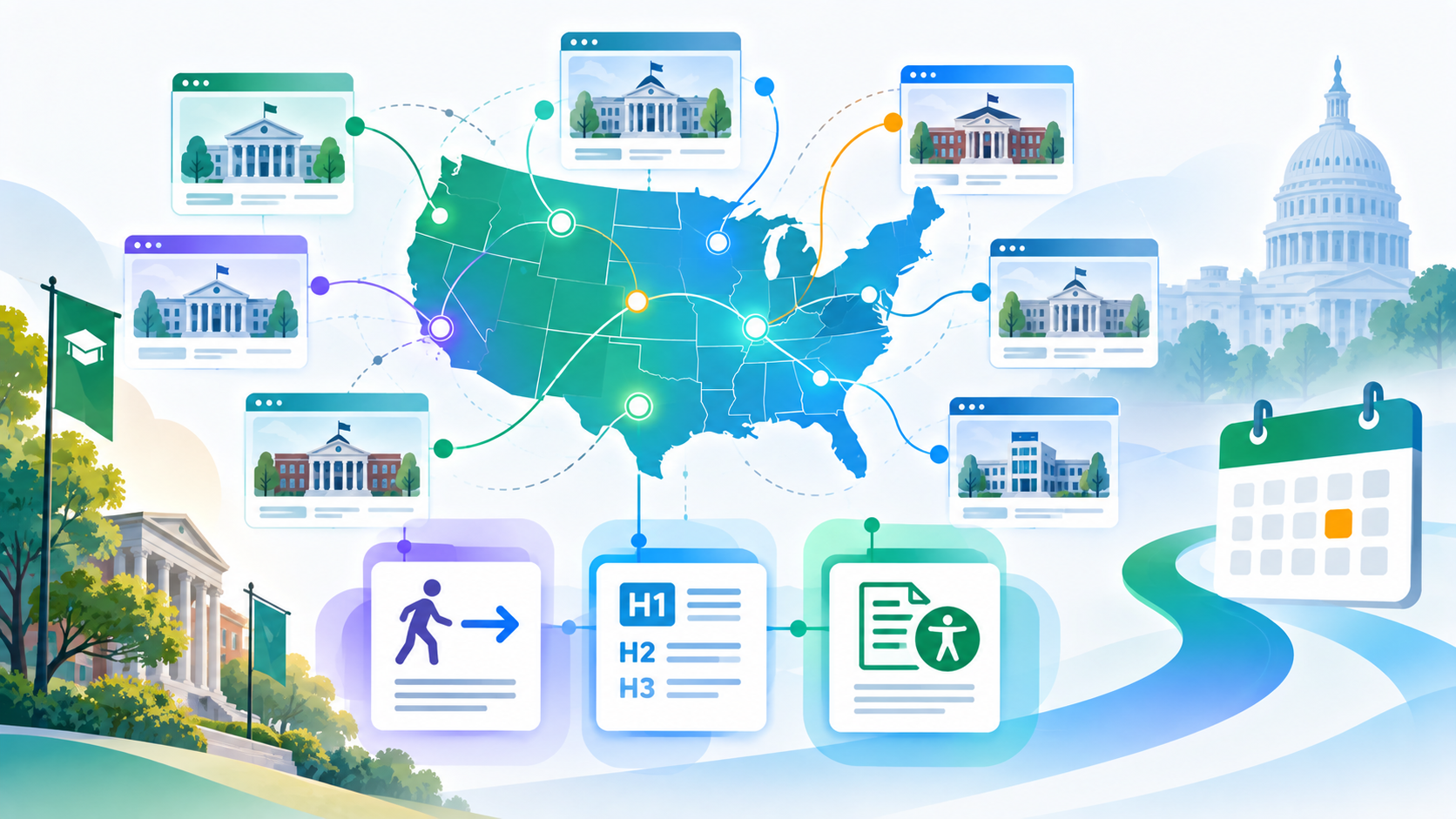
On 10 September 2026, the World Wide Web Consortium’s Web Accessibility Initiative (W3C/WAI) updated the WCAG 3.0 Working Draft, still a pre-Recommendation document with open questions on its conformance model. That update arrives as a separate, binding deadline draws closer: under a U.S. Department of Justice Interim Final Rule published in the Federal Register on 20 April 2026, large public entities — a threshold that covers nearly all U.S. public universities — must bring their websites, mobile apps, and digital course materials into conformance with WCAG 2.1 Level AA by 26 April 2027, now roughly nineteen months away. Webometrics examined the public homepages of 17 U.S. public universities on 21 September 2026 for three baseline, directly observable accessibility signals: the presence of a skip-navigation link, the number and coherence of H1 heading elements, and whether a link to an accessibility statement or policy was discoverable on the page. The sample was drawn systematically, one flagship public university from every third U.S. state in alphabetical order. A skip-navigation link was present on 14 of 17 homepages (82%) and an accessibility statement link was discoverable on 15 of 17 (88%). Heading structure was less consistent: only 9 of 17 homepages (53%) used a single H1 element, 7 of 17 (41%) exposed two or more H1 elements, and 1 of 17 (6%) exposed none. This is not a formal WCAG 2.1 AA conformance audit; it is a narrow, reproducible signal check intended to establish a baseline ahead of the 2027 deadline.
Key Findings
- 14 of 17 sampled U.S. public university homepages (82%) had a detectable skip-navigation or “skip to content” link near the top of the page on 21 September 2026.
- 15 of 17 homepages (88%) had a discoverable link to an accessibility statement, accessibility policy, or digital-accessibility office page, typically located in the site footer.
- Only 9 of 17 homepages (53%) used a single, unambiguous H1 heading element; 7 of 17 (41%) exposed two or more H1 elements on the same page, and 1 of 17 (6%) exposed no H1 element at all.
- Only one institution in the sample, the University of Georgia, lacked both a detectable skip-navigation link and a discoverable accessibility statement link at the time of collection.
- Multiple-H1 structures were not confined to any one type of institution in this sample: they appeared on homepages ranging from large research universities (the University of Michigan, the University of Texas at Austin) to smaller state-system flagships (the University of New Mexico, the University of North Dakota).
Why This Matters for Universities
A skip-navigation link, a coherent heading structure, and a discoverable accessibility statement are three of the least technically demanding accessibility practices a website can implement, and none requires the kind of specialized testing (contrast-ratio analysis, keyboard-navigation walkthroughs, screen-reader evaluation) that a full WCAG 2.1 AA conformance review involves. A skip link lets keyboard and screen-reader users bypass repeated navigation menus and reach the main content directly, a practice with a long history in accessibility guidance. A page’s heading structure functions as its outline for assistive technology: screen-reader users frequently navigate by jumping between headings, and a page with zero H1 elements, or several H1 elements with no clear hierarchy beneath them, removes or muddies that outline. An accessibility statement does not by itself demonstrate conformance, but its presence and prominence is one visible indicator of whether an institution has assigned clear ownership and public accountability for its accessibility program. None of these three signals is, by itself, evidence of WCAG 2.1 AA conformance or non-conformance; they are structural indicators that a fuller audit would need to build on.
Authoritative Background
The W3C Accessibility Guidelines (WCAG) 3.0 Working Draft was updated on 10 September 2026. It remains a Working Draft — the pre-Recommendation stage of the W3C process — and W3C/WAI’s own announcement points to a list of specific changes in the September 2026 draft and to open “review questions on the conformance model,” while inviting public feedback by email to the WAI mailing list or via GitHub. WCAG 3.0 is not yet a finished standard and does not replace WCAG 2.1, which remains the technical standard referenced in current regulation.
That regulation is the more immediately consequential development. The U.S. Department of Justice’s original 2024 final rule under Title II of the Americans with Disabilities Act required state and local government entities, including public universities, to make their web content and mobile applications conform to WCAG 2.1 Level AA. On 20 April 2026, DOJ published an Interim Final Rule in the Federal Register extending the compliance timeline it had set in 2024: entities serving a population of 50,000 or more — a threshold that covers nearly all U.S. public universities — now have until 26 April 2027 to conform; smaller public entities and special district governments have until 26 April 2028. The underlying WCAG 2.1 Level AA obligation was not removed or altered by this rule; only the compliance dates were extended. DOJ’s stated reasons for the extension cited resource and staffing constraints among covered entities and slower-than-expected progress in automated accessibility-remediation tools.
Webometrics has not previously published a study examining university website accessibility as a technical-infrastructure variable. Prior Webometrics technical studies have examined AI-crawler access via robots.txt, CDN and DNS routing, and multilingual URL architecture; accessibility is a distinct evidence layer from any of these.
Research Question
As the WCAG 2.1 AA compliance deadline for large U.S. public entities under DOJ’s amended ADA Title II rule approaches (26 April 2027), do the public homepages of a systematically sampled set of U.S. public universities already display three baseline, non-invasive accessibility signals: a skip-navigation link, a single coherent H1 heading structure, and a discoverable accessibility statement link?
Methodology
Collection date: 21 September 2026, a single point-in-time snapshot.
Population: the primary public flagship research university of each of the 50 U.S. states.
Sampling procedure: the 50 U.S. states were ordered alphabetically (Alabama through Wyoming) and numbered 1 through 50. Every third state was selected beginning with position 1 (positions 1, 4, 7, 10, 13, 16, 19, 22, 25, 28, 31, 34, 37, 40, 43, 46, and 49), producing a systematic sample of 17 states: Alabama, Arkansas, Connecticut, Georgia, Illinois, Kansas, Maine, Michigan, Missouri, Nevada, New Mexico, North Dakota, Oregon, South Carolina, Texas, Virginia, and Wisconsin. For each selected state, the state’s primary public flagship research university was identified and its main public homepage was used as the unit of observation. This procedure was fixed before any homepage was inspected, to avoid selecting institutions based on an expected result.
Sample size: 17 institutions (34% of U.S. states).
Inclusion rule: one institution per selected state; the institution’s primary public .edu homepage, not a subsite, department page, or admissions microsite.
Exclusion rule: none applied; all 17 selected institutions’ homepages were reachable and inspected on the collection date.
Variables observed:
- Presence of a skip-navigation or “skip to content” link positioned near the top of the page’s content.
- The number of H1 heading elements present on the homepage, and whether they formed a single, coherent top-level heading.
- Whether a link to an accessibility statement, accessibility policy, or digital-accessibility office page was discoverable in the page’s header, primary navigation, or footer.
Evidence source: each institution’s homepage was retrieved and its rendered content and structure inspected directly on 21 September 2026.
Analysis approach: descriptive tabulation and cross-tabulation of the three variables across the sample. No inferential statistical testing was applied given the sample size, and no causal claims are made.
Limitations: this is not a WCAG 2.1 AA conformance audit. The DOJ rule and WCAG 2.1 AA cover a substantially broader set of requirements, including color contrast, keyboard operability, form-field labeling, captioning, and full alternative-text coverage for meaningful images, none of which this study measured. The content-retrieval method used in this study reliably surfaces link text and heading-tag structure but could not reliably verify finer, attribute-level technical details across the full sample, including the HTML “lang” attribute on the document root, complete image alternative-text coverage, or ARIA landmark-role attributes; these variables are flagged below as a named follow-up requiring direct page-source retrieval tooling rather than reported as inconclusive findings. The sample is limited to 17 of 50 U.S. state flagship public universities and does not include non-flagship public institutions, community colleges, private universities, or public universities outside the United States; findings should not be generalized beyond the sample examined. Only the homepage of each institution was inspected; internal pages, admissions portals, learning-management systems, and course materials — all of which are separately covered by the DOJ rule — were not assessed. Websites are dynamic and may have changed since the 21 September 2026 collection date.
Results
| University | State | Homepage | Skip-navigation link | H1 elements observed | Accessibility statement link discoverable |
|---|---|---|---|---|---|
| University of Alabama | Alabama | ua.edu | Yes | 2 (duplicate text) | Yes |
| University of Arkansas | Arkansas | uark.edu | Yes | 4 (distinct) | Yes |
| University of Connecticut | Connecticut | uconn.edu | Yes | 1 | Yes |
| University of Georgia | Georgia | uga.edu | No | 1 | No |
| University of Illinois Urbana-Champaign | Illinois | illinois.edu | No | 1 | Yes |
| University of Kansas | Kansas | ku.edu | Yes | 1 | Yes |
| University of Maine System | Maine | maine.edu | No | 1 | Yes |
| University of Michigan | Michigan | umich.edu | Yes | 2 (duplicate text) | No |
| University of Missouri | Missouri | missouri.edu | Yes | 1 | Yes |
| University of Nevada, Reno | Nevada | unr.edu | Yes | 2 (duplicate text) | Yes |
| University of New Mexico | New Mexico | unm.edu | Yes | 2 (distinct) | Yes |
| University of North Dakota | North Dakota | und.edu | Yes | 2 (distinct) | Yes |
| University of Oregon | Oregon | uoregon.edu | Yes | 1 | Yes |
| University of South Carolina | South Carolina | sc.edu | Yes | 0 | Yes |
| University of Texas at Austin | Texas | utexas.edu | Yes | 2 (duplicate text) | Yes |
| University of Virginia | Virginia | virginia.edu | Yes | 1 | Yes |
| University of Wisconsin–Madison | Wisconsin | wisc.edu | Yes | 1 | Yes |
Summary: 14 of 17 homepages (82%) had a detectable skip-navigation link; 15 of 17 (88%) had a discoverable accessibility statement link; 9 of 17 (53%) used a single H1 element, 7 of 17 (41%) used two or more, and 1 of 17 (6%) used none.
Analysis
The two link-based signals — skip navigation and a discoverable accessibility statement — were present at broadly similar, high rates across the sample (82% and 88% respectively), suggesting that most of the sampled institutions’ web teams have already implemented at least a baseline navigational accommodation and have designated a public point of reference for accessibility policy or complaints. Only one institution in the sample, the University of Georgia, lacked both signals at the time of collection.
Heading structure showed a different pattern. A well-formed page typically uses exactly one H1 element to identify its primary subject, with H2 and lower-level headings organizing the content beneath it. In this sample, just over half of homepages (53%) followed that pattern. Close to two in five (41%) exposed multiple H1 elements, in most cases because a homepage template renders several distinct hero or section headings — such as Arkansas’s four separate H1-level statements across its scrolling homepage sections — each marked as a top-level heading rather than a subordinate one. One homepage, the University of South Carolina’s, used no H1 element at all at the time of collection, structuring its main sections with H2 headings only. Because heading structure is generated by a site’s underlying template or content-management system rather than configured page by page, an inconsistency observed on the homepage is plausibly, though not confirmed by this study to be, present across other pages built on the same template; this is a hypothesis for future research rather than an observed finding.
The unevenness in heading structure, set against comparatively strong performance on the two link-based signals, is consistent with an interpretation that accessibility-specific policy commitments (publishing a statement, designating a mechanism, adding a skip link, all of which tend to originate from an institution’s accessibility office or a compliance-driven initiative) have reached most of the sampled institutions, while more granular front-end implementation details governed by day-to-day web-development and content-authoring practice, such as heading-tag usage, are less consistently standardized. This is a Webometrics interpretation of the observed pattern, not a claim about any institution’s internal processes, which this study did not examine.
University Examples
The University of Illinois Urbana-Champaign’s homepage lacked a detectable skip-navigation link at the time of collection but linked to an “Accessibility” page from both its primary navigation and its footer. The University of Michigan’s homepage included a skip-navigation link but did not expose a discoverable accessibility statement link in its header, footer, or navigation at the time of collection. The University of South Carolina’s homepage used a skip-navigation link and a discoverable “Digital Accessibility” link but did not use an H1 element on the page examined. These observations describe the specific homepage state on 21 September 2026 and are not evaluations of the institutions’ overall accessibility programs, which this study did not assess.
Implications for Higher Education
With the large-public-entity WCAG 2.1 AA compliance deadline now under twenty months away, university web governance teams have a defined, near-term reason to move beyond ad hoc accessibility fixes toward a documented conformance program that covers, at minimum, the areas WCAG 2.1 AA actually specifies: perceivable content (including image alternative text and captions), operable interfaces (including full keyboard operability), understandable content and navigation, and robust compatibility with assistive technology. Heading structure is one of the more straightforward elements to standardize, because it is typically controlled by a homepage template or content-management system rather than by individual content editors; fixing it at the template level can resolve the issue sitewide rather than page by page. Because the DOJ rule also covers mobile applications and digital course materials, not only the public website, institutions should treat the homepage findings reported here as a narrow entry point into a substantially larger compliance scope, not as a proxy for it.
Recommended Actions
- Commission or schedule a full WCAG 2.1 AA conformance audit — covering contrast, keyboard operability, alternative text, captions, and assistive-technology compatibility — well ahead of the 26 April 2027 deadline for large public entities, rather than relying on homepage-level signal checks such as this one.
- Audit the homepage and key entry-point templates for heading-tag usage specifically, standardizing on a single H1 per page at the template level where a content-management system currently allows multiple top-level headings to be generated.
- Where an accessibility statement or policy page does not yet exist or is not linked from the homepage footer or primary navigation, add one, and ensure it identifies a named office or contact for accessibility feedback and remediation requests.
- Extend the scope of any internal review beyond the homepage to admissions portals, learning-management systems, and digital course materials, which the DOJ rule covers explicitly and which this study did not examine.
These actions are recommended as accessibility and compliance practice. No claim is made or implied that implementing them will affect search ranking, AI-search citation, or Webometrics indicator scores.
Limitations
This study is a narrow, homepage-level signal check, not a WCAG 2.1 AA conformance audit; it did not assess color contrast, keyboard operability, form-field labeling, video captioning, or complete image alternative-text coverage, all of which the DOJ rule and WCAG 2.1 AA require. The retrieval method used could not reliably verify certain finer technical attributes — the HTML “lang” attribute on the document root, complete alternative-text coverage across all images, and ARIA landmark-role attributes — across the full sample; these are named as a follow-up research opportunity requiring direct page-source retrieval tooling rather than treated as findings. The sample of 17 institutions, one flagship public university per selected state, does not include non-flagship public universities, community colleges, private institutions, or public universities outside the United States, and findings should not be generalized beyond the institutions examined. Only the homepage of each institution was inspected on a single date; internal pages and other digital properties covered by the DOJ rule were not assessed, and homepages are dynamic and may change at any time after collection.
Conclusion
Among a systematic sample of 17 U.S. public flagship university homepages examined on 21 September 2026, most already display two of the three baseline accessibility signals Webometrics checked: a skip-navigation link (82%) and a discoverable accessibility statement link (88%). Heading structure was less consistent, with just over half (53%) of homepages using a single H1 element and close to two in five (41%) exposing multiple top-level headings. As the U.S. Department of Justice’s amended ADA Title II compliance deadline for large public entities approaches on 26 April 2027, these findings suggest an institutional sector broadly aware of accessibility obligations at the policy level, with room for more consistent implementation of basic semantic-structure practices that a fuller conformance program would also need to address.
Sources
- W3C Web Accessibility Initiative (WAI), WCAG 3.0 Working Draft update announcement, 10 September 2026 — w3.org/WAI/news/2026-09-10/wcag3
- U.S. Department of Justice, Interim Final Rule, “Extension of Compliance Dates for Nondiscrimination on the Basis of Disability; Accessibility of Web Information and Services,” Federal Register document 2026-07663, published 20 April 2026 — federalregister.gov/documents/2026/04/20/2026-07663
- Direct inspection of the 17 sampled university homepages listed in the Results table, collected 21 September 2026.
Suggested Citation
Webometrics by UNIRANKS (2026). Are U.S. Public University Homepages Ready for the 2027 Accessibility Deadline? A Webometrics Signal Study of 17 Institutions. Webometrics.org, 21 September 2026.
Related Articles