
Cloudflare's AI-Crawler Defaults and University Websites: A Webometrics DNS Study
On 15 September 2026, Cloudflare introduced a new edge-level classification for web crawlers — Search, Training, and Agent — along with an...
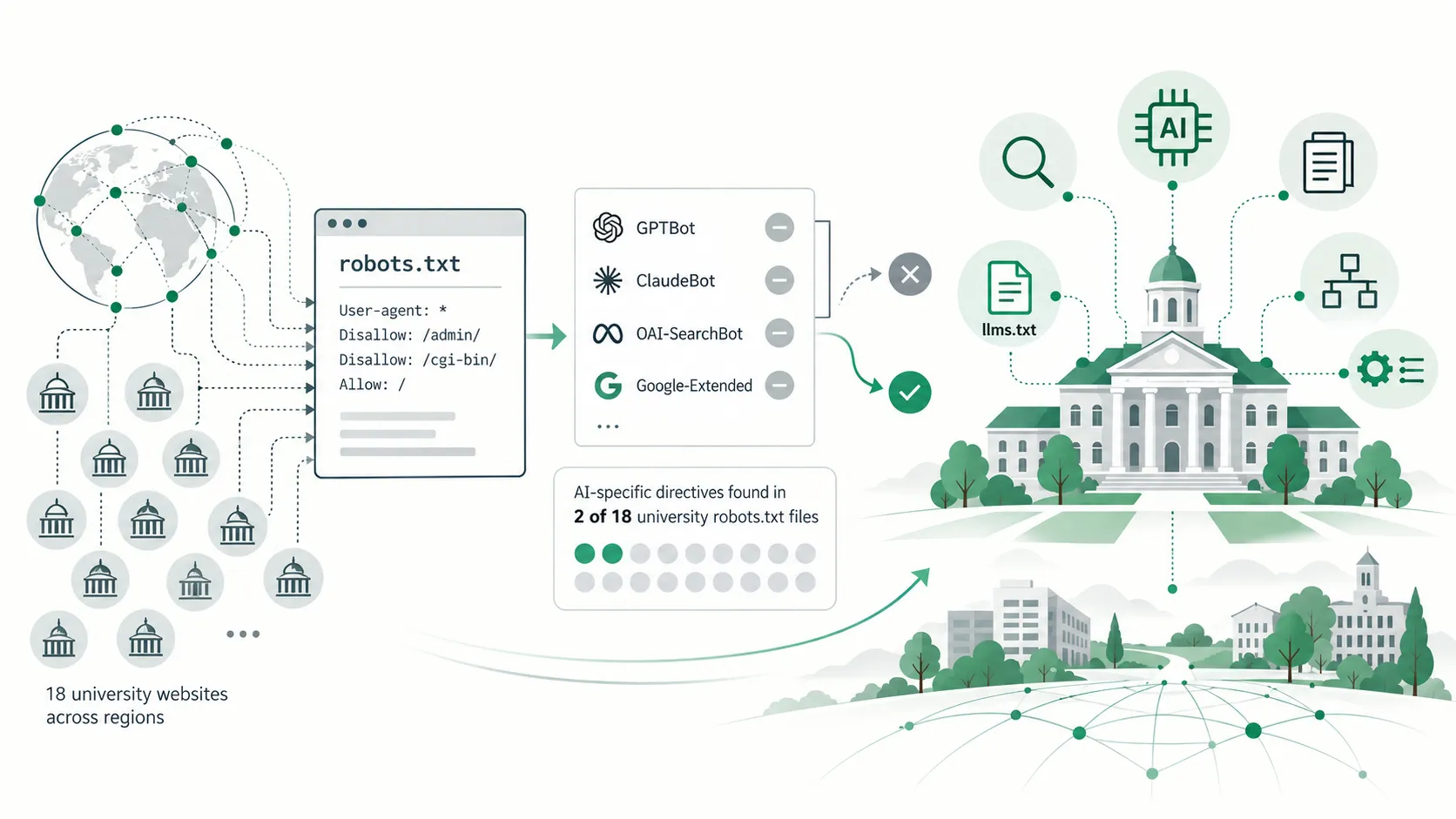
On 30 October 2026, Google, Microsoft and OpenAI each announced support for a shared robots.txt signal that lets websites state whether their content may be used to train generative AI models. The signal is defined in an IETF Internet-Draft, not yet a standard, as a robots.txt group addressed to the policy token User-Agent: __usage_ai-training. Microsoft's announcement and Google's crawler documentation name this token; Google's blog post describes it as a shared "policy token" within robots.txt. No provider has said the signal is active today. Microsoft has also announced a separate page-level "AI grounding" preference and a dated transition away from the older NoArchive and NoCache controls, with a first step on 15 December 2026.
To establish a starting point before adoption, Webometrics examined the main-site robots.txt files of the 20 highest-placed institutions in the July 2026 Webometrics world ranking on 18 November 2026. None of the 19 files retrieved contained a __usage_ai-training group. Sixteen of the 19 contained only wildcard (User-agent: *) rules, which the draft says must not be read as a training preference. This article explains how the new signal works, what the baseline shows, and what university web, library and research teams should decide before early 2027.
Three primary announcements and one technical document were published on the same day.
| Source | What it says | Timing stated |
|---|---|---|
| IETF Internet-Draft draft-kelley-aipref-training-preference-signal-00 (author affiliated with Anthropic) | Defines the __usage_ai-training policy token, written as an ordinary robots.txt group. Intended status: Standards Track. | Published 30 October 2026; expires 3 May 2027 unless revised |
| Google Search Central blog | Google plans to support the shared control. A training opt-out through the token, where Google-Extended is not explicitly specified, would be treated as a Google-Extended disallow. | "We aim to support this new control along with other AI providers in 2027" |
| Microsoft Bing blog | Adopts the shared training preference in robots.txt, extends it to page level, and adds a separate page-level AI grounding preference. | New preferences honored as Microsoft crawls from 1 February 2027 |
| OpenAI | Will honor the common signal; existing crawler controls continue to apply. | Aims to implement the signal in the coming months, according to its announcement |
The draft uses the AI training definition from the IETF AI Preferences working group: "Using an asset to modify the learned parameters of a generative AI model." Training of models used only for non-generative tasks, such as classification or ranking, is outside that definition.
The draft adds no new directive names and no new grammar. A site writes a normal robots.txt group whose User-Agent line is the policy token rather than a crawler name. The draft's own example is:
User-Agent: __usage_ai-training
Disallow: /
Allow: /press-kit/
This expresses a preference against AI training for all paths except /press-kit/, where it expresses a preference in favor. Five rules in the draft matter most for universities:
Disallow under User-agent: * is not an AI-training preference under this mechanism.User-Agent: __usage_ai-training line, no preference has been expressed through this mechanism.Existing company-specific controls do not disappear. Google says Google-Extended continues alongside the shared signal, and its crawler documentation states that "Google-Extended does not impact a site's inclusion in Google Search nor is it used as a ranking signal in Google Search." OpenAI says its existing robots.txt controls, such as GPTBot, will continue to apply alongside the new signal. Under Google's stated interpretation, an opt-out through the shared token is treated like a Google-Extended disallow, which the same documentation says does not affect inclusion in Google Search.
Microsoft separates two uses of web content. AI training is set in robots.txt with the shared token, or per page. AI grounding, meaning the use of content to inform generated answers in Bing, Copilot and Microsoft 365, is a page-level setting only. Both default to Allow when no preference is published. Microsoft states that "these preferences will replace existing Microsoft preferences NoArchive and NoCache for training and grounding."
The page-level syntax Microsoft documents is:
<meta name="Bingbot" content="ai-training:disallow">
X-Robots-Tag: Bingbot: ai-training:disallow
<meta name="Bingbot" content="ai-grounding:disallow">
X-Robots-Tag: Bingbot: ai-grounding:disallow
A third grounding value, ai-grounding:disallowextended, limits grounding to Microsoft-operated experiences and excludes grounding services Microsoft provides to third parties. Microsoft warns that choosing Disallow or DisallowExtended for grounding will reduce visibility in AI experiences, while not affecting eligibility for traditional Bing results.
| Date | Microsoft milestone | Who needs to act |
|---|---|---|
| 15 December 2026 | Temporary grounding transition preferences open in Bing Webmaster Tools | Only sites using NoArchive or NoCache on that date |
| 1 February 2027 | New training and grounding preferences honored as pages are crawled | Everyone who wants a non-default setting |
| 1 March 2027 | NoArchive and NoCache no longer read as training or grounding preferences | Sites relying on NoArchive or NoCache |
| 30 September 2027 | Temporary grounding preferences expire (or earlier, on recrawl) | Sites that recorded a temporary preference |
Microsoft adds two cautions that apply to every institution: "Publishing a setting is not the same as activating it," because the page must be recrawled, and "Neither choice guarantees inclusion, traffic, or payment."
The sample was the 20 highest-placed institutions in the July 2026 Webometrics world ranking. The ranking was used only to define the sample. For each institution, the official domain was taken from its Webometrics profile, and the robots.txt file at the main web host (usually the www host) was retrieved on 18 November 2026 between 13:16 and 13:17 UTC. Each file was read in full and recorded for: whether a file was served; which User-agent groups it contained; a __usage_ai-training group; a Google-Extended group; groups for other AI crawlers such as GPTBot, ClaudeBot or CCBot; and any Content-Signal line. Faculty sites, repositories, journal platforms and other subdomains were not examined.
| Institution | Host examined | Groups in file | __usage_ai-training | Google-Extended | Other AI-crawler groups | Content-Signal |
|---|---|---|---|---|---|---|
| Harvard University | www.harvard.edu | Wildcard only | No | No | No | No |
| Stanford University | www.stanford.edu | Wildcard only | No | No | No | No |
| University of Oxford | www.ox.ac.uk | Wildcard only | No | No | No | No |
| University of Michigan | umich.edu | Wildcard only | No | No | No | No |
| Cornell University | www.cornell.edu | Wildcard plus site-quality tools | No | No | No | No |
| Johns Hopkins University | www.jhu.edu | Wildcard plus 31 named groups (32 user agents) | No | Yes (Disallow: /) | Yes (incl. GPTBot, ClaudeBot, CCBot) | Yes (ai-train=no) |
| University of Cambridge | www.cam.ac.uk | Wildcard only | No | No | No | No |
| University of Pennsylvania | www.upenn.edu | Wildcard only | No | No | No | No |
| University of Washington | www.washington.edu | Wildcard only | No | No | No | No |
| Yale University | www.yale.edu | Wildcard only | No | No | No | No |
| UCL University College London | www.ucl.ac.uk | Wildcard plus three non-AI agents | No | No | No | No |
| Columbia University | www.columbia.edu | No file served (HTTP 404) | n/a | n/a | n/a | n/a |
| University of California Los Angeles | www.ucla.edu | Wildcard only | No | No | No | No |
| University of Toronto | www.utoronto.ca | Wildcard only | No | No | No | No |
| University of California Berkeley | www.berkeley.edu | Wildcard only | No | No | No | No |
| University of California San Diego | ucsd.edu | Wildcard only | No | No | No | No |
| Massachusetts Institute of Technology | www.mit.edu | Wildcard only | No | No | No | No |
| University of British Columbia | www.ubc.ca | Wildcard only | No | No | No | No |
| University of Wisconsin Madison | www.wisc.edu | Wildcard only | No | No | No | No |
| University of Florida | www.ufl.edu | Wildcard only | No | No | No | No |
__usage_ai-training group. This is expected so soon after the announcement and gives a clean pre-adoption baseline.User-agent: *) groups. Under the draft, these files express no AI-training preference through the shared signal, whatever their wildcard rules say.Disallow: /, mostly AI and data crawlers, including Google-Extended, GPTBot, ClaudeBot and CCBot, and a Content-Signal line with ai-train=no, inside a block labelled as Cloudflare managed content.Silence is now a choice with a default. Under Microsoft's stated policy, both training and grounding default to Allow when nothing is published. For 18 of the 19 files examined, the main website currently states no AI-specific preference at all. That may well reflect a deliberate open-access stance, which many universities hold for research and teaching content. The point is that the outcome should be decided by the institution, not left to defaults that were set before these controls existed.
Wildcard rules will not carry over. Some institutions may assume that their general robots.txt rules already govern AI use. The draft is explicit that wildcard groups do not match the policy token, and Microsoft states that its settings "govern use of content, not crawl access." A university that wants a training preference must write one.
Existing named-crawler files need a decision, not a rewrite. The one file with AI-crawler groups already blocks the major training crawlers by name. The shared token would not replace those groups, because crawler rules keep working independently. It would add a single, provider-neutral statement that participating providers have said they will read. Google's post says it will read a shared-token opt-out as a Google-Extended disallow only when Google-Extended is not explicitly specified, and the draft allows providers to treat their own named tokens as more specific. A file that names Google-Extended separately should therefore be checked to make sure the two rules say what the institution intends.
One institution, many properties. This baseline covers only main websites. Universities also run repositories, open-access journals, library catalogs, faculty sites and research-group sites, each with its own robots.txt. Webometrics' earlier study of AI-crawler directive consistency across university web properties found that different properties of the same institution can carry different rules. The shared token makes it easier to align them, or to choose different stances on purpose, for example allowing training on openly licensed repository content while restricting it elsewhere.
Bing grounding is a separate, page-level question. Institutions that once added NoArchive or NoCache to limit Bing's use of content have until 1 March 2027 to republish their intent with the new page-level values. Those that never used these tags need no transition action, according to Microsoft.
User-Agent: __usage_ai-training group with Disallow or Allow paths. Do not rely on User-agent: *.ai-training and ai-grounding values and, from 15 December 2026, record a temporary grounding preference in Bing Webmaster Tools before 1 March 2027.For the Google Search side of AI controls, including AI Overviews and AI Mode, see Webometrics' guide to Search generative AI control for universities. For how individual AI crawlers were treated in an earlier sample, see AI crawler access at universities: a robots.txt study of 18 domains.
Webometrics is a UNIRANKS project dedicated to webometric university evaluation and research. Its ranking uses three indicators. Impact reflects an institution's presence and recognition across the wider web; Openness and Excellence draw on scholarly data from the UNIRANKS Open Index (OI). Details are in the Webometrics methodology. Robots.txt preferences, AI-training settings and grounding settings are not Webometrics indicators, and adopting or not adopting them does not by itself change an institution's score or position. They are presented here as governance and good-practice decisions about how university content is used.
Read our Editorial Standards & Publication Policy, including how to report an error.
On 15 September 2026, Cloudflare introduced a new edge-level classification for web crawlers — Search, Training, and Agent — along with an...
Algeria is a linguistically layered higher-education market: Arabic is the country's constitutional official language, Tamazight has held...
At UNESCO's Digital Learning Week 2026 (8–11 September 2026, Paris), more than 25 education ministers adopted a joint statement on sustaining...
Research studies of how universities appear on the web, in search and in AI tools.
 Latest research
How to Report a Closed University to Webometrics
20 November 2026
The Webometrics ranking of universities worldwide and by region, built on Impact, Openness and Excellence.
 Current edition
July 2026 Webometrics Edition: Countries, Regions and Leaders
09 November 2026
Who we are, how the ranking is calculated, and the standards we publish by.
 How we work
Editorial Standards & Publication Policy
09 November 2026