
Cloudflare's AI-Crawler Defaults and University Websites: A Webometrics DNS Study
On 15 September 2026, Cloudflare introduced a new edge-level classification for web crawlers — Search, Training, and Agent — along with an...

Google's Search generative AI control is a Search Console setting that lets a website owner decide whether a site's links and content can appear in AI Overviews, AI Mode and generative AI features in Google Discover. It has three options (Include, Exclude and Inherit control from parent) and it is set property by property. For a university, which typically runs dozens of subdomains and Search Console properties for faculties, libraries, repositories and journals, the practical question is not only whether to use the control, but who in the institution holds the authority to decide.
This article explains what the control does according to Google's own documentation, how its inheritance model works, what it does not do, and what governance questions it raises for universities. It is an explainer based on Google's published documentation. Webometrics did not inspect any university's Search Console configuration, because that setting is not observable from outside an institution.
According to Google's Search Central page on controlling what you share with Google Search (last updated 21 October 2026), the Search generative AI control is a site-wide method that lets site owners "manage your site's inclusion in generative AI features on Google Search, including AI Overviews and AI Mode." It is listed alongside older methods such as removing content, password protection, the noindex rule, robots.txt, and robots meta tags, data-nosnippet and X-Robots-Tag.
Google's Search Console Help article on the control states that, as of 31 August 2026, the control has been rolled out to all websites worldwide. It is found in Search Console under Settings, then Search generative AI, and it applies to AI Overviews, AI Mode and generative AI features in Google Discover.
Google's Help article describes three options for each Search Console property:
| Setting | What Google says it does |
|---|---|
| Include | The site's links and content may appear in Search generative AI features. This is the default for all properties, and the site can receive impressions and traffic from these features. |
| Exclude | The site's links and content are hidden from these features, and the site receives no traffic or impressions from them. Content crawled from the site is not eligible as input for generating an AI response or preview. |
| Inherit control from parent | The property follows the setting of its parent property, and changes at the parent apply automatically. This is the default for properties that have a parent, and an owner can override it at any time. |
Google notes that excluding a site does not stop content from other sites appearing in these features, and that such content may look similar to the excluded site's own.
The inheritance rules are the part of the control most relevant to institutions with complex web estates. Google's Help article explains that a property inherits from its closest parent that has manually configured the control. If no parent has done so, the property inherits from its top-level domain property. Parents can be domain, subdomain or URL-prefix properties. Google gives the example of a property for example.com/business/cats, which inherits from example.com unless a closer parent, such as example.com/business/, has set its own value.
Child property owners can either follow the parent or set their own value for that property and its subpages. Google also states that owners of a top-level domain property see a notice on the control page when a child property overrides the parent's setting.
Google's documentation is explicit about several limits, and these matter for how universities describe the control internally:
Google also states that exclusion generally takes effect within one to two days after the control is set, although some content may take longer because of caching and propagation, and that changes generally take a few days to take effect.
Universities already manage several mechanisms that touch how pages are presented. Google's AI features documentation (last updated 10 December 2025) says there are no additional requirements to appear in AI Overviews or AI Mode, and that a page qualifies as a supporting link if it is indexed and eligible to appear in Search with a snippet. For limiting what is shown from a page, that documentation lists nosnippet, data-nosnippet, max-snippet and noindex, and it points to Google-Extended for limiting AI training and grounding uses in other Google systems.
| Mechanism | Level | What Google's documentation says it is for |
|---|---|---|
| Search generative AI control | Search Console property (site-wide, with inheritance) | Manages inclusion in generative AI features on Google Search, including AI Overviews and AI Mode |
| noindex | Page | Tells Google not to index the content or let it appear in Google Search results |
| nosnippet, data-nosnippet, max-snippet | Page or text passage | Limits the information shown from pages in Search |
| Google-Extended | Crawler token in robots.txt | Pointed to by Google for limiting AI training and grounding uses in other Google systems |
Because the mechanisms operate at different levels and for different purposes, they are not interchangeable. A university that has already tuned its robots.txt for AI crawlers, as examined in Webometrics' study of AI-crawler access at universities, has not thereby configured this Search Console control, and the reverse is also true.
The following points are Webometrics' interpretation of Google's documentation, not statements made by Google.
A university web estate is rarely a single site. Faculties, libraries, institutional repositories, journal platforms, research centres and student-facing services often sit on separate subdomains, sometimes managed by different teams or external vendors. Because Search Console properties can be nested, and because a child property can override its parent, a decision made at the institutional domain level may or may not reach every part of the estate. Conversely, a faculty or library team that owns a child property can set its own value.
This produces several practical questions an institution may wish to answer deliberately:
There is a related consistency issue. Webometrics' earlier research on AI-crawler directive consistency across university web properties examined whether one institution applies the same robots.txt rules across its properties. The Search generative AI control raises the same type of question for a Search Console setting, although Webometrics has not measured it, because the setting is visible only to property owners.
Google states that excluded sites receive no traffic or impressions from these features and that included sites can receive them. Google recommends the Generative AI performance report in Search Console to see how content performs in these features and to estimate the effect of a change. Whether inclusion or exclusion better serves an institution depends on its goals, for example the public reach of research outputs, control over how institutional content is presented, or the sensitivity of particular content. Webometrics does not recommend one setting. Neither setting should be presented internally as a way to improve rankings, since Google states the control is not a ranking or inclusion signal, and no outcome in traffic, visibility or citation can be guaranteed from either choice.
The Search generative AI control is configured inside Search Console, so no external party can observe a university's setting. This article therefore reports no counts of universities that include or exclude their content. Observable related signals, such as robots meta tags, nosnippet attributes, X-Robots-Tag headers and robots.txt tokens, could be studied in a separate, properly sampled analysis, but would not reveal the Search Console setting itself. Google's documentation may also change; the statements here reflect the pages as accessed on 23 October 2026.
For context on how Webometrics approaches university web visibility, see the Webometrics methodology, the Webometrics world ranking and the wider AI & Search Visibility section. Webometrics is a UNIRANKS project dedicated to the development and application of webometric university evaluation and research. Webometrics.org is the project's dedicated public website and publication platform. Discoverability of the kind discussed here is also related to the signals described in what makes a university website authoritative.
No. Google's Help article states that the control does not remove a site from Search and points to the noindex rule for that purpose. It manages inclusion in generative AI features such as AI Overviews and AI Mode.
Google states that the control is not a ranking or inclusion signal for other parts of Search. Universities should not expect either setting to change how pages rank in standard results.
No. Google's documentation treats them as separate. The control manages inclusion in generative AI features on Google Search, while Google points to Google-Extended for limiting AI training.
A property set to Inherit follows its closest manually configured parent, or the top-level domain property if none is configured. A child owner can override the parent, and top-level domain owners see a notice when this happens.
Google says exclusion generally takes effect within one to two days of the control going live, though some content may take longer, and changes generally take a few days to take effect.
Not from outside. The setting is visible only to Search Console property owners, so no public count of institutions using Include or Exclude is available from this source.
Questions about how your institution appears in Webometrics, or about improving its web presence? Contact the Webometrics team.
Webometrics (2026). Search Generative AI Control for Universities: Who Decides Whether Faculty and Repository Sites Appear in Google AI Overviews and AI Mode? Webometrics.org, 23 October 2026.
Read our Editorial Standards & Publication Policy, including how to report an error.
On 15 September 2026, Cloudflare introduced a new edge-level classification for web crawlers — Search, Training, and Agent — along with an...
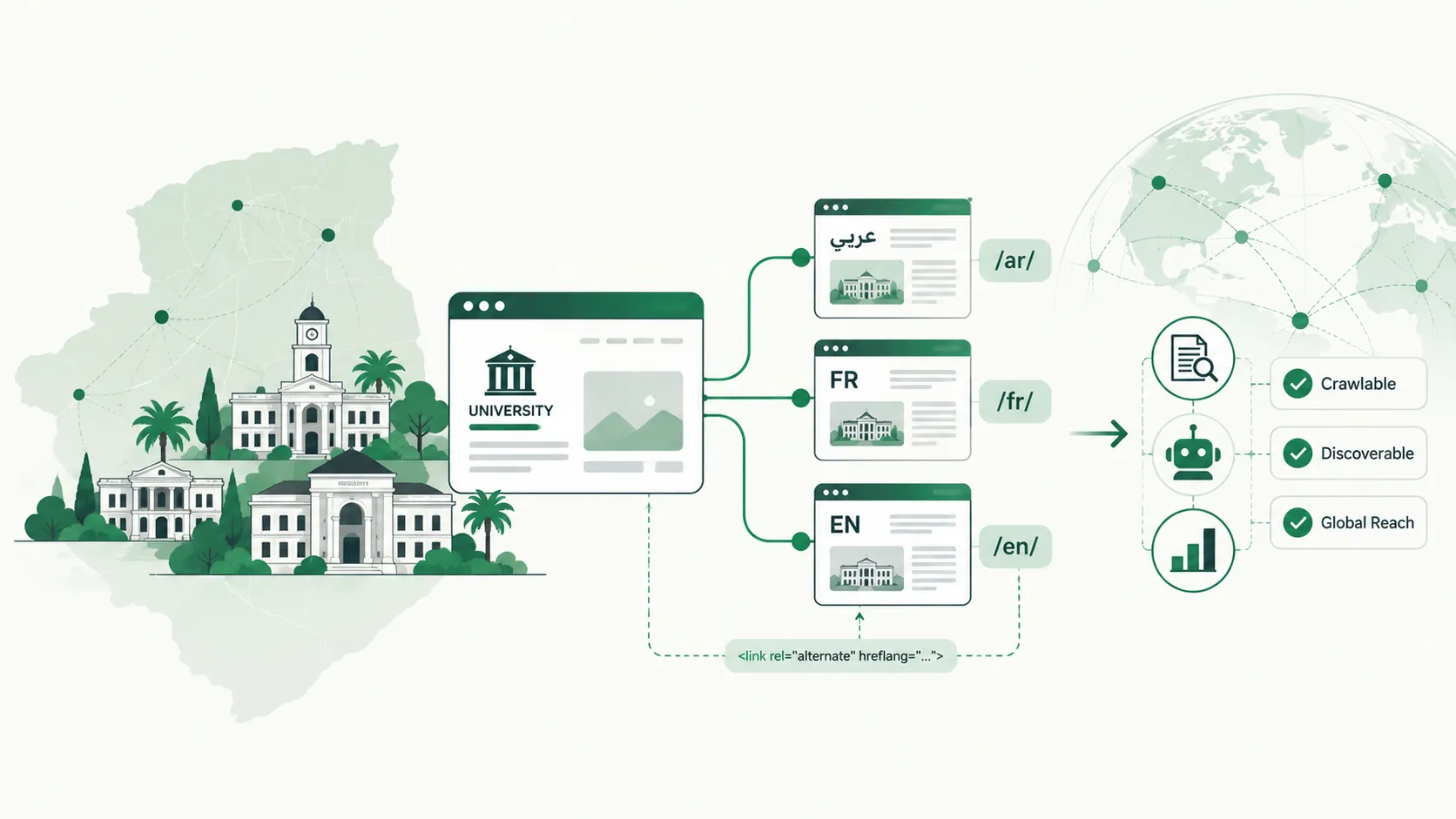
Algeria is a linguistically layered higher-education market: Arabic is the country's constitutional official language, Tamazight has held...
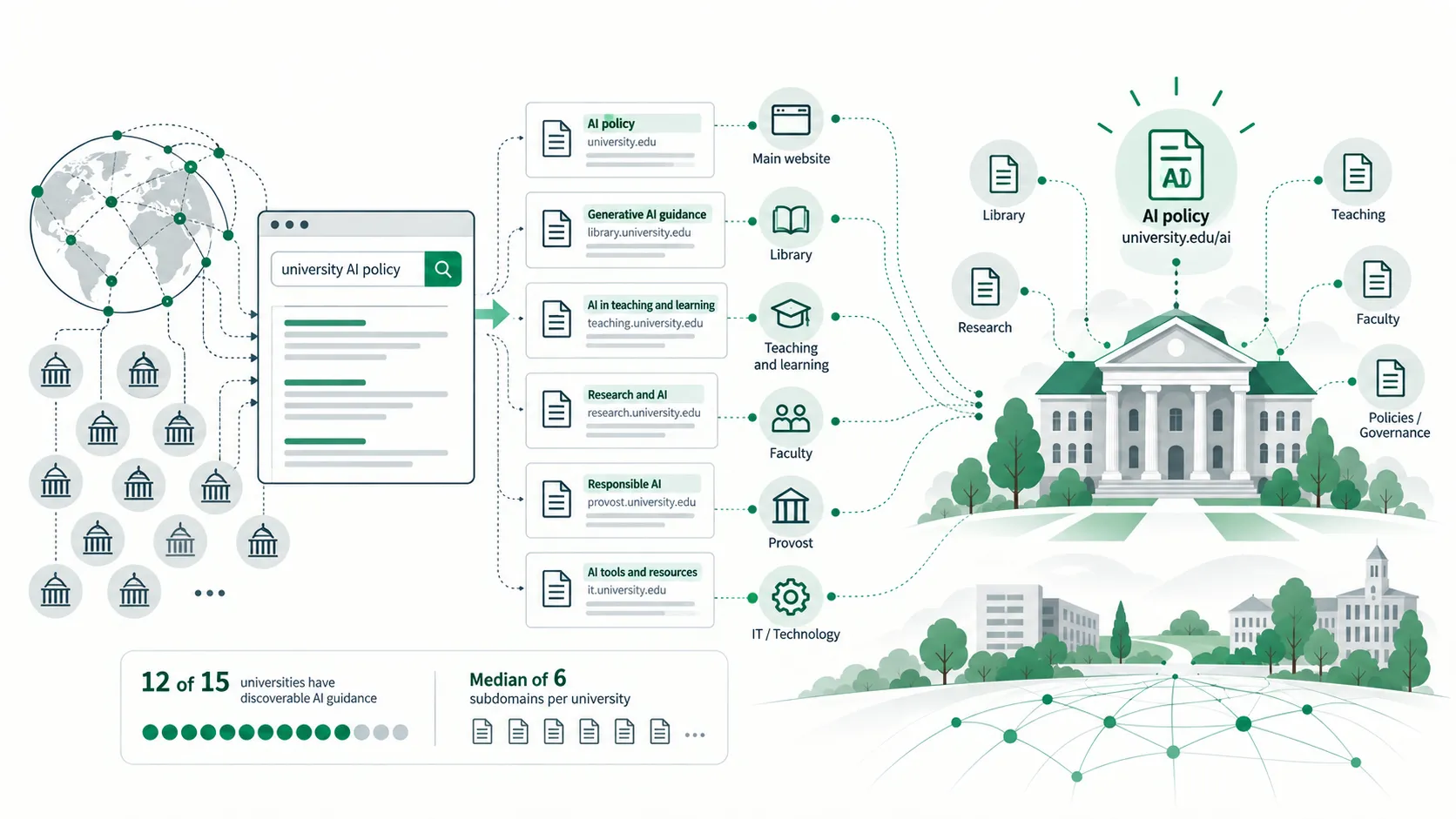
At UNESCO's Digital Learning Week 2026 (8–11 September 2026, Paris), more than 25 education ministers adopted a joint statement on sustaining...
Research studies of how universities appear on the web, in search and in AI tools.
 Latest research
How to Report a Closed University to Webometrics
20 November 2026
The Webometrics ranking of universities worldwide and by region, built on Impact, Openness and Excellence.
 Current edition
July 2026 Webometrics Edition: Countries, Regions and Leaders
09 November 2026
Who we are, how the ranking is calculated, and the standards we publish by.
 How we work
Editorial Standards & Publication Policy
09 November 2026