Google Search Profiles Explained: What the New Follow Badge Means for University Research Communications
On 16 September 2026, Google updated its Search Central documentation to let website owners add a Search profile badge a follow button linking to their Google Search profile to their own site. The update also confirmed that the underlying eligibility threshold for claiming a Search profile has now been lowered twice since the feature launched in June 2026, most recently to 10,000 followers on a single major social or video platform. For university communications offices, research-news teams, and digital-strategy staff, this raises a concrete question: what is a Search profile, does an institution's own social presence already qualify, and is this a feature worth acting on now?
This article explains what Search profiles and the new badge actually are, traces the eligibility changes using Google's own documentation, and sets out what the feature does and does not mean for how universities are found and followed online.
What Is a Google Search Profile?
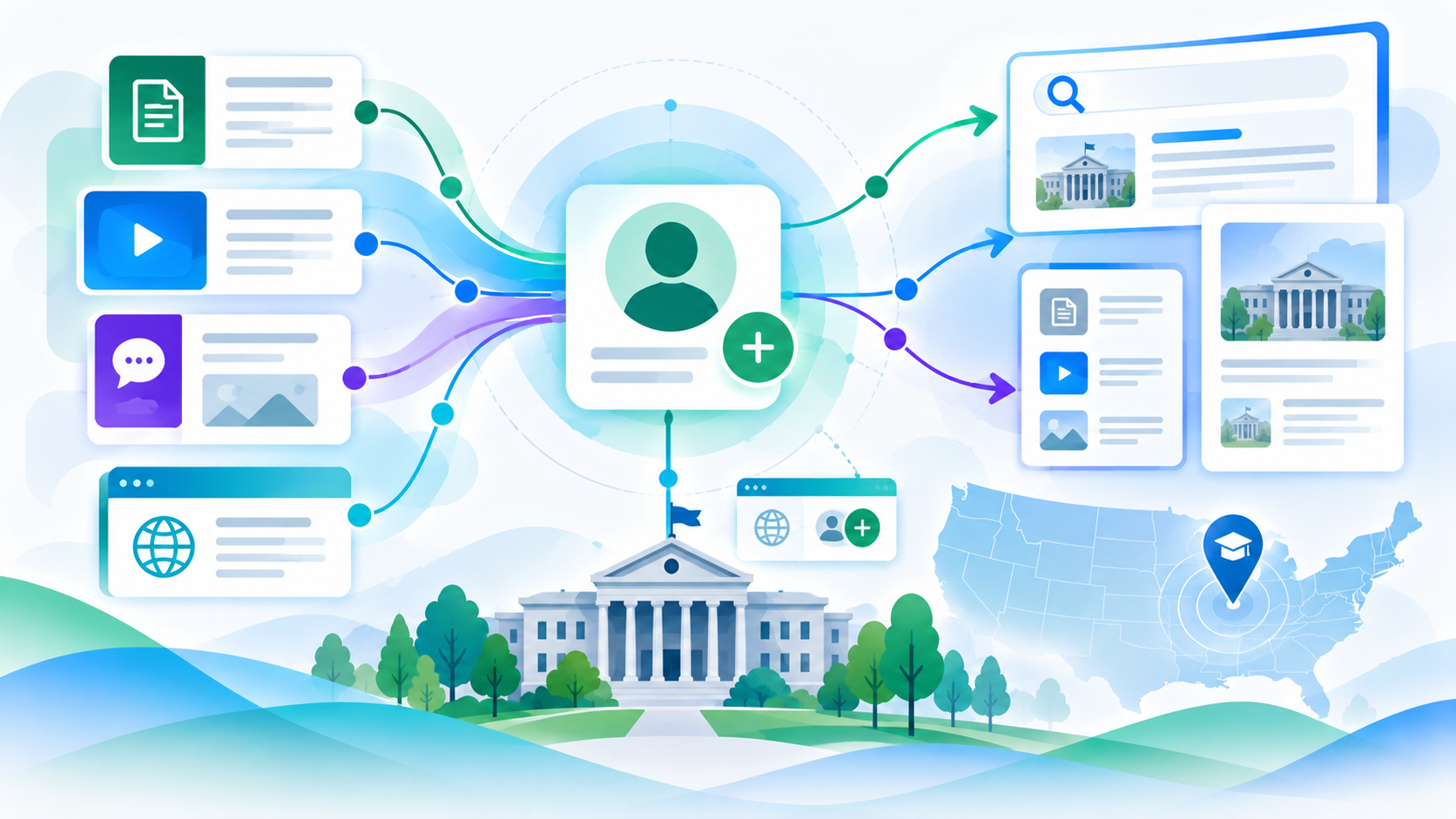
A Search profile is a dedicated, shareable destination on Google that brings a publisher's or creator's content articles, videos, and social posts together in one place. Google introduced the feature on 4 June 2026. In Google's own description, "Search profiles give publishers and creators a central place to showcase their latest articles, videos and social posts," and the profile can surface in Google Search knowledge panels, in Google Discover, and at a direct URL in the form profile.google.com/@handle.
Search profiles are tied into Google Discover, the personalized content feed shown in the Google app and on Android home screens: once a user follows a profile, that creator's or publisher's content becomes easier to surface in the user's Discover feed. This is a distinct mechanism from ordinary organic search ranking a Search profile does not replace a website's own search listing, it sits alongside it as a separate, followable identity.
The New Search Profile Badge (16 September 2026)
Until mid-September 2026, claiming a Search profile only created the destination page itself; there was no standard way for a publisher to promote that profile from its own website. Google's Search Central documentation, last updated 16 September 2026 (UTC), closed that gap: "After you've claimed your Search profile, you can encourage your audience to find your content from across the web by adding a Search profile badge to your website."
The badge is an icon or text link Google supplies official badge assets that a site owner embeds as a simple HTML link pointing to their profile.google.com/@handle URL. Google's documentation sets specific brand requirements for using it correctly:
- a minimum touch target of 48×48dp on Android or 44×44px on iOS and the web;
- the "Super G" icon must not be stretched, distorted, rotated, or recolored;
- monochrome and colorful badge styles should not be mixed on the same page.
Google also operates a separate "Preferred Sources" badge (see below); where a site uses both, Google's guidance is to give visual priority to "the higher emphasis Search profile button with the label," to keep the two features visually distinct.
How Eligibility Has Changed Since Launch
Search profiles were not opened to all websites at once. Eligibility has moved in three documented steps since the June 2026 launch, each widening the pool of accounts that qualify:
| Date | Eligibility threshold | Source |
|---|---|---|
| 4 June 2026 (launch) | Reported at 100,000 followers/subscribers on YouTube, Instagram, or X, or 300,000 on TikTok | Google (blog.google); contemporaneous industry reporting |
| Mid-August 2026 | Lowered to 35,000 followers/subscribers on a qualifying platform | Industry reporting on Google's announcement |
| 16 September 2026 | Lowered again to 10,000 followers/subscribers on YouTube, Instagram, X, or TikTok | Google Search Help: "We've lowered the eligibility threshold to 10,000 followers across YouTube, Instagram, X, or TikTok." |
Google's current help documentation sets out the full eligibility picture as of this review: a claimant needs at least 10,000 followers or subscribers on at least one of YouTube, Instagram, X, or TikTok; must be at least 18 years old; and content must meet Google's policies. Critically, the same page states plainly that "Search profiles are currently only available in the United States." Google has said only that it intends to "expand Search profiles to more publishers and creators around the world" in the future, without giving a date.
Search Profiles vs. Preferred Sources: Two Different Features
Search profiles are sometimes confused with Google's separate "Preferred Sources" feature, launched earlier in 2026, because both give publishers a badge and both aim to increase reader-initiated discovery. They are not the same mechanism:
- Search profiles aggregate one publisher's or creator's content across platforms into a single followable Google destination, surfaced through Discover and knowledge panels.
- Preferred Sources lets a reader mark a specific domain or subdomain as a source they want prioritized; preferred sites receive a "preferred" label and priority placement in Top Stories, and where the site is included in Search generative AI features in Search Console in AI Mode and AI Overviews.
A university communications office could, in principle, be relevant to both: Preferred Sources concerns how a reader treats an existing domain (such as a university's official news site) inside Search results, while a Search profile concerns whether the institution's account-level social and video presence has its own followable identity on Google. Webometrics has not previously examined either feature in the university context.
Why This Matters for Universities
Most research universities already operate the kind of fragmented, multi-platform communications presence that Search profiles are designed to unify: an official news or press-office website, a YouTube channel carrying lecture recordings and research-explainer video, Instagram and TikTok accounts aimed largely at prospective students, and an X account used for research commentary and rapid announcements. Each of these normally functions as a separate, disconnected presence in Google Search. A Search profile is explicitly designed to bring that fragmented footprint into a single, followable destination, and to surface it through Discover a feed through which a meaningful share of general and prospective-student audiences already encounter content without visiting a publisher's website directly.
This connects to several of Webometrics' established topic areas: institutional digital identity, research dissemination, and AI-search and Discover-style visibility, all of which sit within the wider search-engine accessibility and digital-transformation themes that Webometrics tracks across the higher-education sector.
Are University Communications Offices Currently Eligible?
The honest answer, as of this review, is: it depends, and for most institutions worldwide, not yet.
The geographic restriction is the larger constraint. Because Google states that Search profiles are "currently only available in the United States," non-US universities cannot currently claim one regardless of their social-media following, and this is worth stating plainly so that international communications teams do not spend time pursuing a feature that is not yet open to them.
For US institutions, the follower threshold is now realistic for many research universities, at least on their largest platform. A flagship research university's official Instagram, YouTube, or X account frequently exceeds 10,000 followers; a department-, school-, or program-level account is less likely to. Webometrics has not measured the actual follower counts of a defined university sample against this threshold for this article doing so reliably would require direct, verifiable access to each platform's current follower count, which was not obtained to a standard this article is prepared to publish as evidence so no adoption or eligibility statistic is reported here. US communications offices that want to check their own standing can do so directly by comparing their official accounts' current follower or subscriber counts against Google's published 10,000-follower threshold.
A Webometrics Perspective: Where This Fits Among Web-Impact Signals
Google has not stated that claiming a Search profile or displaying its badge affects a site's organic search rankings, and Webometrics makes no claim that either action affects an institution's Impact, Openness, or Excellence rank in the Webometrics ranking. The two systems are unrelated: one is a Google Search product feature, the other is Webometrics' own published, independent methodology.
Conceptually, however, the capability that Search profiles formalize a verified, cross-platform institutional identity that aggregates web, video, and social content into a single followable destination sits close to categories the public Webometrics methodology already describes as observable components of the Impact indicator, including Social Presence & Influence, Digital Reach, and Online Reputation & Digital Recognition. Webometrics treats Search profiles as a development worth monitoring within those categories, not as a confirmed input to any Webometrics score.
Practical Guidance for University Communications and Research-Dissemination Teams
- US institutions with an account already near or above 10,000 followers on YouTube, Instagram, X, or TikTok can review Google's current eligibility and claiming process directly through Google Search Help before deciding whether to pursue a Search profile for their official news, research-communications, or admissions account.
- Institutions outside the United States should treat this as a feature to monitor rather than act on: eligibility does not currently extend beyond the US, and Google has not published a timeline for wider availability.
- Communications teams considering a Search profile should first confirm which single account should represent the institution, since a profile aggregates content around one claimed identity a decision that may involve consolidating or prioritizing among multiple existing official accounts (main institutional account, admissions, athletics, research-specific channels).
- Any institution adding the badge should follow Google's published brand and accessibility guidance (touch-target size, unaltered logo, consistent badge style) rather than a self-styled version of the icon.
- No team should treat this feature as a ranking or traffic guarantee. Google has not published evidence that a Search profile changes organic ranking, and Webometrics has not observed or claimed any effect on its own indicators.
Limitations
This article is an explainer of a documented Google Search Central feature, not an empirical Webometrics study; it does not report original measurements of university adoption, follower counts, or badge implementation, and no such figures should be inferred from it. The eligibility-threshold history for June and mid-August 2026 is drawn from contemporaneous industry reporting on Google's own announcements rather than from a Google document dated to each of those specific days; the 16 September 2026 threshold, the US-only restriction, and the badge specification are confirmed directly on Google's own current documentation. Eligibility criteria, thresholds, and geographic availability are controlled entirely by Google and may change again after publication; readers should treat the figures above as accurate to the review date of this article and verify current terms directly with Google before acting on them.
Frequently Asked Questions
What is a Google Search profile?
A Search profile is a dedicated Google destination, introduced 4 June 2026, that aggregates a publisher's or creator's articles, videos, and social posts into one followable identity, surfaced through Google Discover, knowledge panels, and a direct profile URL.
What is the Search profile badge?
It is a follow button that a site owner with a claimed Search profile can add to their own website, introduced through a Google Search Central documentation update dated 16 September 2026.
Can any university claim a Search profile?
Only if the institution's relevant account has at least 10,000 followers or subscribers on YouTube, Instagram, X, or TikTok, and the claimant is based in the United States, since Google states the feature is "currently only available in the United States" as of this review.
Is a Search profile the same as Google's Preferred Sources feature?
No. Preferred Sources lets readers mark a specific website domain as prioritized in Top Stories and, where eligible, AI Mode and AI Overviews. Search profiles aggregate a publisher's or creator's content across platforms into a single followable Google destination. The two are separate, complementary features.
Does having a Search profile improve a university's Webometrics ranking?
No. Webometrics does not use Search profile status as a ranking input, and Google has not stated that a Search profile affects organic search rankings.
Conclusion
Google's Search profile badge, documented on 16 September 2026, is a small technical addition to a feature that has expanded quickly since its June 2026 launch: the qualifying follower threshold has fallen from a reported 100,000 to 10,000 in roughly three months, even as the feature itself remains restricted to the United States. For most universities outside the US, this is currently a feature to watch rather than adopt. For eligible US institutions with an active, sizable social or video following, it offers a documented, low-effort way to give a fragmented multi-platform communications presence a single, followable identity inside Google's ecosystem one that sits conceptually near, but is not a confirmed input to, the kinds of digital-presence signals Webometrics already tracks under its Impact indicator.
Sources
- Google Search Central, "Add a Search Profile Badge to Your Website." Last updated 2026-09-16 UTC. developers.google.com/search/docs/appearance/search-profiles
- Google Search Central, "Guide to Preferred Sources in Google Search for Web Publishers." developers.google.com/search/docs/appearance/preferred-sources
- Google Search Help, "Create a new Search profile." support.google.com/websearch/answer/16904498
- Google (Ibrahim Badr, Product Manager, Search), "A new profile to help publishers and creators highlight their work on Search," blog.google, 4 June 2026. blog.google
- Google Search Central, documentation update log. developers.google.com/search/updates
Suggested Citation
WEBOMETRICS by UNIRANKS (2026). Google Search Profiles Explained: What the New Follow Badge Means for University Research Communications. Webometrics.org, 22 September 2026.
Related Articles