How to Evaluate a University Ranking: Transparency, Methodology and Reproducibility

A university ranking is trustworthy to the extent that it discloses what it measures, how it collects and validates its data, and how far a reader can check its results — not because of its size, its media profile, or how long it has existed. Readers comparing rankings do not have to take any single list on faith. A small set of internationally recognized questions, developed specifically to judge ranking quality, can be applied to any ranking: does it state its purpose and audience, does it name and define its indicators, does it document how data is collected and validated, can its results be checked against public information, and is there any independent oversight of the process itself? These questions are not improvised. They come from a formal reference point in the ranking field: the Berlin Principles on Ranking of Higher Education Institutions.
This article explains where the Berlin Principles came from, sets out the evaluation questions they support, and shows what applying them looks like in practice — including how a currently published, web-based methodology such as Webometrics’ own addresses several of these questions directly on its own methodology page.
Why Ranking Evaluation Matters for Higher Education
University rankings influence more than casual browsing. Prospective students and their families use them to shortlist institutions. Government agencies and funding bodies reference them in policy discussions. University leadership and communications teams track them as part of institutional strategy and international positioning. Journalists and media outlets cite them as shorthand for institutional standing.
Yet rankings vary enormously in what they actually measure. Some are built primarily from reputation surveys of academics and employers. Others draw on citation and publication databases. Others, including Webometrics, observe an institution’s digital presence directly on the open web. Others combine self-reported institutional data with external signals. None of these approaches is inherently more legitimate than another; each captures a different slice of what a university does, and each has boundaries on what it can and cannot tell a reader.
The practical problem is that this variation is not always visible at first glance, and a ranking’s headline position can be mistaken for a single, objective measure of overall institutional quality. Being able to evaluate a ranking’s transparency and methodological soundness — independent of whether a reader agrees with any particular result — is therefore a distinct and useful skill, separate from debating which ranking is "best."
The Berlin Principles: An Established Standard for Ranking Quality
The Berlin Principles on Ranking of Higher Education Institutions were adopted in May 2006 at a meeting of the International Ranking Expert Group (IREG). IREG was established in 2004 through a joint initiative of UNESCO’s European Centre for Higher Education (UNESCO-CEPES) and the Institute for Higher Education Policy (IHEP), a Washington, D.C.-based higher-education research organization. The Principles were later adopted as the founding reference standard of the IREG Observatory on Academic Ranking and Excellence, an international body that reviews ranking methodologies against them.
The Berlin Principles set out sixteen statements describing what a methodologically sound ranking should do, organized into four groups.
| Category | Focus | Representative principles |
|---|---|---|
| A. Purposes and goals | Clarify the ranking’s purpose and intended audience; recognize that institutions have different missions; disclose the information sources used. | Rankings should be one assessment approach among several, and should specify the linguistic, cultural, economic and historical context of the systems they cover. |
| B. Design and weighting of indicators | Keep methods clear and unambiguous; choose indicators for relevance and validity rather than convenience; measure outcomes over inputs where feasible. | Indicator weights should be prominently displayed, and changes to them limited, so that year-to-year movement is not confused with a genuine change in institutional performance. |
| C. Collection and processing of data | Apply objective, verifiable and properly collected data from representative samples; apply quality assurance to the ranking process itself. | Rankings should draw on audited or verifiable data where possible and involve advisory input with international participation. |
| D. Presentation of results | Give users a clear account of the factors used to produce a ranking; provide a way to correct errors. | Results should be presented so that a user can understand what went into them, with a mechanism for correcting factual mistakes. |
The Principles do not require a ranking to publish an exact scoring formula. What they do require — most directly the instruction that "the choice of methods used to prepare rankings should be clear and unambiguous," and the instruction that indicator weights be prominently displayed and changed only for clearly stated reasons — is that a ranking be clear about what it measures and about how it handles central methodological choices, even where a specific numeric weight is withheld.
Five Practical Questions to Ask of Any Ranking
The sixteen Berlin Principles translate into a short, practical checklist that a reader can apply to any ranking, in any methodological tradition, without needing specialist training.
- Does the ranking state a clear purpose and intended audience? A ranking built for prospective undergraduate students, one built for research-funding agencies, and one built to describe institutional digital presence are answering different questions, and a reader should be able to identify which one they are looking at.
- Are the indicators named and defined, even where exact weights are undisclosed? A trustworthy methodology page names what it measures — for example, research output, citation impact, reputation-survey responses, or categories of web-based signals — in enough detail that a reader understands the general basis for the result.
- Is the data-collection and validation process documented? This includes how the ranking identifies and verifies the institutions it covers, how it treats missing or incomplete data, and what happens when a data source is judged unreliable.
- Can a reader check the result against public information? This does not require a reader to be able to recompute an exact score. It does mean the ranking discloses its edition or publication date, describes material changes between editions, and does not rely on private, unstated criteria to explain a result.
- Is there a stated mechanism for correcting errors or an independent review of the process? Rankings that welcome factual corrections, and that describe any external or advisory review of their own methodology, meet a higher bar than those that provide no such channel.
How Independent Methodology Reviews Approach the Same Question
Academic and higher-education-sector bodies have applied a similar logic when reviewing ranking methodologies as a category. The European University Association (EUA), in its published reports on global university rankings, describes its own analytical approach as examining "what is said to be measured, what is actually measured," using only publicly available and freely accessible information — deliberately mirroring what an ordinary reader, rather than an insider, can access. That is a useful discipline for any reader to borrow directly: read a ranking’s own published methodology description, then compare it against what the ranking’s public results actually show, rather than assuming the two automatically match.
Why Most Rankings Withhold Exact Scoring Formulas
A tension sits inside the Berlin Principles themselves. Principle B asks for indicator weights to be "prominently displayed," yet ranking organizations across essentially every methodological tradition — reputation-based, citation-based and web-based alike — withhold at least some calculation detail. The commonly stated reason is that fully disclosing an exact formula makes it easier to optimize narrowly for a small number of measurable signals rather than to genuinely strengthen the full range of institutional performance the ranking intends to capture. This is a documented, openly discussed trade-off in the ranking field generally; it is not unique to any one ranking or evaluation tradition.
The practical implication for a reader is that a withheld scoring formula is not, by itself, evidence of poor transparency. What matters is whether the ranking still discloses which indicators it uses, where its data comes from, how that data is validated, and — ideally — why detailed weighting or formula information is being withheld.
A Worked Example: Reading a Published Web-Ranking Methodology Page
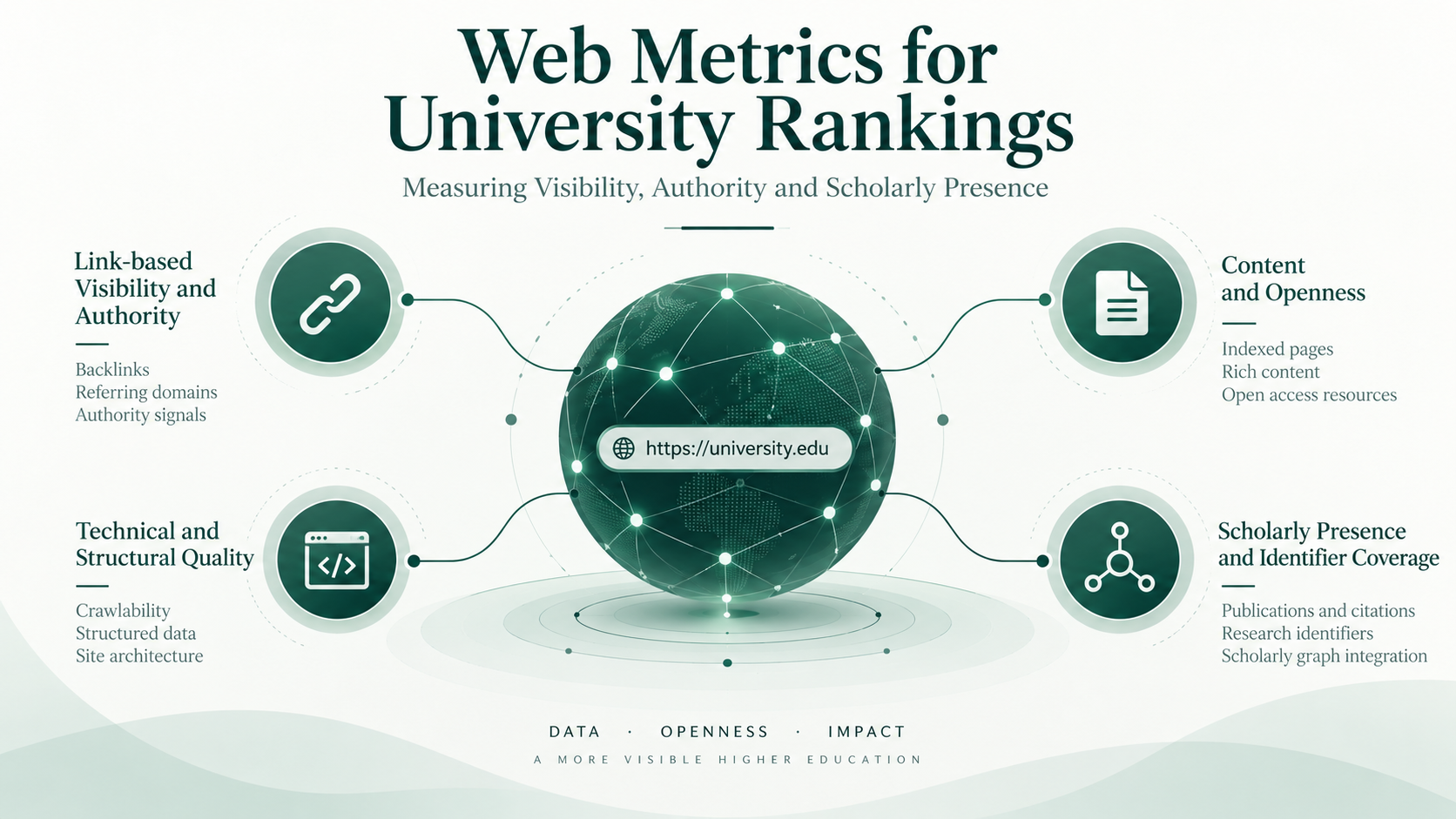
Applying this framework to a real, currently published methodology page shows what the trade-off looks like in practice. Webometrics’ own methodology page states its current edition date, defines its three principal indicators — Impact, Openness and Excellence — and breaks each of them down into a set of named, publicly described sub-indicators. It also states directly, in the section of its methodology addressing ranking integrity, that it does not disclose exact scoring formulas, detailed signal weights, internal thresholds or certain other operational parameters, and gives an explicit reason: reducing the risk that the ranking could be reverse-engineered or manipulated through those details.
Read against the five questions above, this single page discloses the indicators being measured (question 2), documents category-level detail on data sources and how unreliable signals are treated (question 3), and states its edition and the reasoning behind what it withholds rather than leaving the gap unexplained (question 4). It does not, on its own, establish whether Webometrics or any other ranking meets every one of the sixteen Berlin Principles — that would require checking items such as independent advisory review and a public error-correction channel as well, which fall outside what a single methodology page can demonstrate. The value of the exercise is narrower and more useful: it shows a reader concretely what "transparent about what is measured, reserved about the exact formula" looks like on a live page, so the same check can be applied to any other ranking’s published methodology.
Readers who want the full indicator definitions can consult the current Webometrics methodology directly, including the published breakdown of what each of the Impact, Openness and Excellence indicators covers.
What "Reproducibility" Can Reasonably Mean for a University Ranking
Full independent recomputation of an exact ranking score — a reader gathering the same raw data and arriving at the identical published figure — is rare across ranking traditions generally, not only for web-based rankings. Reputation-survey data is typically proprietary at the level of individual responses. Citation-based rankings often depend on licensed bibliometric databases that are not freely queryable in the exact configuration the ranking used. Web-based rankings observe a very large number of public-web signals at a particular point in time, which a reader cannot fully re-collect after the fact.
A more realistic and useful standard of reproducibility for a reader to expect is process transparency rather than arithmetic reproducibility: the ranking discloses what it measures and from which general categories of sources, states its edition date and describes material changes between editions, and explains — even at a general level — how it treats missing, anomalous or unverifiable data. This allows a reader to check the shape and stability of a methodology over time and to understand roughly how a result was produced, without requiring that every underlying data point be independently re-derivable.
Limitations of Any Ranking-Evaluation Framework
The Berlin Principles are a voluntary reference standard, not a binding regulation. No external authority compels a ranking to comply with them, and in most cases adherence is self-described by the ranking organization itself unless it has specifically sought external review against the Principles. Meeting these transparency criteria says something meaningful about how a ranking is built and communicated. It does not, on its own, confirm that a ranking’s chosen indicators are the right ones for a particular reader’s purpose, or that every underlying data point was accurate for every institution measured.
A ranking can be transparent about its methodology and still be reasonably contested on whether what it measures is the most meaningful basis for a given comparison — for example, whether reputation-survey responses, citation counts, or web-based visibility signals best answer the question a particular reader is actually asking. Evaluating a ranking’s transparency and evaluating whether its results answer the reader’s own question are related but separate exercises, and this article addresses only the first.
Frequently Asked Questions
Do the Berlin Principles require a ranking to publish its exact scoring formula?
No. The Principles call for clear, unambiguous methods and for indicator weights to be prominently displayed and changed only for stated reasons. They do not require disclosure of a precise underlying calculation, and in practice most rankings across methodological traditions withhold at least some calculation detail.
Is a ranking less trustworthy if it does not publish numeric indicator weights?
Not necessarily. Withholding exact weights while still naming and defining the underlying indicators, documenting how data is collected and validated, and stating a reason for withholding further detail — commonly to reduce manipulation risk — is a documented practice across ranking types. It is not, by itself, evidence of poor transparency.
What is the single most reliable way to compare university rankings?
There is no single most reliable ranking, because different rankings measure different things: academic reputation, research citation impact, or web-based digital presence, among other approaches. A more useful practice is to identify which dimension of university performance actually matters for the question at hand, then apply the five evaluation questions in this article to whichever ranking or rankings address that dimension.
Where can I check a ranking’s current methodology directly?
On the ranking’s own published methodology page, checked against its stated edition or publication date, since ranking methodologies are periodically revised. The current Webometrics methodology, for example, is published at webometrics.org/methodology and is dated by edition.
Does meeting a transparency standard like the Berlin Principles guarantee that a ranking’s results are accurate?
No. Meeting defined transparency and process criteria indicates that a ranking is clear about what it measures and how, but it does not certify the accuracy of every underlying data point or guarantee that a reader will agree with the ranking’s conclusions.
Conclusion
A university ranking does not need to publish its exact scoring formula to be evaluated fairly, and it does not need to be the largest or best-known list to be methodologically sound. What a reader can reasonably expect — and what the Berlin Principles on Ranking of Higher Education Institutions have described as good practice since 2006 — is a clearly stated purpose, named and defined indicators, a documented data-collection and validation process, enough public information to sanity-check a result over time, and some channel for correcting errors. Applying these five questions to any ranking, including a web-based ranking such as Webometrics, gives readers a consistent, source-based way to judge methodological transparency for themselves, rather than relying on a ranking’s reputation alone.
Sources
- International Ranking Expert Group (IREG), UNESCO-CEPES and the Institute for Higher Education Policy (IHEP), "Berlin Principles on Ranking of Higher Education Institutions" (2006). ihep.org — Berlin Principles
- IREG Observatory on Academic Ranking and Excellence. ireg-observatory.org
- Rauhvargers, A. (2011, 2013). "Global University Rankings and Their Impact," Reports I and II. European University Association. eua.eu — Global University Rankings and Their Impact
- Webometrics by UNIRANKS, current methodology (edition: July 2026). webometrics.org/blog/methodology
Suggested Citation
WEBOMETRICS by UNIRANKS (2026). How to Evaluate a University Ranking: Transparency, Methodology and Reproducibility. Webometrics.org, 22 September 2026.