Where Nigerian Universities Diverge: Impact, Openness and Excellence in the July 2026 Webometrics Edition

Webometrics examined the 100 highest-ranked Nigerian institutions in the July 2026 edition of the Webometrics ranking, comparing each institution's Impact, Openness and Excellence ranks to identify which indicator is relatively strongest and which is relatively weakest within its own profile. Across this population, Openness was the weakest of the three indicators for 97 of 100 institutions (97%), while Excellence was the strongest indicator for 92 of 100 institutions (92%). Impact was the strongest indicator for the remaining 8 institutions and the weakest for 3. This pattern held across every rank band examined the national top 10, positions 11–50, and positions 51–100 and the gap between an institution's strongest and weakest indicator rank widened considerably further down the population, from a few hundred positions among the leading institutions to several thousand among institutions ranked closer to 100th nationally. The finding describes how Nigerian universities' web-visibility profiles are shaped across the three Webometrics indicators; it does not measure teaching quality, research quality, or national education policy, and it should not be read as a judgment of any individual institution.
Key Findings
Webometrics collected World, Impact, Openness and Excellence ranks for the 100 Nigerian institutions listed on the first page of the July 2026 Webometrics Nigeria country ranking, then compared the three indicator ranks within each institution's own profile.
- Openness was the weakest of the three indicators for 97 of the 100 institutions examined (97%).
- Excellence was the strongest of the three indicators for 92 of the 100 institutions examined (92%); Impact was strongest for the remaining 8 (8%). Openness was never the strongest indicator for any institution in the sample.
- Impact was the weakest indicator for only 3 institutions (University of Ibadan, Ahmadu Bello University and Tech-U Technical University Ibadan); Excellence was never the weakest indicator for any institution in the sample.
- Among the national top 10, 9 of 10 institutions had Openness as their weakest indicator; the single exception, University of Ibadan, had its weakest indicator in Impact rather than Openness.
- The median gap between an institution's strongest and weakest indicator rank was 3,745 positions, but this gap widened sharply outside the leading institutions: the five most internally uneven profiles in the sample (Thomas Adewumi University Oko-Irese, Southwestern University, McPherson University, Godfrey Okoye University and Achievers University Owo) each showed a gap of more than 6,700 positions between their strongest and weakest indicator, driven in every case by a comparatively low Openness rank.
- The five most internally balanced profiles in the sample were concentrated among the highest-ranked institutions nationally, led by University of Lagos (gap of 1,173 positions) and University of Ibadan (gap of 1,219 positions).
Why This Matters for Universities
A university's Webometrics position is not a single number. It is built from three indicators that measure different things: how visible and connected an institution is across the wider web (Impact), how accessible and discoverable its knowledge and public information are (Openness), and how strong its scholarly and technical digital quality is (Excellence). Two Nigerian universities with similar overall World Ranks can arrive there through very different indicator profiles, and a university's own leadership, library, research office and web/IT teams generally have visibility into only one part of that picture unless the three indicator ranks are examined side by side.
For Nigerian higher-education leaders, librarians, research offices and communications teams, a systematic, evidence-based look at which indicator is comparatively under-represented across the national population not just at one institution helps frame where continued attention to openness and discoverability may complement work already under way on visibility and reputation. For prospective students, researchers and international partners, the same three-indicator structure is a reminder that a single overall rank does not tell the full story of how an institution's digital presence is built.
Authoritative Background
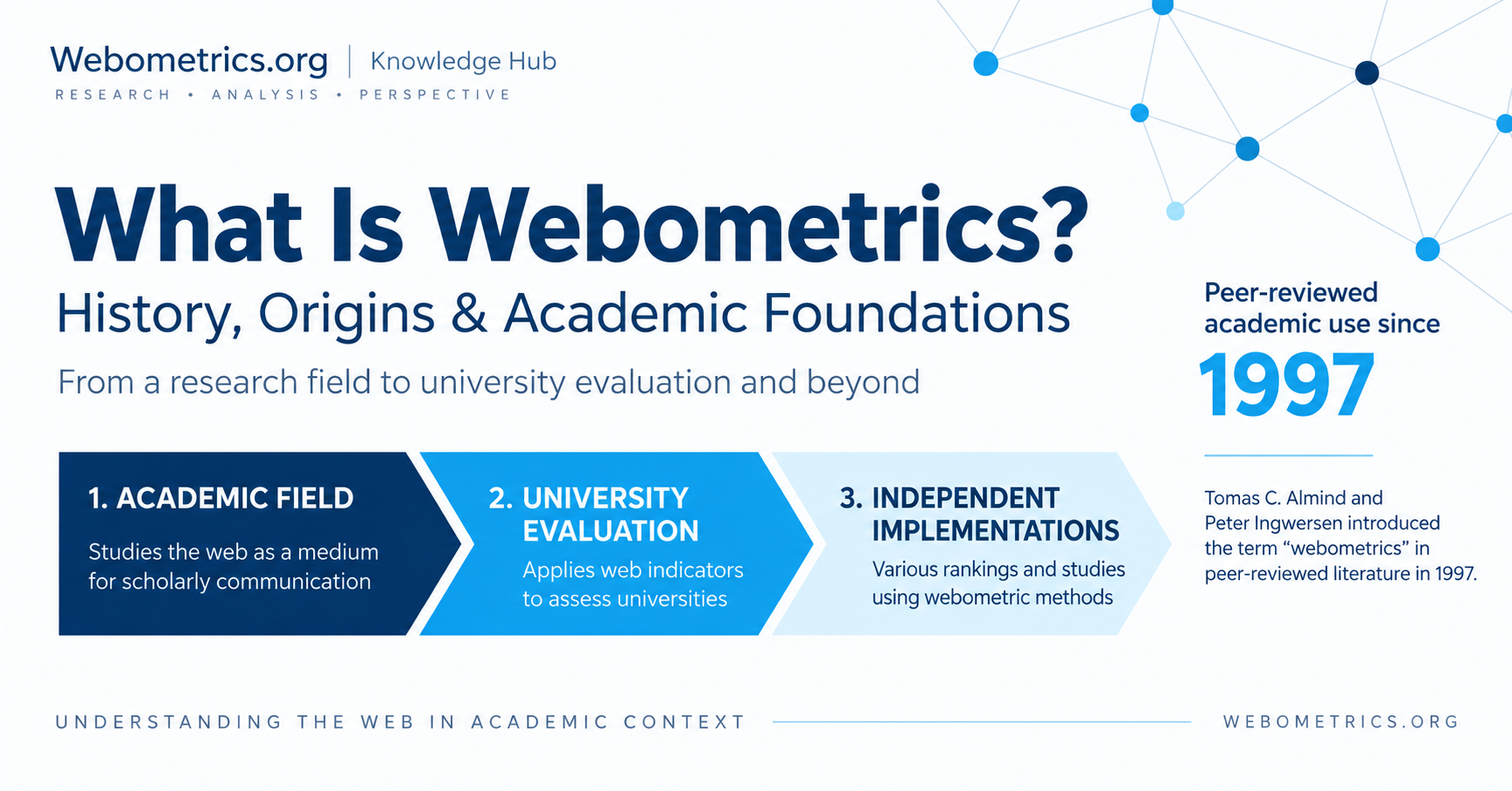
Webometrics is a UNIRANKS project dedicated to the development and application of webometric university evaluation and research, and Webometrics.org is the project's dedicated public website and publication platform. The current public edition, confirmed live on the Webometrics ranking for Nigeria on 26 September 2026, is the July 2026 edition (displayed on the page as the "2nd Edition – Final").
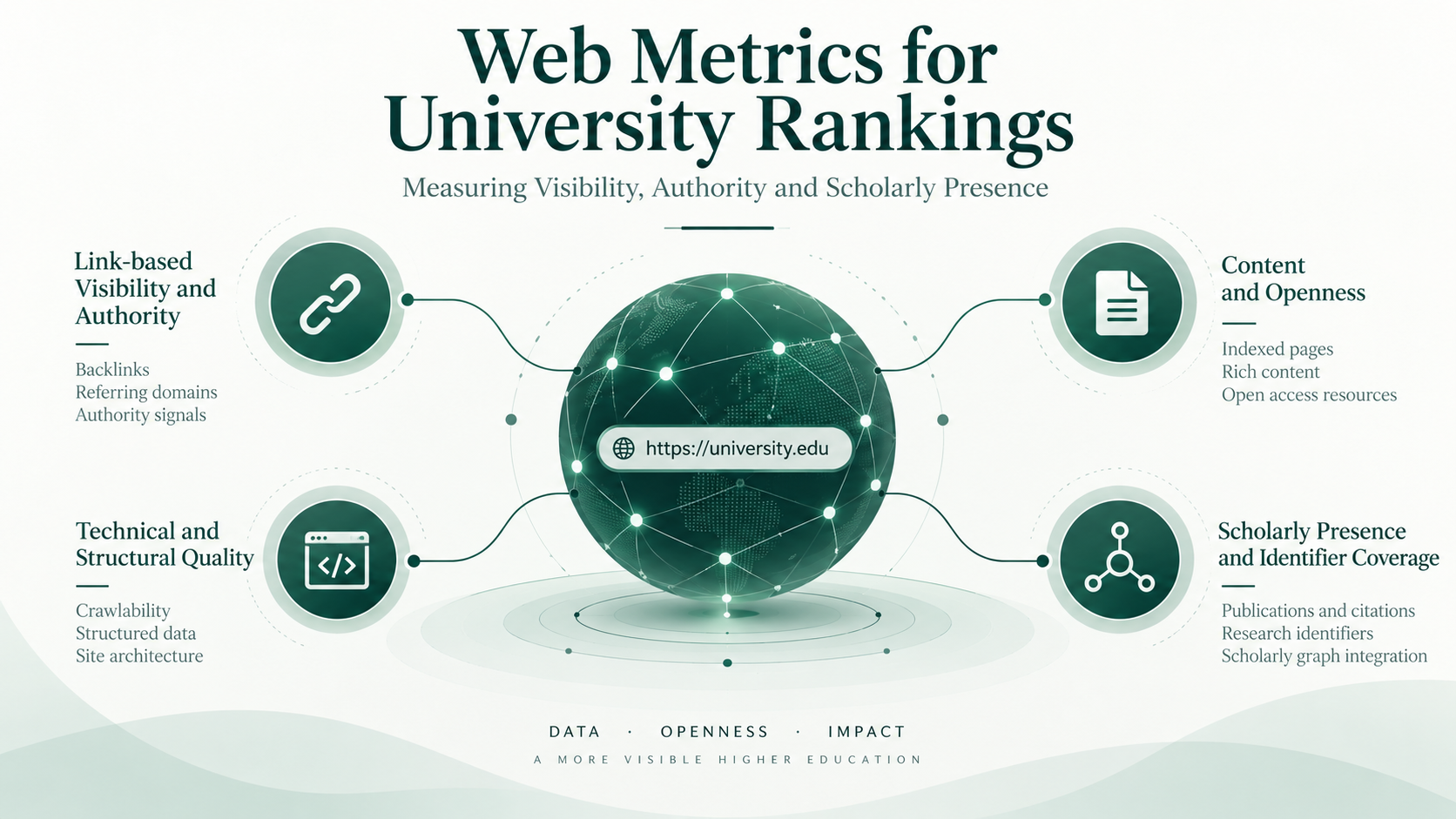
Webometrics evaluates institutional web presence through three principal indicators, explained in full on the Webometrics methodology page and in Webometrics' explainer on what Impact, Openness and Excellence mean. Impact measures digital visibility, authority, reach and global influence how strongly an institution is present and recognized across the wider digital ecosystem. Openness measures accessible knowledge, discoverability and public digital access how effectively an institution makes its knowledge, information and digital resources publicly available and discoverable. Excellence measures academic, research and digital quality, combining scholarly excellence with technical and website quality. The current published methodology does not disclose numeric weights for how the three indicators combine into an institution's overall position, and this article does not state or imply any such weighting. Underlying signals are collected, normalized and analyzed through UNIRANKS Growth Intelligence (GI) for web-visibility, search, technical and reputation signals, and UNIRANKS Open Index (OI) contributes research intelligence where scholarly presence is being measured; both systems support the public Webometrics ranking without individually determining it.
Publishing all three indicator ranks alongside the overall World Rank rather than a single composite score is itself part of how Webometrics explains a ranking position, since it lets an institution, and an outside reader, see which dimension of digital presence is driving that position. This article uses that published structure as the basis for an original, population-level comparison that has not previously been carried out for Nigeria on Webometrics.org, extending the country-level analytical approach Webometrics first used in its 2025 country-first read of Latin America's web presence to a within-country, institution-level comparison.
For context on the national system these institutions sit within, Nigeria's National Universities Commission (NUC) the federal regulatory body for Nigerian university education listed 328 universities nationally as of its own website in September 2026: 77 federal, 69 state and 182 private institutions. This figure describes the size of the regulated national university system; it is not a Webometrics measurement and is not used to interpret any institution's ranking position in this article.
Research Question
Within the July 2026 Webometrics edition, how do Nigerian universities' Impact, Openness and Excellence ranks compare to one another, and is there a consistent pattern in which indicator tends to be an institution's relative strength or relative weakness both across the population as a whole and across different rank bands?
Methodology
Collection date: 26 September 2026.
Data source: the Webometrics Nigeria country ranking page, July 2026 edition, read directly and in full for the population defined below. No Google Analytics, Google Search Console or other private analytics data was used to select this population; those internal signals were used only, in an earlier and separate step, to decide that Nigeria was a country meriting this week's editorial attention, following Webometrics' standing rule that private analytics may influence topic selection but must never appear in a published article.
Population: the 100 Nigerian institutions listed on the first page of the Webometrics ranking for Nigeria in the July 2026 edition, corresponding to national positions 1 through 100 and World Ranks 1,272 through 7,615. The Nigeria page extends beyond this first page; this study is explicitly scoped to the first 100 nationally ranked institutions, stated here as the defined population rather than treated as the full national ranking.
Variables: for each institution, its World Rank, Impact Rank, Openness Rank and Excellence Rank, each as published on the Webometrics Nigeria page on the collection date.
Analysis procedure: for each institution, the three indicator ranks were compared directly. Because Webometrics ranks run from 1 (strongest) upward, the indicator with the numerically lowest rank was recorded as that institution's relative strength, and the indicator with the numerically highest rank was recorded as its relative weakness. This comparison is internal to each institution's own three ranks; it does not compare one institution's Impact rank to another institution's Openness rank. The count of "weakest indicator" and "strongest indicator" occurrences was then tabulated across the full population of 100 and across three rank bands defined before the data was reviewed: the national top 10, positions 11–50, and positions 51–100. The numerical gap between each institution's strongest and weakest indicator rank was also calculated as a simple measure of how unevenly distributed its three indicator ranks are.
Limitations: Impact, Openness and Excellence are calculated from different underlying signal sets and are not necessarily distributed across all ranked institutions worldwide in the same way. A comparatively low Excellence rank number and a comparatively high Openness rank number for the same institution describes that institution's relative position within Webometrics' global comparison on each indicator; it is not proof that the institution's research quality exceeds its openness in any absolute sense, and this study does not attempt to separate that possibility from a genuine difference in institutional practice. This study also does not identify which specific Openness sub-indicators (for example, institutional digital content, academic and research web presence, or discoverability and indexability) are driving the pattern for any given institution; a page-level or sub-indicator-level audit would be required to do that, and is proposed as a follow-up study below. The population is limited to the first 100 nationally ranked institutions and does not include Nigerian institutions ranked beyond that point. Webometrics does not publish numeric indicator weights, so this study does not and cannot attribute a specific share of an institution's overall rank to any one indicator.
Results
The table below reports, for each rank band, how often each indicator was an institution's relative weakness and how often it was an institution's relative strength.
| Rank band | Institutions | Openness weakest | Impact weakest | Excellence weakest | Excellence strongest | Impact strongest | Openness strongest |
|---|---|---|---|---|---|---|---|
| National top 10 | 10 | 9 (90%) | 1 (10%) | 0 (0%) | 6 (60%) | 4 (40%) | 0 (0%) |
| Positions 11–50 | 40 | 38 (95%) | 2 (5%) | 0 (0%) | 37 (92.5%) | 3 (7.5%) | 0 (0%) |
| Positions 51–100 | 50 | 50 (100%) | 0 (0%) | 0 (0%) | 49 (98%) | 1 (2%) | 0 (0%) |
| Full population | 100 | 97 (97%) | 3 (3%) | 0 (0%) | 92 (92%) | 8 (8%) | 0 (0%) |
Excellence was never the weakest indicator for any of the 100 institutions examined, and Openness was never the strongest indicator for any institution. The pattern strengthens moving down the rank bands: every one of the 50 institutions ranked nationally 51st through 100th had Openness as its weakest indicator.
The gap between an institution's strongest and weakest indicator rank also widened substantially outside the leading institutions. Among the national top 10, the two most balanced profiles University of Lagos (Impact 1,550; Openness 2,371; Excellence 1,198; gap of 1,173 positions) and University of Ibadan (Impact 2,028; Openness 1,425; Excellence 809; gap of 1,219 positions) showed gaps of little more than a thousand rank positions. Further down the population, the gap grew far larger: Thomas Adewumi University Oko-Irese showed the widest gap in the sample (Impact 1,748; Openness 10,800; Excellence 2,279; a gap of 9,052 positions), followed by Southwestern University Oku Owa (gap of 8,572), McPherson University (gap of 7,428), Godfrey Okoye University (gap of 6,828) and Achievers University Owo (gap of 6,756).
Analysis
Two patterns emerge from this population that are worth distinguishing carefully.
The first is a consistent directional pattern: within almost every Nigerian institution's own three-indicator profile, Openness is the relative weak point and Excellence is the relative strong point. This is not a finding about any single university; it is a population-level pattern that held for 97 of 100 institutions and strengthened, rather than weakened, in the lower rank bands. Because Openness specifically measures how accessible, discoverable and publicly available an institution's knowledge and digital resources are covering institutional digital content, academic and research web presence, open knowledge, accessibility and discoverability this pattern is consistent with an interpretation that many Nigerian university websites are more effective at building external visibility and demonstrating scholarly and technical quality than at making their full range of public digital resources easy to discover. That interpretation is offered as a plausible explanation grounded in what the Openness indicator measures, not as a proven cause; a page-level audit of the specific Openness sub-indicators would be needed to confirm it, and Webometrics has not conducted that audit as part of this study.
The second pattern is that indicator divergence is far from uniform across the population. Institutions closer to the top of the national ranking tend to show more internally balanced profiles, while institutions further down show substantially larger gaps between their strongest and weakest indicator. This is consistent with, though does not prove, an interpretation that the institutions with the strongest and longest-established overall web presence in Nigeria (several of the leading institutions in this population are long-established federal universities) have also built more consistent digital infrastructure across all three indicators, while newer or smaller institutions may have concentrated web-development effort on a narrower set of signals for instance, general visibility or specific research outputs without yet building out the wider public-facing digital resources that Openness measures. As with the first pattern, this is Webometrics analysis rather than a documented external fact, and it should be read as a hypothesis for further study rather than a settled conclusion.
Both patterns describe web-visibility profiles as measured by Webometrics indicators. Neither should be read as a statement about the underlying quality of teaching, research or governance at any Nigerian institution, and rank divergence should not be interpreted as institutional weakness.
University Examples
The following examples are drawn directly from the population studied and are described only in terms of their published Webometrics indicator ranks, without any inference about institutional quality beyond those ranks.
University of Ibadan (national position 1; World Rank 1,272) was the single exception to the Openness-weakest pattern within the national top 10: its Excellence rank (809) and Openness rank (1,425) were both comparatively strong, leaving Impact (2,028) as its relatively weakest indicator still a strong position in absolute terms, but the least strong of the three for this institution.
Covenant University Ota (national position 3; World Rank 1,295) showed one of the larger gaps among the national top 10: an Impact rank of 1,135 and an Excellence rank of 1,479 alongside an Openness rank of 3,347, a gap of 2,212 positions between its strongest and weakest indicator.
Ahmadu Bello University (national position 11; World Rank 2,681), one of Nigeria's largest and longest-established federal universities, was one of only three institutions in the full population whose weakest indicator was Impact rather than Openness (Impact 2,759; Openness 2,664; Excellence 1,435) a reminder that the population-level pattern does not apply uniformly even among leading institutions.
Thomas Adewumi University Oko-Irese (national position 39; World Rank 4,866) showed the single widest indicator gap in the population studied: an Impact rank of 1,748 and an Excellence rank of 2,279, both markedly stronger than its Openness rank of 10,800.
Implications for Higher Education
For Nigerian university leadership, this population-level pattern offers a starting point for an internal question rather than a ready-made answer: does the institution's own web presence make its full range of public knowledge resources academic programs, faculty and research information, institutional repositories, open-access publications, public reports and student-facing services as easy to find and access as the institution's external visibility might suggest? Because Openness covers a wide range of Webometrics sub-indicators, from institutional digital content to accessibility and indexability, a useful next step for an individual institution is a targeted internal review of its own site against those specific sub-indicator categories, rather than treating "Openness" as a single undifferentiated problem.
For Nigeria's National Universities Commission, library associations, and research-office networks, the consistency of this pattern across such a large share of the national population including institutions across all three ownership types suggests it may reflect a broader, system-level pattern in how Nigerian university websites have developed, rather than being specific to any one type or size of institution. Webometrics' own findings here identify the pattern; they do not identify its cause, and further institution-level research would be needed before drawing conclusions about why it exists.
Recommended Actions
- Review institutional repository, open-access publication, and public-document pages against the Openness indicator's published sub-indicator categories (Institutional Digital Content; Academic & Research Web Presence; Open Knowledge; Accessibility & Digital Inclusion; Public Digital Services & Interaction; Discoverability & Indexability) to identify which specific category may be under-represented.
- Confirm that institutional repositories and open-access publication lists are indexable by search engines and are not blocked by robots directives or authentication barriers that would prevent public discovery.
- Where an institutional repository or research-output listing exists but is hosted on a separate subdomain or platform, confirm it is clearly linked from the main institutional website rather than requiring prior knowledge of its address.
- Treat this population-level pattern as a starting hypothesis for institution-specific review, not as a verified diagnosis of any single university's website; the specific causes at any one institution require direct inspection of that institution's own site.
Webometrics does not promise that any specific technical or content change will improve an institution's ranking position or search visibility; the actions above describe a documented pattern in publicly available Webometrics indicator data and general principles of discoverability, not guaranteed outcomes.
Limitations
This study compares indicator ranks within each institution's own profile; it does not compare raw scores, and Webometrics does not publish raw scores or numeric indicator weights. The three indicators are calculated from different underlying signal sets that may not be distributed identically across all globally ranked institutions, so a stronger Excellence rank than Openness rank describes an institution's relative global standing on each measure, not a proven absolute difference in performance between the two areas. The population is limited to the 100 Nigerian institutions ranked highest nationally in the July 2026 edition and does not include institutions ranked beyond national position 100. This study did not conduct a page-level audit of any individual institution's website; its findings are drawn entirely from Webometrics' own published indicator ranks, collected on a single date (26 September 2026), and may change as the ranking is updated in future editions. The interpretations offered in the Analysis section are Webometrics analysis and, in one case, an explicitly labeled hypothesis; they are not documented external facts and should be read accordingly.
Conclusion
Among the 100 highest-ranked Nigerian institutions in the July 2026 Webometrics edition, Openness was the weakest of the three Webometrics indicators for 97 of 100 institutions, and Excellence was the strongest for 92 of 100 a consistent pattern that held across the national top 10, positions 11–50, and positions 51–100, and that grew more pronounced, not less, further down the population. The size of the gap between an institution's strongest and weakest indicator also grew substantially outside the leading institutions. These findings describe how Nigerian universities' web-visibility profiles are currently distributed across Impact, Openness and Excellence as measured by Webometrics; they identify a pattern worth further institution-level investigation, not a verdict on any individual university or on Nigerian higher education as a whole. Explore the current Webometrics university rankings for Nigeria, or read more Webometrics research on university digital visibility and openness.
Sources
- Webometrics ranking for Nigeria, July 2026 edition webometrics.org/nigeria (collected 26 September 2026)
- Webometrics methodology
- National Universities Commission (Nigeria), official website nuc.edu.ng (accessed September 2026)
Suggested Citation
Webometrics by UNIRANKS. (2026, September 26). Where Nigerian universities diverge: Impact, Openness and Excellence in the July 2026 Webometrics edition. Webometrics.org.
Related Articles